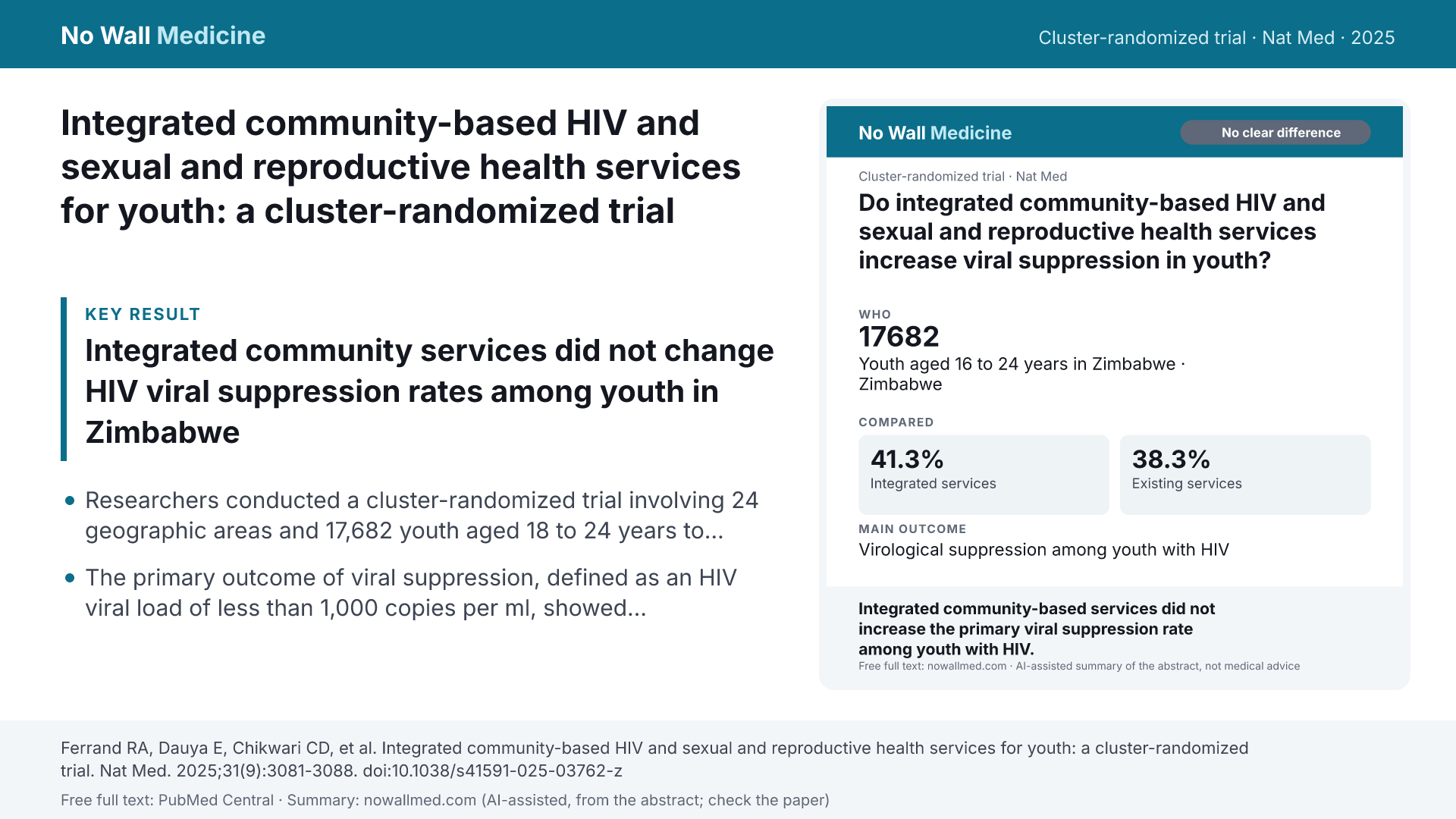
Integrated community services did not change HIV viral suppression rates among youth in Zimbabwe
Integrated community-based HIV and sexual and reproductive health services for youth: a cluster-randomized trial
Cluster-randomized trialNo clear difference
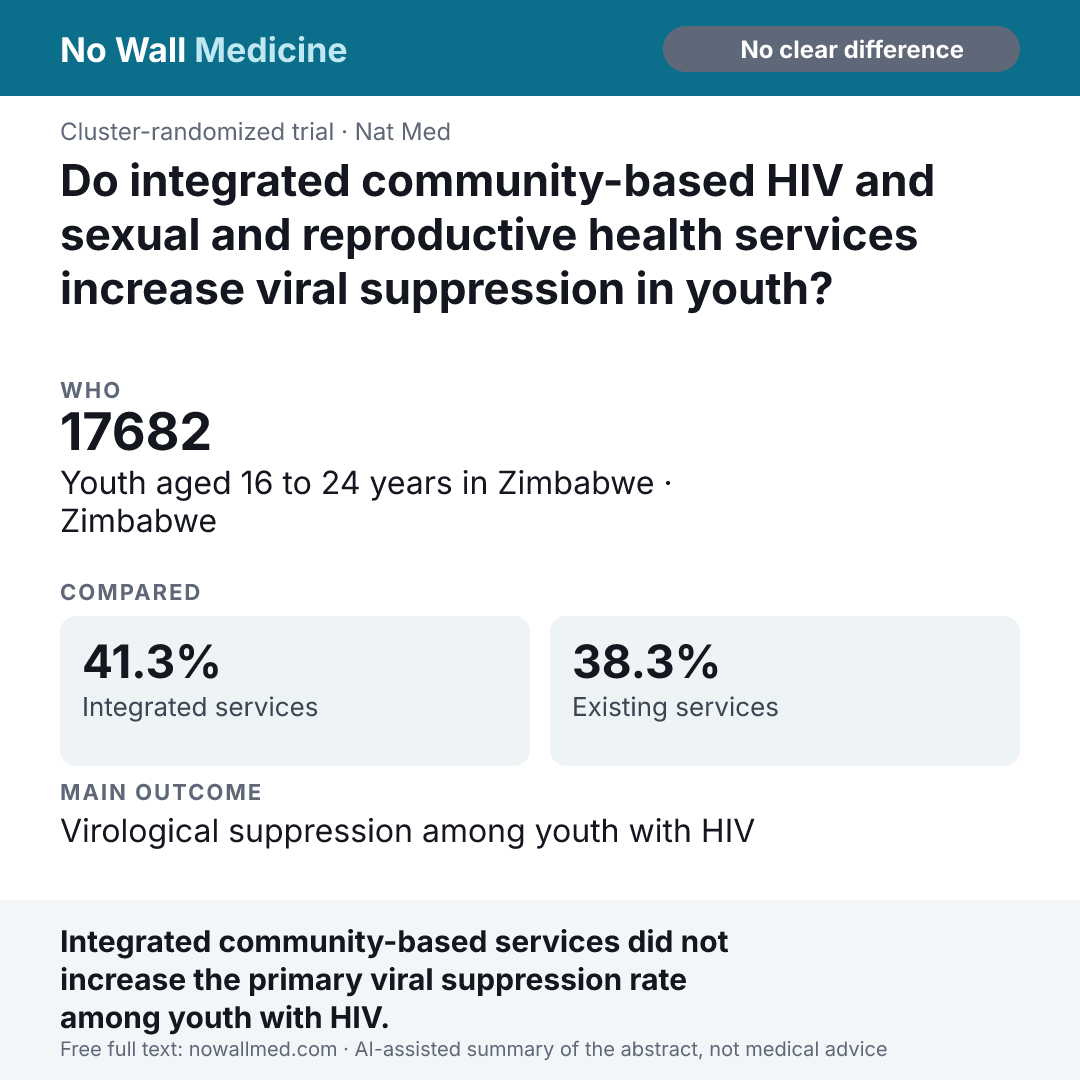
Do integrated community-based HIV and sexual and reproductive health services increase viral suppression in youth?
Who
17682
Youth aged 16 to 24 years in Zimbabwe · Zimbabwe
Compared
41.3%Integrated services
38.3%Existing services
Main outcome
Virological suppression among youth with HIV
Result: risk ratio 1.07 (95% confidence interval 0.88 to 1.30)
Bottom line: Integrated community-based services did not increase the primary viral suppression rate among youth with HIV.
Nat Med · 2025-06-24 · Save PNG
Same trial (NCT03719521)
Papers we list that report this registered trial, oldest first. Read a secondary analysis alongside the main results.
- Main results No clear difference
Community STI screening did not lower overall infection rates among Zimbabwean youth Lancet Glob Health 2024-11 - Related analysis No clear difference
This paper Nat Med 2025-06
Clinical question: Do integrated community-based HIV and sexual and reproductive health services increase viral suppression in youth?
Why it matters: Youth have disproportionately worse HIV viral suppression rates compared to other age groups, requiring better ways to address testing, linkage to care, and support.
Key points
- Researchers conducted a cluster-randomized trial involving 24 geographic areas and 17,682 youth aged 18 to 24 years to test integrated HIV and sexual health services.
- The primary outcome of viral suppression, defined as an HIV viral load of less than 1,000 copies per ml, showed no difference between intervention and control groups.
- In the intervention group, a higher proportion of youth on antiretroviral therapy achieved viral suppression with a risk ratio of 1.18 (95% confidence interval, 1.02-1.37).
Headline and key points written with AI from the paper’s abstract, with every number checked against it. Read the paper before relying on them.
Was this summary helpful?
Subject terms
Headline, design, result, key points, caveat and citation as plain text.
Cite this article
Ferrand RA, Dauya E, Chikwari CD, et al. Integrated community-based HIV and sexual and reproductive health services for youth: a cluster-randomized trial. Nat Med. 2025;31(9):3081-3088. doi:10.1038/s41591-025-03762-z
Spotted a mistake? Suggest a correction