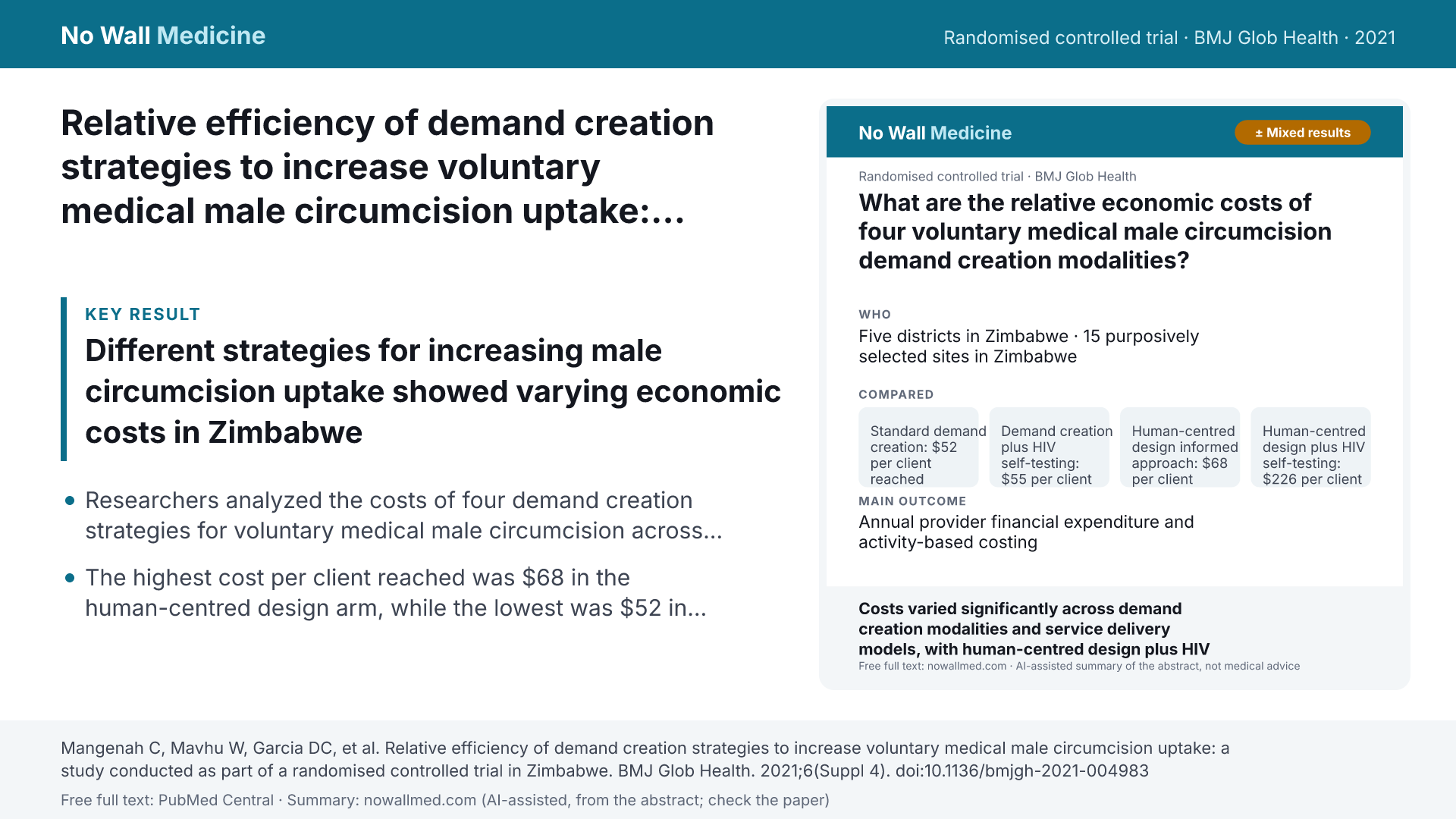
Different strategies for increasing male circumcision uptake showed varying economic costs in Zimbabwe
Relative efficiency of demand creation strategies to increase voluntary medical male circumcision uptake: a study conducted as part of a randomised controlled trial in Zimbabwe
Randomised controlled trialMixed results
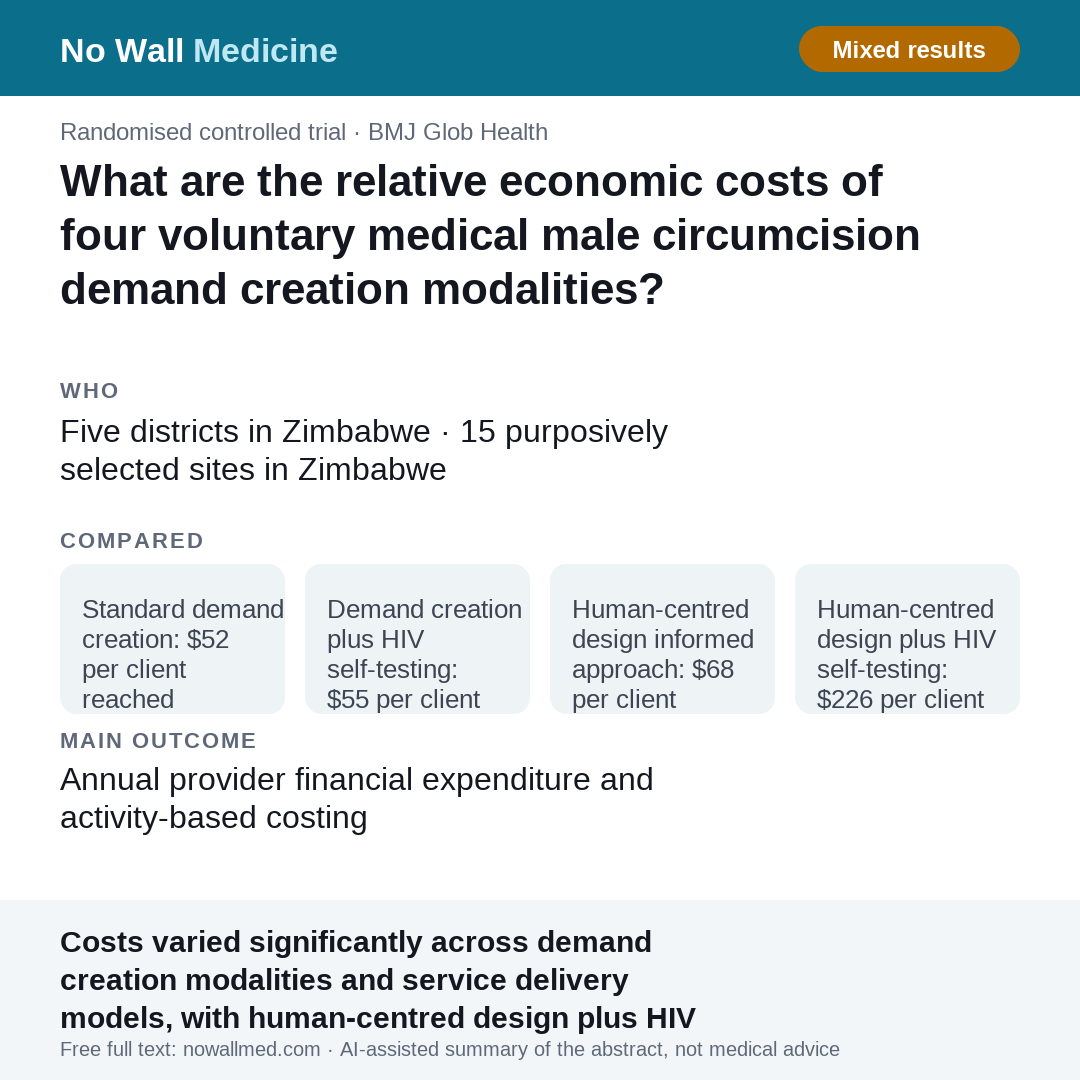
What are the relative economic costs of four voluntary medical male circumcision demand creation modalities?
Who
Five districts in Zimbabwe · 15 purposively selected sites in Zimbabwe
Compared
Standard demand creation: $52 per client reached
Demand creation plus HIV self-testing: $55 per client reached
Human-centred design informed approach: $68 per client reached
Human-centred design plus HIV self-testing: $226 per client circumcised
Main outcome
Annual provider financial expenditure and activity-based costing
Bottom line: Costs varied significantly across demand creation modalities and service delivery models, with human-centred design plus HIV self-testing being most expensive.
BMJ Glob Health · 2021-07-19Download image
Clinical question: What are the relative economic costs of four voluntary medical male circumcision demand creation modalities?
Key points
- Researchers analyzed the costs of four demand creation strategies for voluntary medical male circumcision across five districts in Zimbabwe.
- The highest cost per client reached was $68 in the human-centred design arm, while the lowest was $52 in the standard demand creation arm.
- The highest cost per circumcision was $226 when human-centred design and HIV self-testing were combined, while the lowest was $160 for human-centred design alone.
Headline and key points written with AI from the paper’s abstract, with every number checked against it. Read the paper before relying on them.
Was this summary helpful?
Subject terms
Headline, design, result, key points, caveat and citation as plain text.
Cite this article
Mangenah C, Mavhu W, Garcia DC, et al. Relative efficiency of demand creation strategies to increase voluntary medical male circumcision uptake: a study conducted as part of a randomised controlled trial in Zimbabwe. BMJ Glob Health. 2021. doi:10.1136/bmjgh-2021-004983
Spotted a mistake? Suggest a correction