Augmented reality training showed functional improvements for stroke patients in center or home settings
Augmented reality for stroke rehabilitation during COVID-19
Randomized trialBenefit found
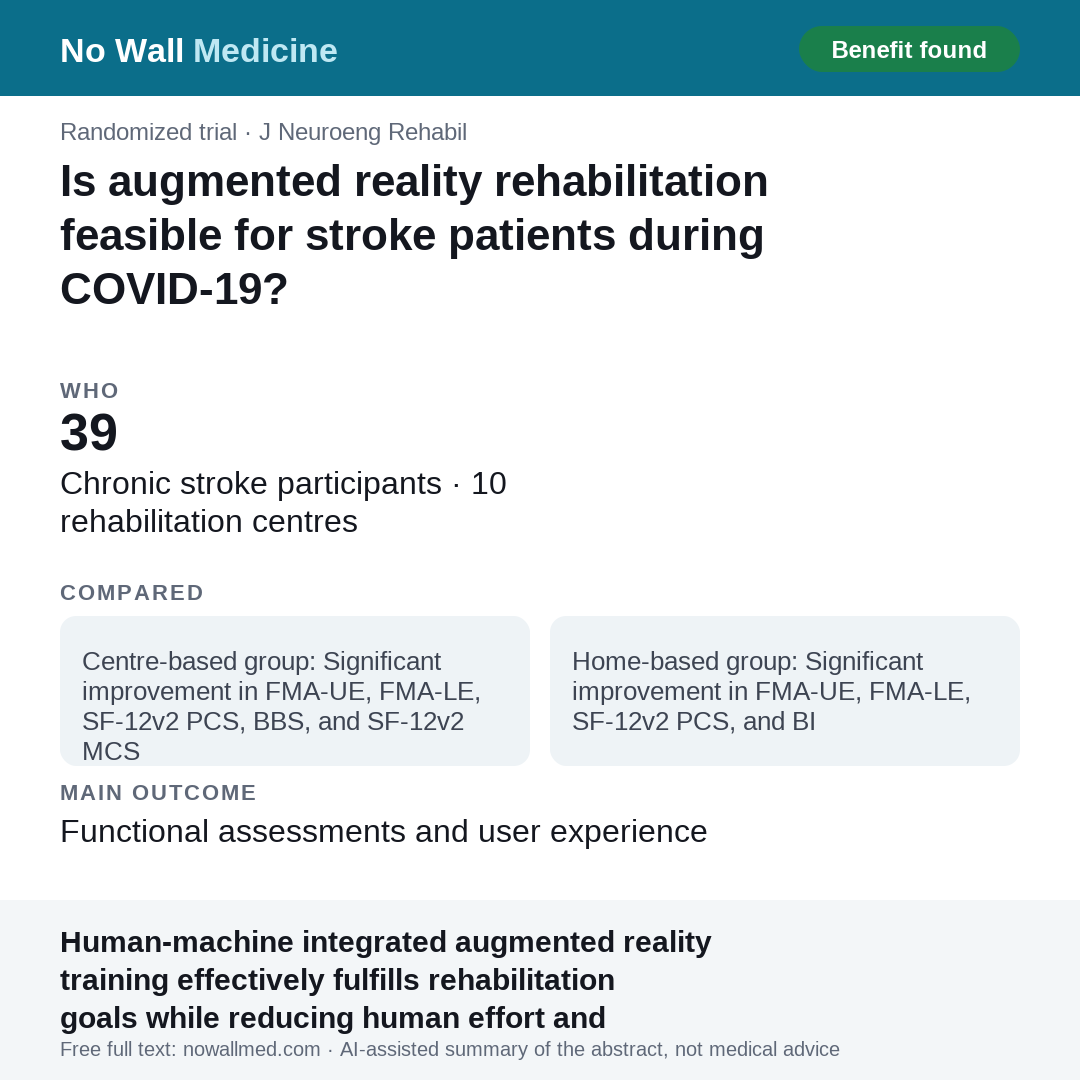
Is augmented reality rehabilitation feasible for stroke patients during COVID-19?
Who
39
Chronic stroke participants · 10 rehabilitation centres
Compared
Centre-based group: Significant improvement in FMA-UE, FMA-LE, SF-12v2 PCS, BBS, and SF-12v2 MCS
Home-based group: Significant improvement in FMA-UE, FMA-LE, SF-12v2 PCS, and BI
Main outcome
Functional assessments and user experience
Bottom line: Human-machine integrated augmented reality training effectively fulfills rehabilitation goals while reducing human effort and contact rates.
J Neuroeng Rehabil · 2022-12-08Download image
Clinical question: Is augmented reality rehabilitation feasible for stroke patients during COVID-19?
Why it matters: It was unknown if augmented reality rehabilitation could meet training goals and reduce human resource needs during pandemic-related manpower shortages.
Key points
- Researchers studied 129 chronic stroke patients across 10 centers, comparing center-based augmented reality training to home-based augmented reality training over 20 sessions.
- Both groups showed significant improvements in upper extremity, lower extremity, and physical health scores, while the home group showed significant improvement in activities of daily living.
- The contact rate was reduced by 30.75-72.30% overall, with a reduction of 75.00-90.00% in the home-based group.
Headline and key points written with AI from the paper’s abstract, with every number checked against it. Read the paper before relying on them.
Was this summary helpful?
Subject terms
Cite this article
Yang ZQ, Du D, Wei XY, Tong RK. Augmented reality for stroke rehabilitation during COVID-19. J Neuroeng Rehabil. 2022. doi:10.1186/s12984-022-01100-9
Spotted a mistake? Suggest a correction
Top studies every Monday
The week’s key trials and guidelines in your specialties, plus any topics you follow. By email, free.
Get the weekly digest