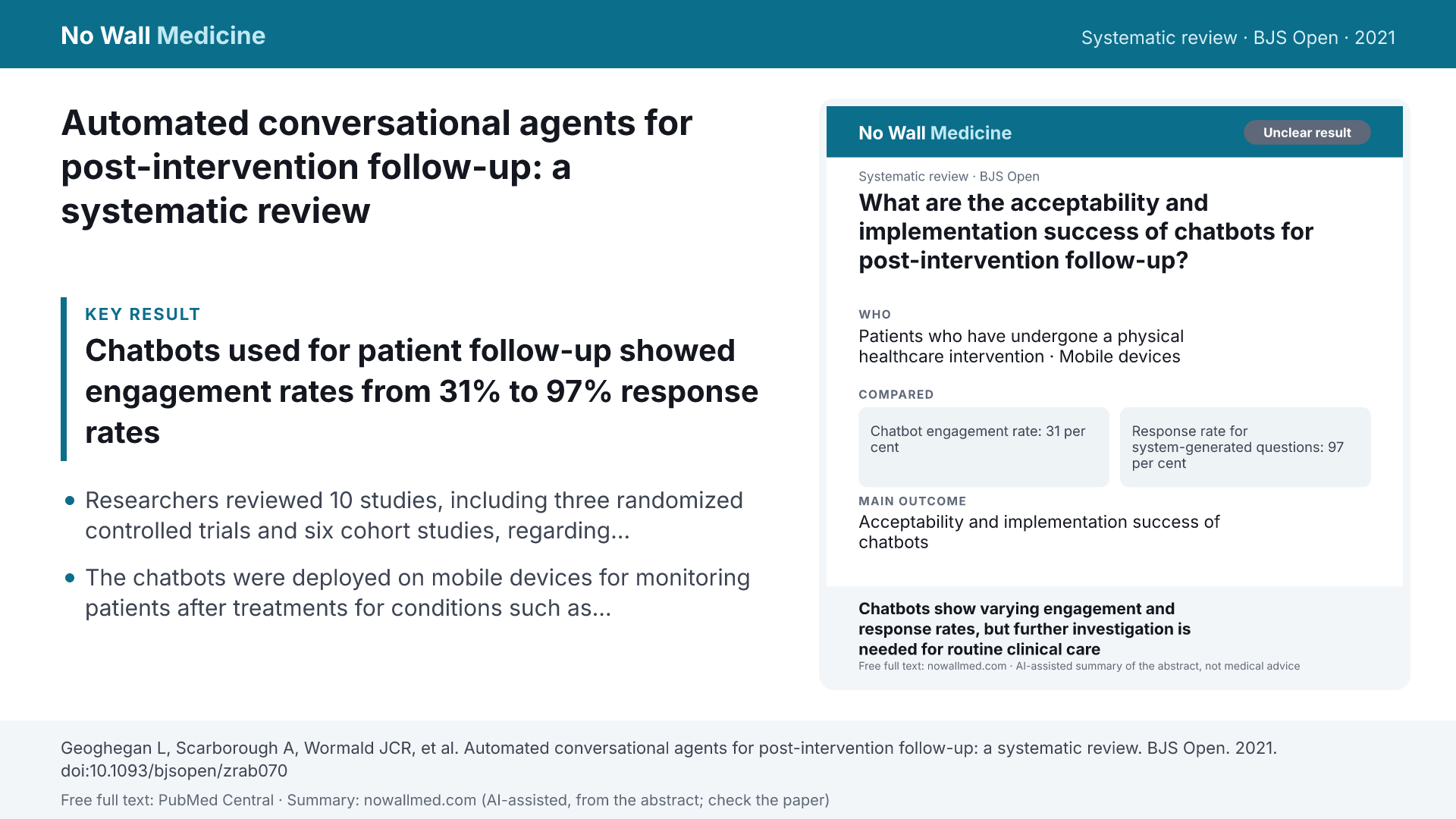
Chatbots used for patient follow-up showed engagement rates from 31% to 97% response rates
Automated conversational agents for post-intervention follow-up: a systematic review
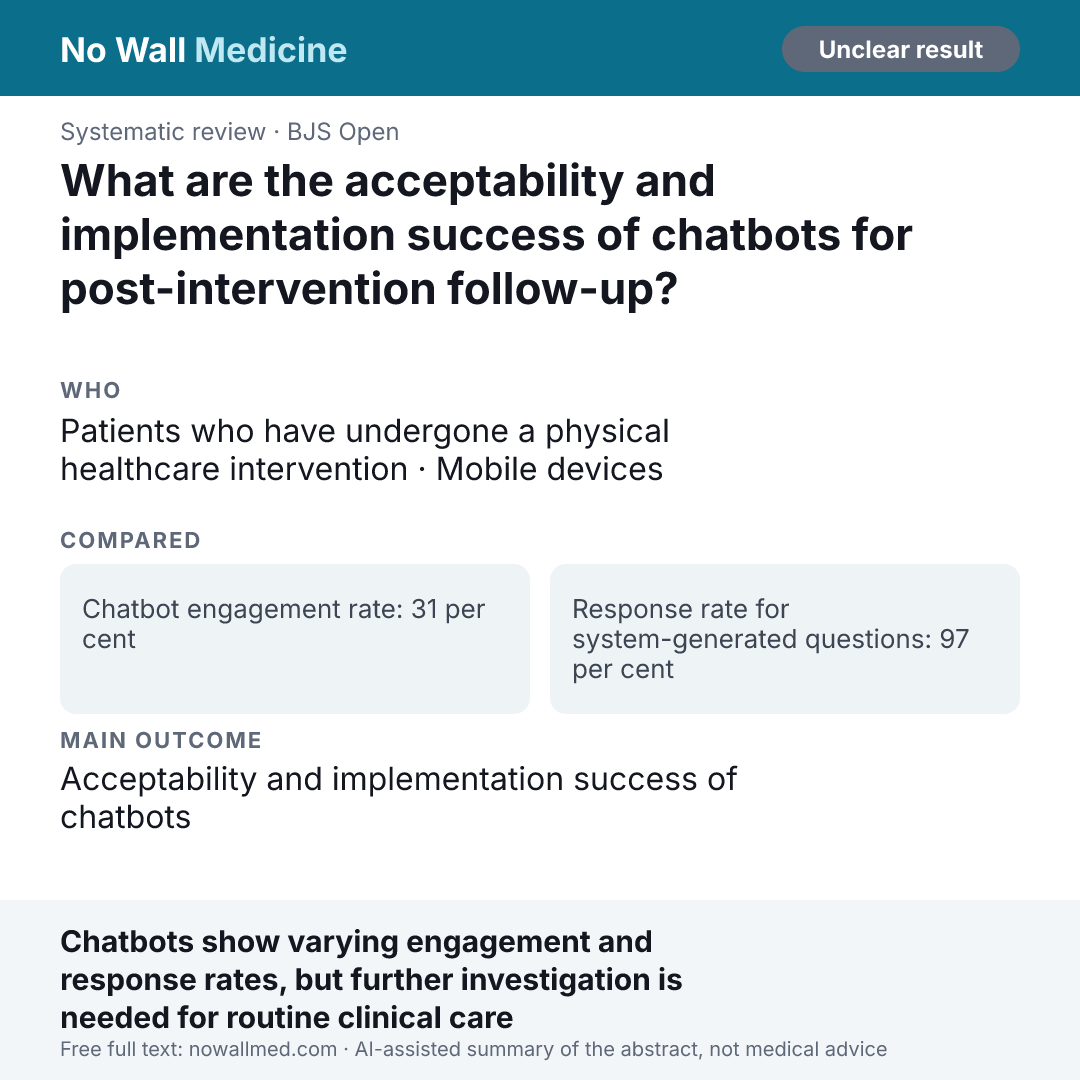
Systematic reviewUnclear result
What are the acceptability and implementation success of chatbots for post-intervention follow-up?
Who
Patients who have undergone a physical healthcare intervention · Mobile devices
Compared
Chatbot engagement rate: 31 per cent
Response rate for system-generated questions: 97 per cent
Main outcome
Acceptability and implementation success of chatbots
Bottom line: Chatbots show varying engagement and response rates, but further investigation is needed for routine clinical care implementation.
Limitation: No study examined patient safety.
BJS Open · 2021-07-29 · Save PNG
Clinical question: What are the acceptability and implementation success of chatbots for post-intervention follow-up?
Key points
- Researchers reviewed 10 studies, including three randomized controlled trials and six cohort studies, regarding automated conversational agents used after physical healthcare interventions.
- The chatbots were deployed on mobile devices for monitoring patients after treatments for conditions such as cancer, hypertension, asthma, and orthopedic surgery.
- Metrics for these systems ranged from a 31% chatbot engagement rate to a 97% response rate for questions generated by the system.
Limitation the authors note: No study examined patient safety.
Headline and key points written with AI from the paper’s abstract, with every number checked against it. Read the paper before relying on them.
Was this summary helpful?
Subject terms
Headline, design, result, key points, caveat and citation as plain text.
Cite this article
Geoghegan L, Scarborough A, Wormald JCR, et al. Automated conversational agents for post-intervention follow-up: a systematic review. BJS Open. 2021. doi:10.1093/bjsopen/zrab070
Spotted a mistake? Suggest a correction