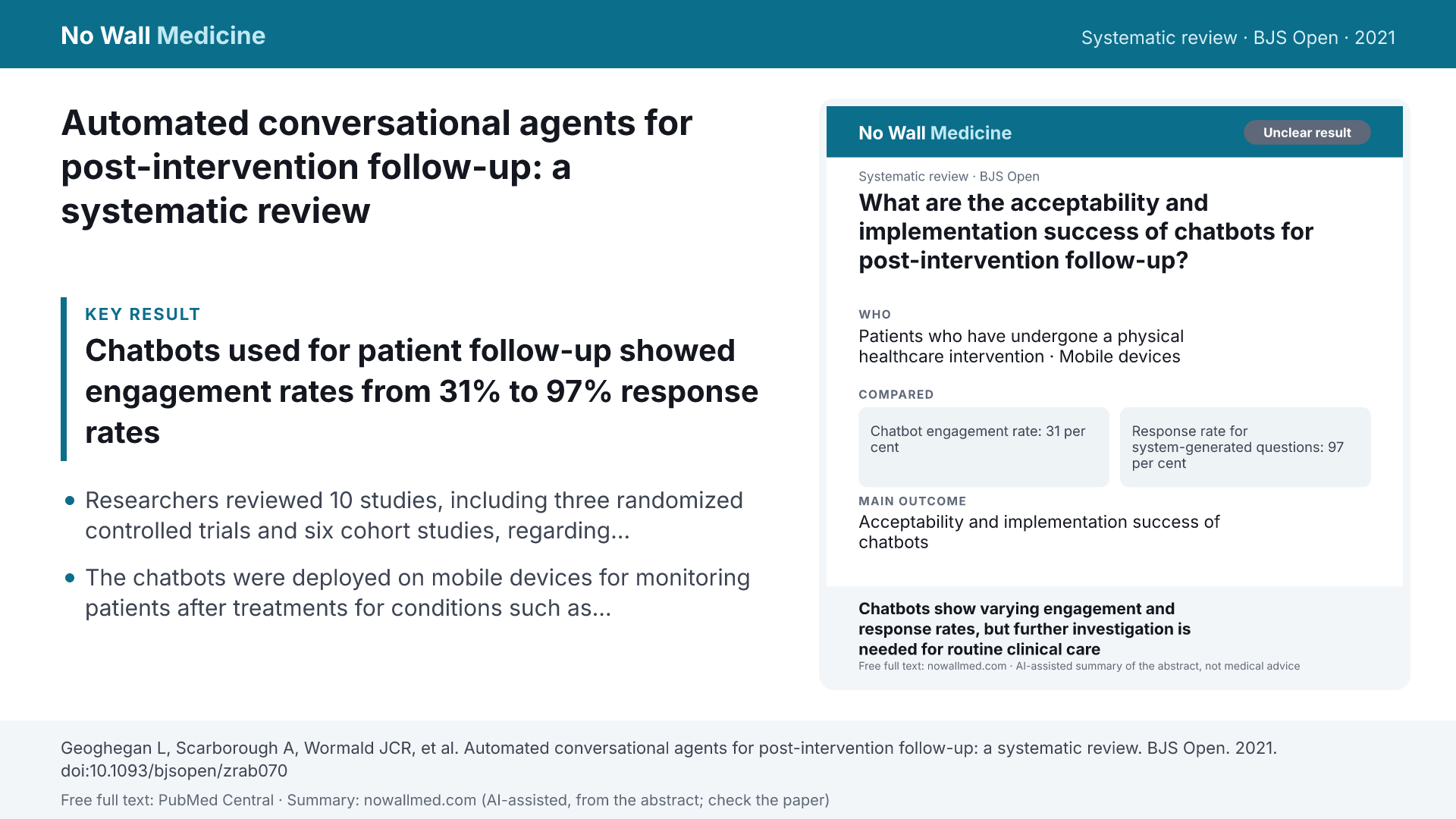
Automated conversational agents for post-intervention follow-up: a systematic review
Key result: Chatbots used for patient follow-up showed engagement rates from 31% to 97% response rates
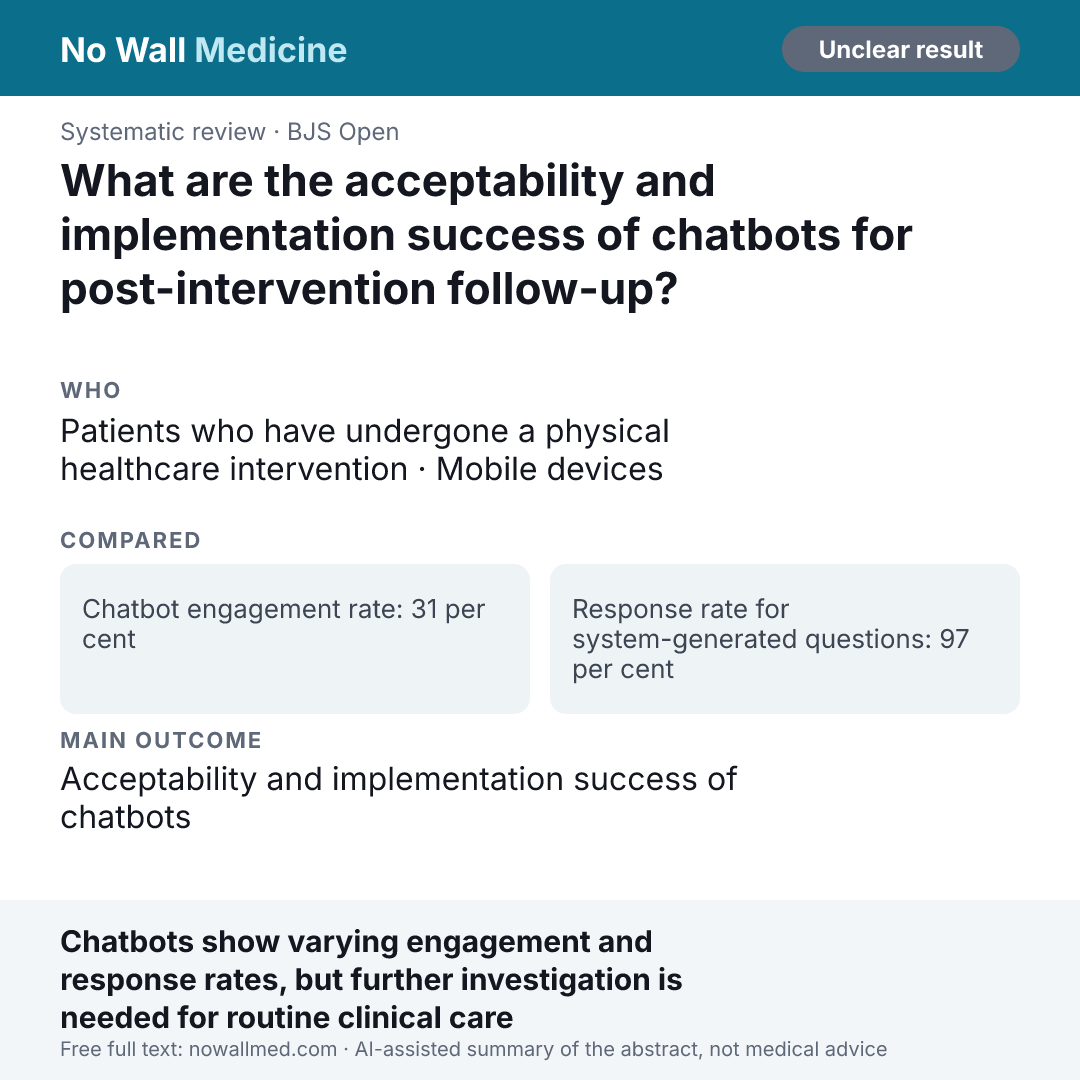
Systematic reviewUnclear result
What are the acceptability and implementation success of chatbots for post-intervention follow-up?
Who
Patients who have undergone a physical healthcare intervention · Mobile devices
Compared
Chatbot engagement rate: 31 per cent
Response rate for system-generated questions: 97 per cent
Main outcome
Acceptability and implementation success of chatbots
Bottom line: Chatbots show varying engagement and response rates, but further investigation is needed for routine clinical care implementation.
Limitation: No study examined patient safety.
BJS Open · 2021-07-29 · Save PNG
Key points
- Researchers reviewed 10 studies, including three randomized controlled trials and six cohort studies, regarding automated conversational agents used after physical healthcare interventions.
- The chatbots were deployed on mobile devices for monitoring patients after treatments for conditions such as cancer, hypertension, asthma, and orthopedic surgery.
- Metrics for these systems ranged from a 31% chatbot engagement rate to a 97% response rate for questions generated by the system.
Limitation the authors note: No study examined patient safety.
Discussion prompts
- Would these patients look like yours? Who was left out?
- Is the main outcome one that matters to patients?
- Is the difference large enough to change what you do?
Cite: Geoghegan L, Scarborough A, Wormald JCR, et al. Automated conversational agents for post-intervention follow-up: a systematic review. BJS Open. 2021. doi:10.1093/bjsopen/zrab070
Free full text: PubMed Central · Summary and visual abstract: nowallmed.com/a/automated-conversational-agents-for-post-intervention-follow-up-a-10xyai4/ (AI-assisted from the abstract; check the paper before relying on it).