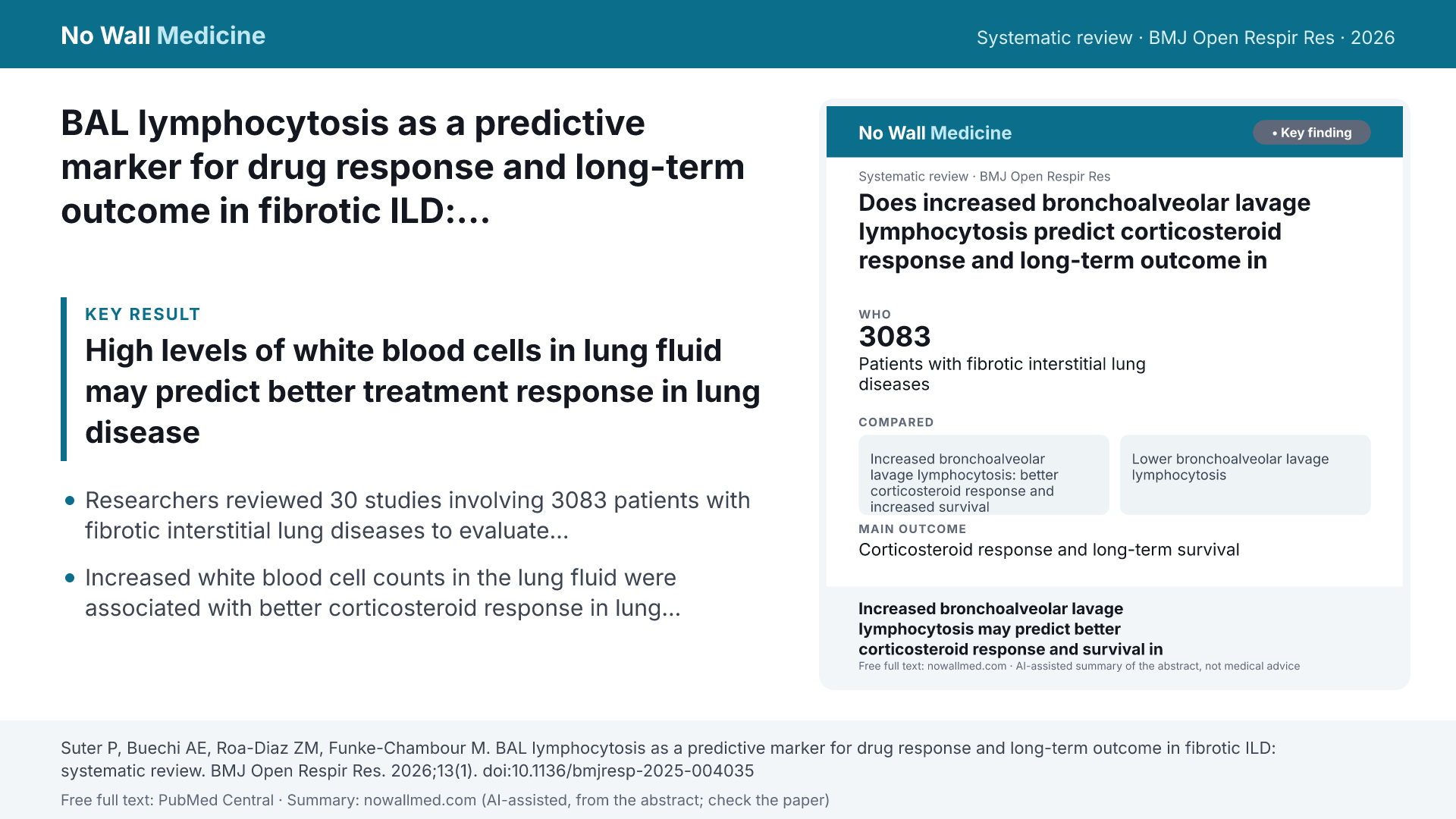
High levels of white blood cells in lung fluid may predict better treatment response in lung disease
BAL lymphocytosis as a predictive marker for drug response and long-term outcome in fibrotic ILD: systematic review
Systematic reviewKey finding
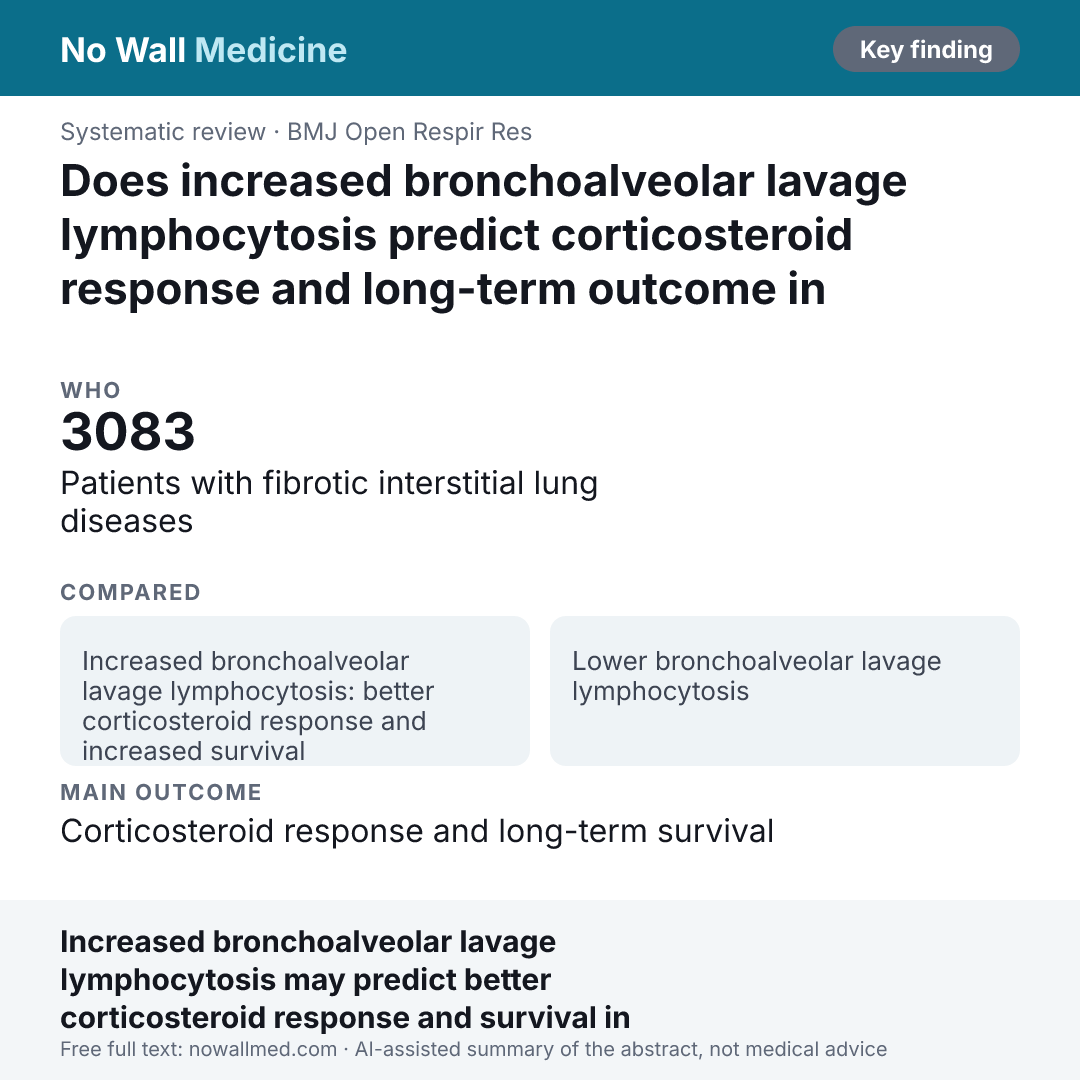
Does increased bronchoalveolar lavage lymphocytosis predict corticosteroid response and long-term outcome in fibrotic interstitial lung diseases?
Who
3083
Patients with fibrotic interstitial lung diseases
Compared
Increased bronchoalveolar lavage lymphocytosis: better corticosteroid response and increased survival
Lower bronchoalveolar lavage lymphocytosis
Main outcome
Corticosteroid response and long-term survival
Bottom line: Increased bronchoalveolar lavage lymphocytosis may predict better corticosteroid response and survival in certain fibrotic interstitial lung diseases.
Limitation: Predominantly observational studies, inconsistent thresholds, and study heterogeneity precluded meta-analysis.
BMJ Open Respir Res · 2026-06-04 · Save PNG
Clinical question: Does increased bronchoalveolar lavage lymphocytosis predict corticosteroid response and long-term outcome in fibrotic interstitial lung diseases?
Key points
- Researchers reviewed 30 studies involving 3083 patients with fibrotic interstitial lung diseases to evaluate if bronchoalveolar lavage lymphocytosis, or increased white blood cell counts in lung fluid, predicts treatment success.
- Increased white blood cell counts in the lung fluid were associated with better corticosteroid response in lung function and increased survival in subtypes like hypersensitivity pneumonitis and non-specific interstitial pneumonia.
- The studies showed varying thresholds for white blood cell counts and most had a moderate to high risk of bias.
Limitation the authors note: The authors state that clinical implementation is limited by insufficient evidence, predominantly observational studies, inconsistent thresholds, and heterogeneous results across different disease entities.
Headline and key points written with AI from the paper’s abstract, with every number checked against it. Read the paper before relying on them.
Was this summary helpful?
Abstract
Background
Fibrotic interstitial lung diseases (fILDs) encompass a heterogeneous group of disorders characterised by varying degrees of inflammation and/or fibrosis. The role of bronchoalveolar lavage lymphocytosis (BALL) as a prognostic biomarker and predictor of corticosteroid (CS) response remains uncertain. We investigated whether, in patients with fILD, increased BALL can serve as a marker for CS responsiveness and whether increased BALL may also predict better long-term outcomes following CS therapy compared with patients with lower BALL levels. Methods
A systematic review was conducted. MEDLINE, Embase, Web of Science and Google Scholar were searched up to 4 August 2025. Eligible studies included mainly observational clinical studies evaluating BALL in fILD, with a focus on short-term CS response (<6 months) as well as long-term survival (>6 months) after treatment, including changes in lung function parameters, radiological response and overall and progression-free survival. Study selection, data extraction and quality assessment were performed independently by two reviewers. Disagreements were resolved by consensus. Results
30 studies involving a total of 3083 patients were included. Increased BALL was associated with better CS response as reflected by improved lung function and increased survival in fILD subtypes, such as hypersensitivity pneumonitis and non-specific interstitial pneumonia. However, BALL thresholds varied, and study heterogeneity precluded meta-analysis. Most studies showed moderate to high risk of bias. Conclusions
Increased BALL may predict CS responsiveness and treatment outcome prediction in fILD; however, clinical implementation remains limited due to insufficient evidence, predominantly observational studies, inconsistent BALL thresholds and heterogeneous results across disease entities. Standardisation and prospective validations are needed to better integrate BALL findings into clinical routine. Prospero registration number
CRD420251057631.
Abstract reproduced under the article’s CC BY licence.
Subject terms
Headline, design, result, key points, caveat and citation as plain text.
Cite this article
Suter P, Buechi AE, Roa-Diaz ZM, Funke-Chambour M. BAL lymphocytosis as a predictive marker for drug response and long-term outcome in fibrotic ILD: systematic review. BMJ Open Respir Res. 2026;13(1). doi:10.1136/bmjresp-2025-004035
Spotted a mistake? Suggest a correction