Pilot trial shows Ringer's lactate and normal saline are feasible for treating diabetic ketoacidosis
Balanced crystalloids (RInger's lactate) versus normal Saline in adults with diabetic Ketoacidosis in the Emergency Department (BRISK-ED): a pilot randomised controlled trial
Triple-blind, pilot randomized controlled trialUnclear result
Is Ringer's lactate feasible compared to normal saline for managing diabetic ketoacidosis?
Who
52
Adults with diabetic ketoacidosis in the emergency department · Canadian academic tertiary care emergency department
Compared
Ringer's lactate: 15.7 (10.4-18.8) hours
Normal saline: 12.7 (7.9-19.2) hours
Main outcome
Time elapsed from emergency department presentation to diabetic ketoacidosis resolution
Bottom line: The pilot trial demonstrated feasibility by exceeding the target recruitment rate for future multicentre trials.
Limitation: This was a pilot trial intended to determine feasibility for future research.
Emerg Med J · 2024-01-22Download image
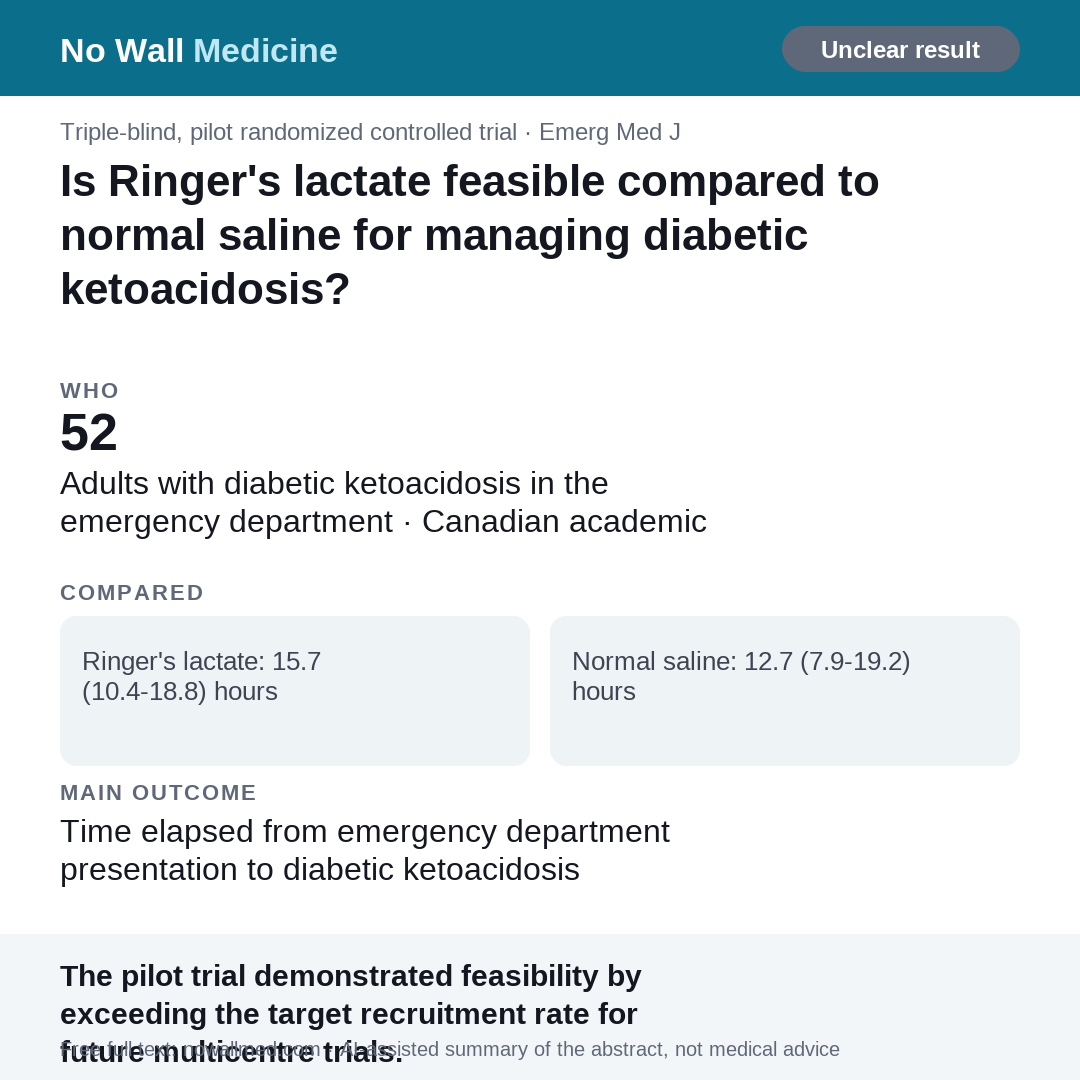
Clinical question: Is Ringer's lactate feasible compared to normal saline for managing diabetic ketoacidosis?
Why it matters: It is unknown if using balanced crystalloids instead of normal saline can effectively manage diabetic ketoacidosis in the emergency department.
Key points
- Researchers conducted a pilot randomized controlled trial of 52 adults with diabetic ketoacidosis to compare Ringer's lactate and normal saline.
- The study met its recruitment target by enrolling 86.7% of eligible patients, with 25 receiving Ringer's lactate and 27 receiving normal saline.
- Among 44 participants with laboratory-confirmed resolution, the median time to resolution was 15.7 hours for Ringer's lactate and 12.7 hours for normal saline.
Headline and key points written with AI from the paper’s abstract, with every number checked against it. Read the paper before relying on them.
Abstract
Background
Current diabetic ketoacidosis (DKA) treatment guidelines recommend using normal saline (NS); however, NS may delay DKA resolution by causing more hyperchloremic metabolic acidosis compared with balanced crystalloids. This study's objective was to determine the feasibility of a future multicentred randomised controlled trial (RCT) comparing intravenous Ringer's lactate (RL) with NS in managing ED patients with DKA. Methods
We conducted a parallel-arm, triple-blind, pilot RCT of adults (≥18 years) with DKA at a Canadian academic tertiary care ED. The primary feasibility outcome was recruitment rate (target ≥41.3% of eligible participants over the 1-year study period); the primary efficacy outcome was time elapsed from ED presentation to DKA resolution. The superiority margin for a clinically significant difference was chosen to be a 40% time reduction to DKA resolution. We also assessed the need to break allocation concealment and loss to follow-up. Patients with clinical suspicion for DKA were screened for inclusion and enrolled patients were randomised 1:1 to receive RL or NS. Patients, clinicians and outcome assessors were blinded to allocation. Results
We enrolled 52 (25 RL, 27 NS) of 60 eligible patients (86.7%), exceeding our target recruitment rate. There were more patients in the NS group with type 1 diabetes, and more patients in the RL group had an admission co-diagnosis in addition to DKA. For the 44 participants with confirmed laboratory evidence of resolution, median (IQR) time to DKA resolution for RL versus NS was 15.7 (10.4-18.8) and 12.7 (7.9-19.2) hours, respectively. There were no cases where blinding was broken, and there was no loss to follow-up. Conclusions
This pilot trial demonstrated our protocol's feasibility by exceeding our target recruitment rate. Our results may be used to inform future multicentre trials to compare the safety and efficacy of RL and NS in managing DKA in the ED. Trial registration number
NCT04926740.
Abstract reproduced under the article’s CC BY NC licence.
Topics
Cite this article
Yan JW, Slim A, Van Aarsen K, Choi YH, Byrne C, Poonai N. Balanced crystalloids (RInger's lactate) versus normal Saline in adults with diabetic Ketoacidosis in the Emergency Department (BRISK-ED): a pilot randomised controlled trial. Emerg Med J. 2024. doi:10.1136/emermed-2023-213290
Spotted a mistake? Suggest a correction
Top studies every Monday
The week’s key trials and guidelines in your specialties, plus any topics you follow. By email, free.
Get the weekly digest