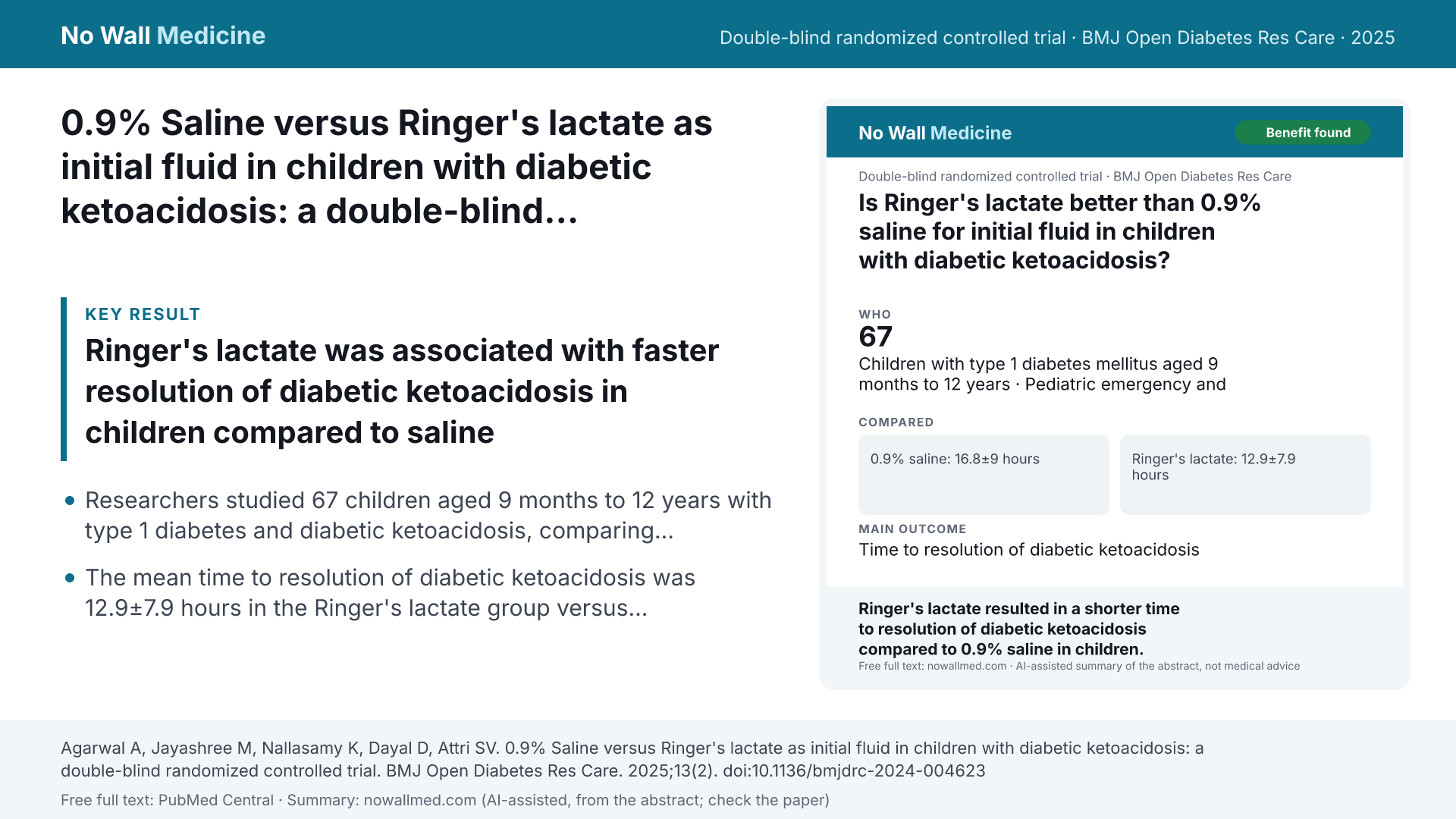
Ringer's lactate was associated with faster resolution of diabetic ketoacidosis in children compared to saline
0.9% Saline versus Ringer's lactate as initial fluid in children with diabetic ketoacidosis: a double-blind randomized controlled trial
Double-blind randomized controlled trialBenefit found
Is Ringer's lactate better than 0.9% saline for initial fluid in children with diabetic ketoacidosis?
Who
67
Children with type 1 diabetes mellitus aged 9 months to 12 years · Pediatric emergency and intensive care units of a teaching hospital
Compared
0.9% saline: 16.8±9 hours
Ringer's lactate: 12.9±7.9 hours
Main outcome
Time to resolution of diabetic ketoacidosis
Result: mean difference 3.85 hours (95% CI 0.3 to 8)
Bottom line: Ringer's lactate resulted in a shorter time to resolution of diabetic ketoacidosis compared to 0.9% saline in children.
BMJ Open Diabetes Res Care · 2025-04-07Download image
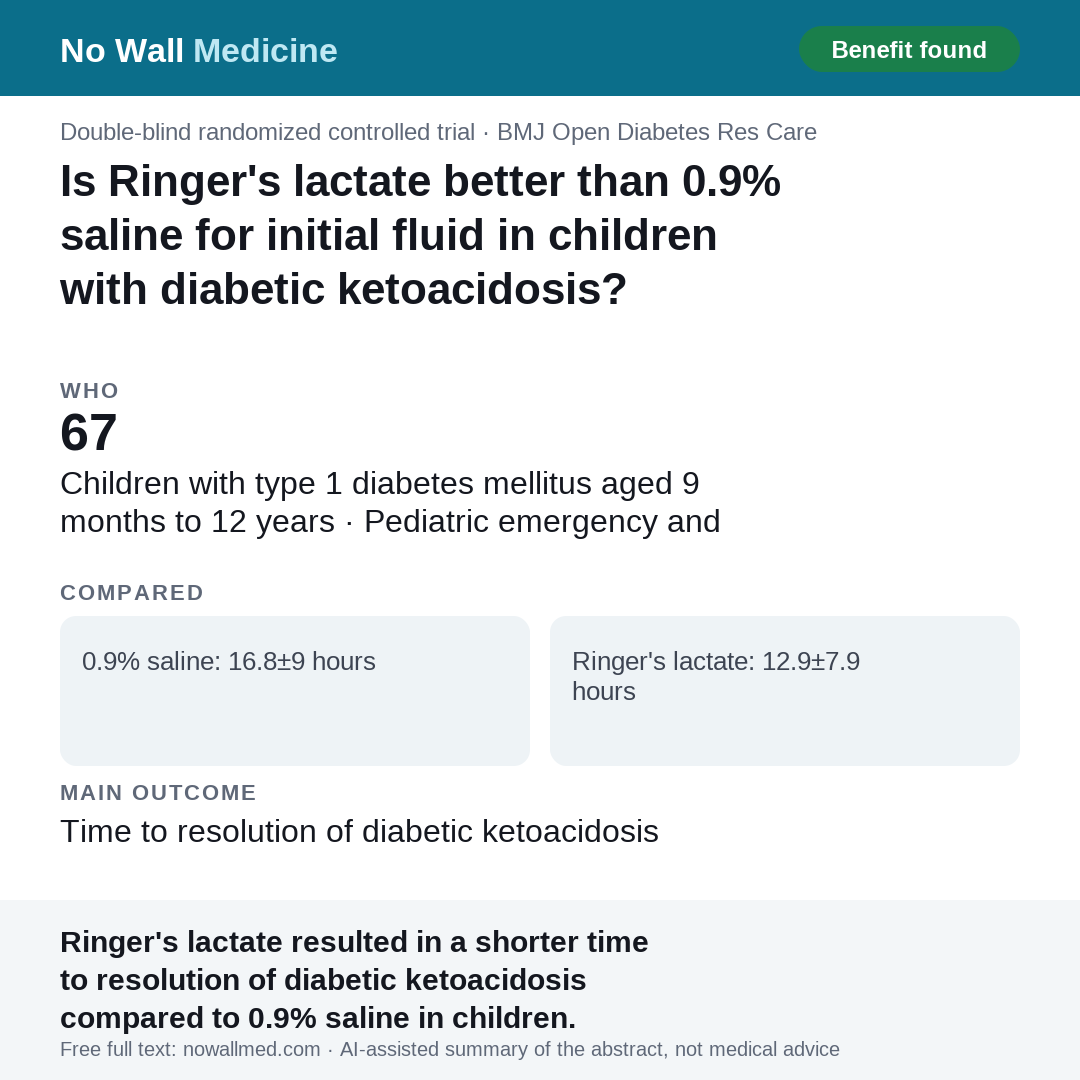
Clinical question: Is Ringer's lactate better than 0.9% saline for initial fluid in children with diabetic ketoacidosis?
Why it matters: It is unclear whether Ringer's lactate or 0.9% saline is better for managing initial fluid resuscitation in children with diabetic ketoacidosis.
Key points
- Researchers studied 67 children aged 9 months to 12 years with type 1 diabetes and diabetic ketoacidosis, comparing 0.9% saline to Ringer's lactate.
- The mean time to resolution of diabetic ketoacidosis was 12.9±7.9 hours in the Ringer's lactate group versus 16.8±9 hours in the saline group.
- The saline group showed a higher rise in chloride at 4 hours (8.7±5.6 vs 3.9±5.1 mmol/L) and 8 hours (10.8±7.7 vs 4.4±8.3 mmol/L).
Headline and key points written with AI from the paper’s abstract, with every number checked against it. Read the paper before relying on them.
Was this summary helpful?
Abstract
Introduction
Ringer's lactate (RL), a balanced crystalloid by regenerating bicarbonate ion, may lead to early diabetic ketoacidosis (DKA) resolution and reduced hyperchloremia as compared with 0.9% saline (NS). Research design and methods
This was a double-blind randomized controlled trial conducted in the pediatric emergency and intensive care units of a teaching hospital. Children with type 1 diabetes mellitus (T1DM) aged 9 months to 12 years who presented in DKA were included. Participants were randomized to receive either NS or RL as initial fluid (used for both resuscitation and replacement). The primary outcome was time to resolution of DKA. Secondary outcomes included change in serum chloride and bicarbonate from baseline, total fluid received and incidence of acute kidney injury. Results
The study was conducted between December 2020 and December 2021, and 67 children were recruited (34 in the NS group and 33 in the RL group). The mean time to DKA resolution was shorter in the RL group compared with the NS group (12.9±7.9 vs 16.8±9 hours). The mean difference and HR for time to DKA resolution in the RL group compared with the NS group were 3.85 hours (95% CI 0.3 to 8) and 1.39 hours (95% CI 1.25 to 1.56), respectively. The rise in chloride from baseline was higher in the NS group as compared with the RL group at 4 and 8 hours (8.7±5.6 vs 3.9±5.1 mmol/L) and (10.8±7.7 vs 4.4±8.3 mmol/L), respectively. On the contrary, the rise in bicarbonate from baseline to 12 hours was significantly higher in the RL group as compared with the NS group (14.7±1.6 vs 12.9±3.1). Conclusions
The time to resolution of DKA was shorter in RL group as compared with the NS group. Regeneration of bicarbonate from lactate ion in the RL forms a strong physiological basis for this outcome as compared with hyperchloremia induced by NS. This makes RL a favorable option in children with DKA.
Abstract reproduced under the article’s CC BY NC licence.
Subject terms
Cite this article
Agarwal A, Jayashree M, Nallasamy K, Dayal D, Attri SV. 0.9% Saline versus Ringer's lactate as initial fluid in children with diabetic ketoacidosis: a double-blind randomized controlled trial. BMJ Open Diabetes Res Care. 2025. doi:10.1136/bmjdrc-2024-004623
Spotted a mistake? Suggest a correction
Top studies every Monday
The week’s key trials and guidelines in your specialties, plus any topics you follow. By email, free.
Get the weekly digest