Baroreflex activation therapy did not significantly change mortality or heart failure morbidity in patients
Baroreflex activation therapy in patients with heart failure and a reduced ejection fraction: Long-term outcomes
Prospective, multicentre, randomized, two-arm, open-label trialMixed results
Does baroreflex activation therapy reduce cardiovascular mortality and heart failure morbidity in HFrEF?
Who
323
New York Heart Association class III patients with reduced ejection fraction · multicentre
Compared
Baroreflex activation therapy plus optimal medical management
Optimal medical management alone
Main outcome
cardiovascular mortality and heart failure morbidity
Result: rate ratio 0.94 (95% CI 0.57-1.57)
Bottom line: Baroreflex activation therapy did not reduce primary endpoints but provided sustainable improvements in quality of life and functional status.
Eur J Heart Fail · 2024-04-12Download image
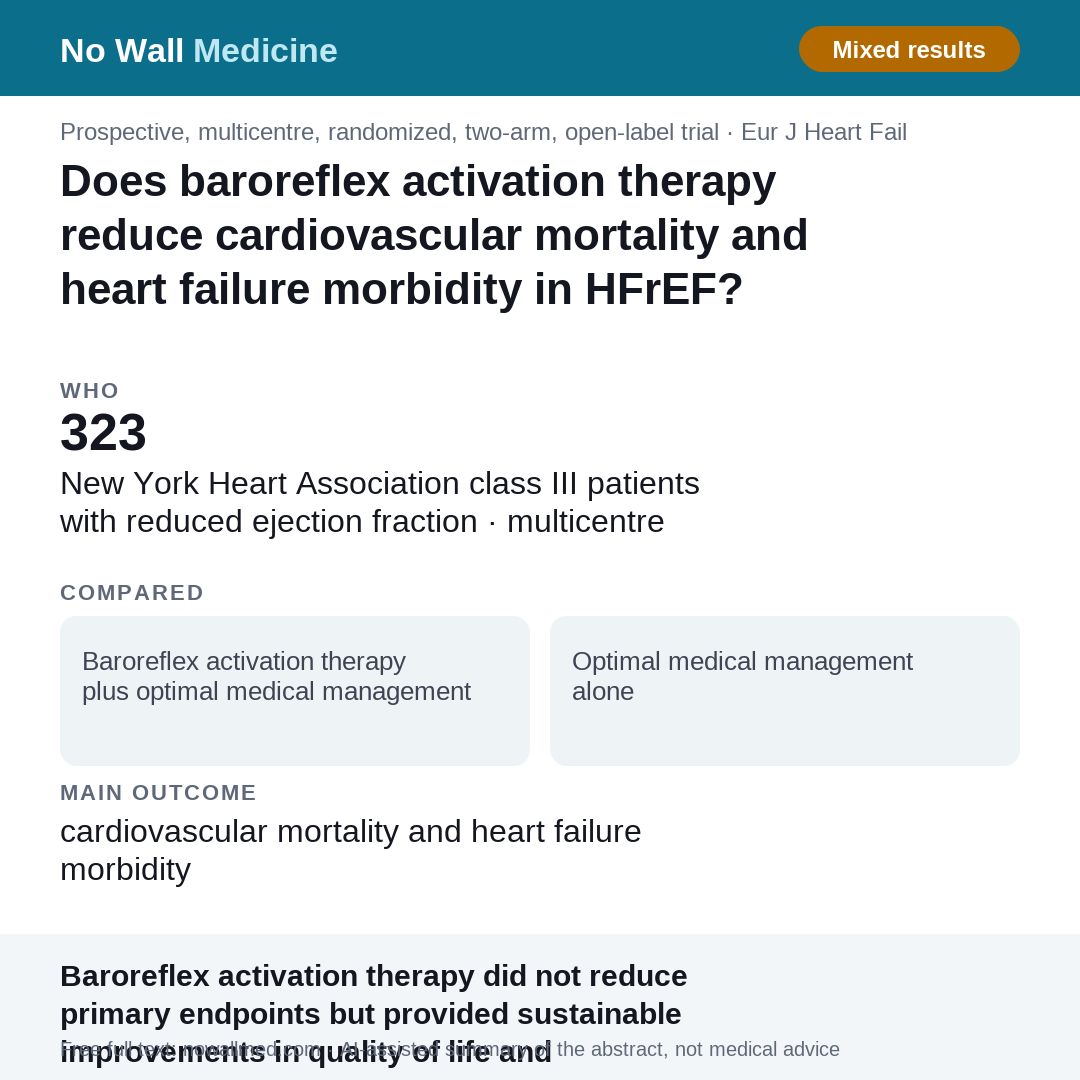
Clinical question: Does baroreflex activation therapy reduce cardiovascular mortality and heart failure morbidity in HFrEF?
Why it matters: It was unknown if baroreflex activation therapy, which targets the carotid artery to modulate the nervous system, reduces cardiovascular death and heart failure hospitalizations.
Key points
- The study randomized 323 patients with heart failure and reduced ejection fraction to receive baroreflex activation therapy plus medical management or medical management alone.
- The primary endpoint of cardiovascular mortality and heart failure morbidity showed no significant difference between groups with a rate ratio of 0.94 (95% CI 0.57-1.57; p = 0.82).
- The baroreflex activation therapy group showed durable improvements in quality of life, exercise capacity, and functional status with a major adverse event-free rate of 97%.
Headline and key points written with AI from the paper’s abstract, with every number checked against it. Read the paper before relying on them.
Was this summary helpful?
Subject terms
Cite this article
Zile MR, Lindenfeld J, Weaver FA, Zannad F, Galle E, Rogers T. Baroreflex activation therapy in patients with heart failure and a reduced ejection fraction: Long-term outcomes. Eur J Heart Fail. 2024. doi:10.1002/ejhf.3232
Spotted a mistake? Suggest a correction
Top studies every Monday
The week’s key trials and guidelines in your specialties, plus any topics you follow. By email, free.
Get the weekly digest