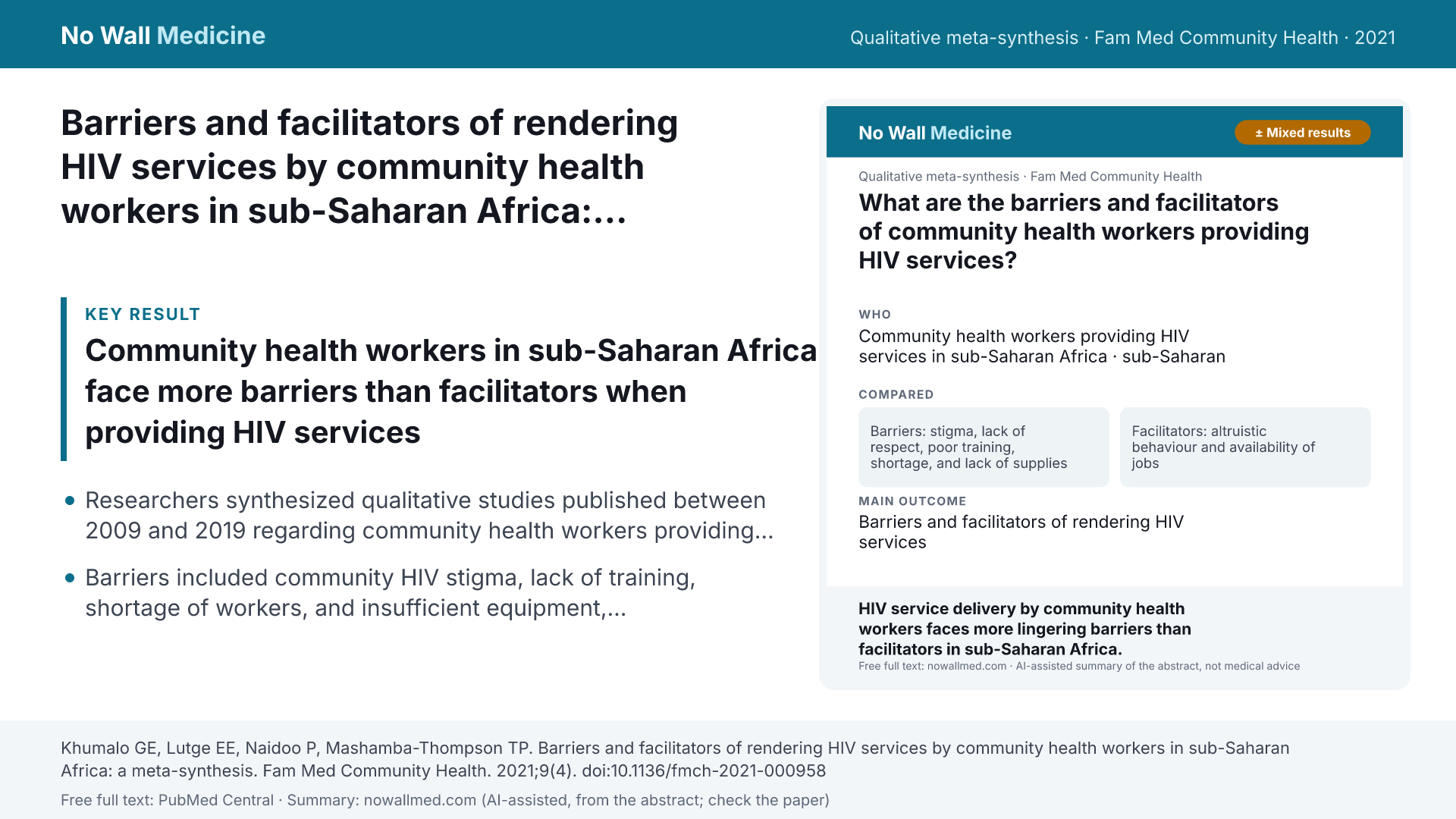
Community health workers in sub-Saharan Africa face more barriers than facilitators when providing HIV services
Barriers and facilitators of rendering HIV services by community health workers in sub-Saharan Africa: a meta-synthesis
Qualitative meta-synthesisMixed results
What are the barriers and facilitators of community health workers providing HIV services?
Who
Community health workers providing HIV services in sub-Saharan Africa · sub-Saharan Africa
Compared
Barriers: stigma, lack of respect, poor training, shortage, and lack of supplies
Facilitators: altruistic behaviour and availability of jobs
Main outcome
Barriers and facilitators of rendering HIV services
Bottom line: HIV service delivery by community health workers faces more lingering barriers than facilitators in sub-Saharan Africa.
Fam Med Community Health · 2021-09-25Download image
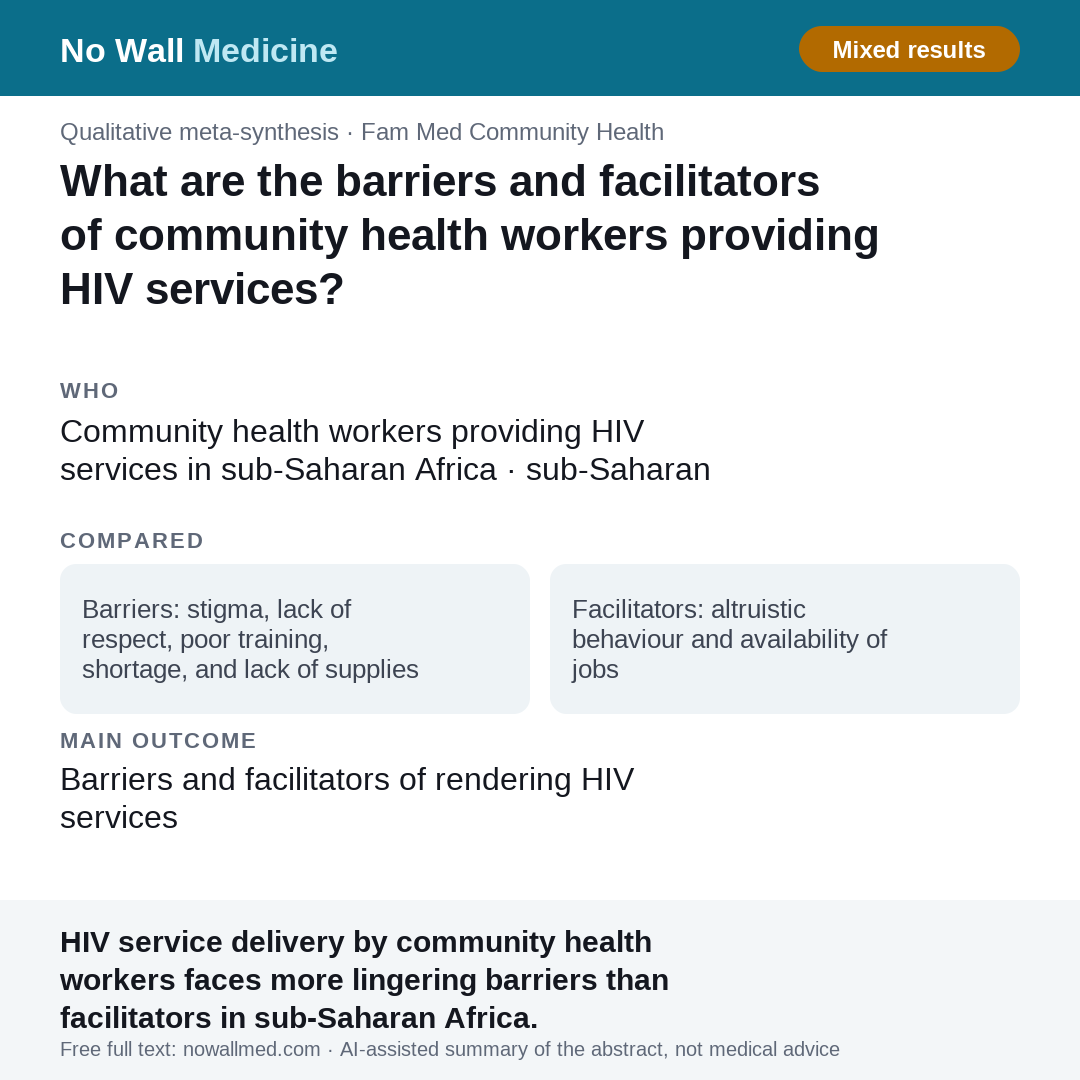
Clinical question: What are the barriers and facilitators of community health workers providing HIV services?
Key points
- Researchers synthesized qualitative studies published between 2009 and 2019 regarding community health workers providing HIV services in sub-Saharan Africa.
- Barriers included community HIV stigma, lack of training, shortage of workers, and insufficient equipment, while altruistic behavior and job availability were facilitators.
- The synthesis found that the delivery of HIV services by these workers is faced by more lingering barriers than facilitators.
Headline and key points written with AI from the paper’s abstract, with every number checked against it. Read the paper before relying on them.
Was this summary helpful?
Abstract
Objectives
To synthesise qualitative studies that address the barriers to and facilitators of providing HIV services by community health workers (CHWs) in sub-Saharan Africa (SSA). Design
This meta-synthesis was guided by Preferred Reporting Items for Systematic Reviews and Meta-Analyses. We included studies that were published between 2009 and 2019. The Ritchie and Spencer framework and the Supporting the Use of Research Evidence framework were used for thematic analysis and framework analysis, respectively. The Qualitative Assessment and Review Instrument was used to assess the quality of selected studies. Eligibility criteria
Qualitative studies published between 2009 and 2019, that included CHWs linked directly or indirectly to the Ministry of Health and providing HIV services in the communities. Information sources
An extensive search was conducted on the following databases: EBSCOhost- (ERIC; Health Source-Nursing/Academic Edition; MEDLINE Full Text), Google Scholar and PubMed. Results
Barriers to rendering of HIV services by CHWs were community HIV stigma; lack of CHW respect, CHWs' poor education and training; poor stakeholders' involvement; poor access to the communities; shortage of CHWs; unsatisfactory incentives; lack of CHW support and supervision, lack of equipment and supplies and social barriers due to culture, language and political structures. The altruistic behaviour of CHWs and the availability of job facilitated the provision of HIV services. Conclusion
The delivery of HIV services by CHWs in SSA is faced by more lingering barriers than facilitators. Planners and policymakers can minimise the barriers by investing in both CHW and community training regarding HIV services. Furthermore, sufficient funding should be allocated to the programme to ensure its efficiency. Prospero registration number
CRD42020160012.
Abstract reproduced under the article’s CC BY NC licence.
Subject terms
Headline, design, result, key points, caveat and citation as plain text.
Cite this article
Khumalo GE, Lutge EE, Naidoo P, Mashamba-Thompson TP. Barriers and facilitators of rendering HIV services by community health workers in sub-Saharan Africa: a meta-synthesis. Fam Med Community Health. 2021. doi:10.1136/fmch-2021-000958
Spotted a mistake? Suggest a correction