Baseline peanut allergy protein levels may predict long-term tolerance after oral immunotherapy
Baseline epitope-specific IgE profiles are predictive of sustained unresponsiveness or high threshold 1-year post oral immunotherapy in the POISED trial
Randomized trialBenefit found
Do baseline epitope-specific IgE profiles predict sustained unresponsiveness or high threshold?
Who
80
Desensitized subjects from the POISED trial
Compared
13%Sustained unresponsiveness in no peanut group (n = 8)
37%Sustained high threshold in 300 mg peanut group (n = 13)
Transient desensitization group
Main outcome
Sustained unresponsiveness or sustained high threshold
Result: accuracy of 94%, area under the curve 0.97, sensitivity 1.00, and specificity 0.91
Bottom line: Baseline epitope-specific IgE profiles and age can predict sustained unresponsiveness or high threshold with high accuracy.
JACI · 2024-11-05Download image
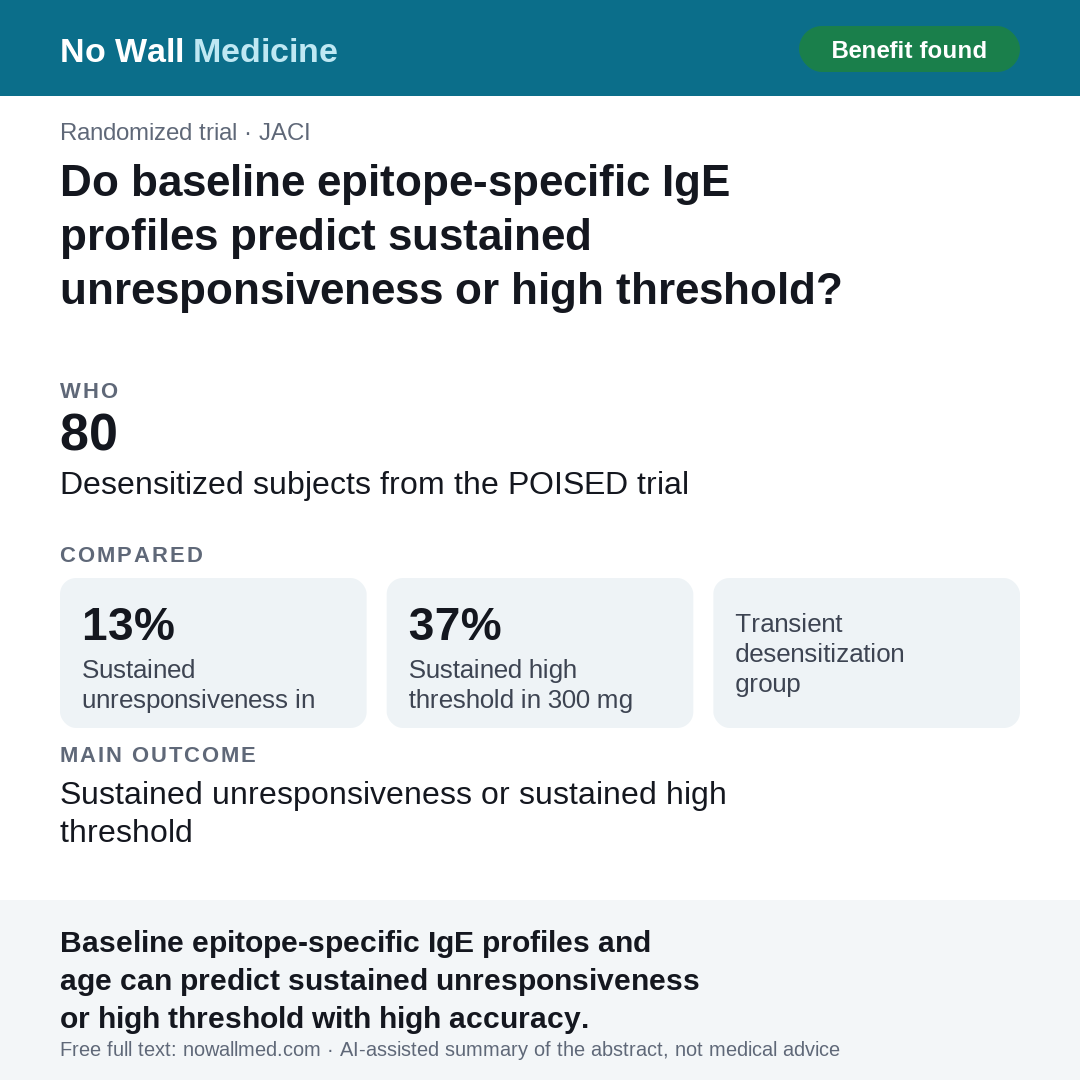
Clinical question: Do baseline epitope-specific IgE profiles predict sustained unresponsiveness or high threshold?
Why it matters: It is unknown whether baseline profiles of specific allergy-related antibodies can identify which patients will maintain tolerance after stopping peanut oral immunotherapy.
Key points
- Researchers studied 80 desensitized subjects from the POISED trial to see if baseline IgE levels, which are allergy-related antibodies, could predict long-term outcomes.
- A machine learning model using 12 baseline epitope-specific IgEs and age predicted sustained unresponsiveness or high threshold tolerance with 94% accuracy.
- In the no peanut group, 13% (n = 8) achieved sustained unresponsiveness, while 37% (n = 13) in the 300 mg peanut group achieved sustained high threshold tolerance.
Headline and key points written with AI from the paper’s abstract, with every number checked against it. Read the paper before relying on them.
Topics
Cite this article
Suprun M, Lee ASE, Getts R, Peck S, Sindher SB, Nadeau KC. Baseline epitope-specific IgE profiles are predictive of sustained unresponsiveness or high threshold 1-year post oral immunotherapy in the POISED trial. JACI. 2024. doi:10.1016/j.jaci.2024.10.017
Spotted a mistake? Suggest a correction
Top studies every Monday
The week’s key trials and guidelines in your specialties, plus any topics you follow. By email, free.
Get the weekly digest