Repetitive negative thinking reduces reward response bias and brain activity related to feedback
Behavioral and electrophysiological evidence of reward processing deficits in repetitive negative thinking: Implications for depression
Multilevel, randomized within-subjects studyHarm found
How does repetitive negative thinking affect reward processing and electrophysiological markers?
Who
62
62 individuals with varying levels of depressive symptoms
Compared
experimentally induced repetitive negative thinking: significantly attenuated reward response bias and feedback-related positivity amplitudes
active control
Main outcome
reward response bias and feedback-related positivity amplitudes
Bottom line: Repetitive negative thinking transiently disrupts behavioral and neural indicators of reward functioning in individuals with depressive symptoms.
Psychol Med · 2026-01-14Download image
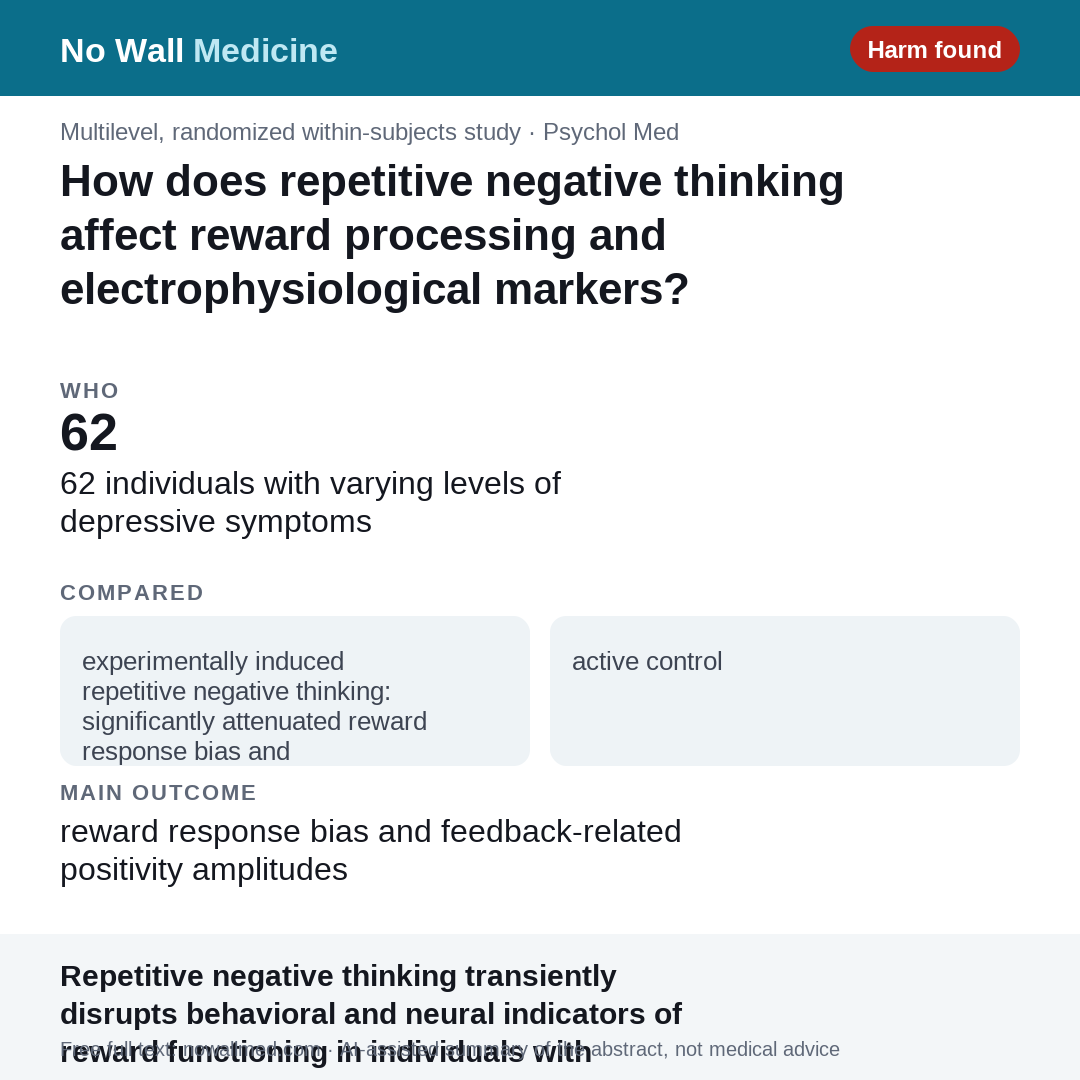
Clinical question: How does repetitive negative thinking affect reward processing and electrophysiological markers?
Why it matters: The state-level mechanisms linking anhedonia and rumination, a form of repetitive negative thinking, remain poorly understood in depression.
Key points
- Researchers studied 62 individuals, including 38 females, using a reward task and brain wave monitoring during induced repetitive negative thinking and a control condition.
- Repetitive negative thinking significantly reduced reward response bias and feedback-related positivity, which are electrical signals in the brain measured via electroencephalography.
- The reduction in reward processing was most pronounced in individuals who reported more severe depressive symptoms.
Headline and key points written with AI from the paper’s abstract, with every number checked against it. Read the paper before relying on them.
Topics
Cite this article
Schettino M, Mastrocesare A, Bomarsi D, Ceccarelli I, Ang YS, Pizzagalli DA. Behavioral and electrophysiological evidence of reward processing deficits in repetitive negative thinking: Implications for depression. Psychol Med. 2026. doi:10.1017/S0033291725102778
Spotted a mistake? Suggest a correction