Positive affect treatment improved depression and anxiety more than negative affect treatment in adults
Positive Affect Treatment for Depression, Anxiety, and Low Positive Affect: A Randomized Clinical Trial
Assessor-blinded, parallel-group, multisite, 2-arm randomized clinical superiority trialBenefit found
Does positive affect treatment improve clinical status more than negative affect treatment?
Who
98
Adults with severely low positive affect and moderate to severe depression or anxiety · Academic outpatient treatment centers in California and Texas
Compared
Positive affect treatment: clinical status improved more than negative affect treatment
Negative affect treatment
Main outcome
Clinical status including positive affect, anhedonia, depression, and anxiety
Result: b = -0.06 (95% CI, -0.11 to -0.01)
Bottom line: Positive affect treatment produced superior clinical outcomes compared to negative affect treatment for depression and anxiety.
JAMA Netw Open · 2026-04-01Download image
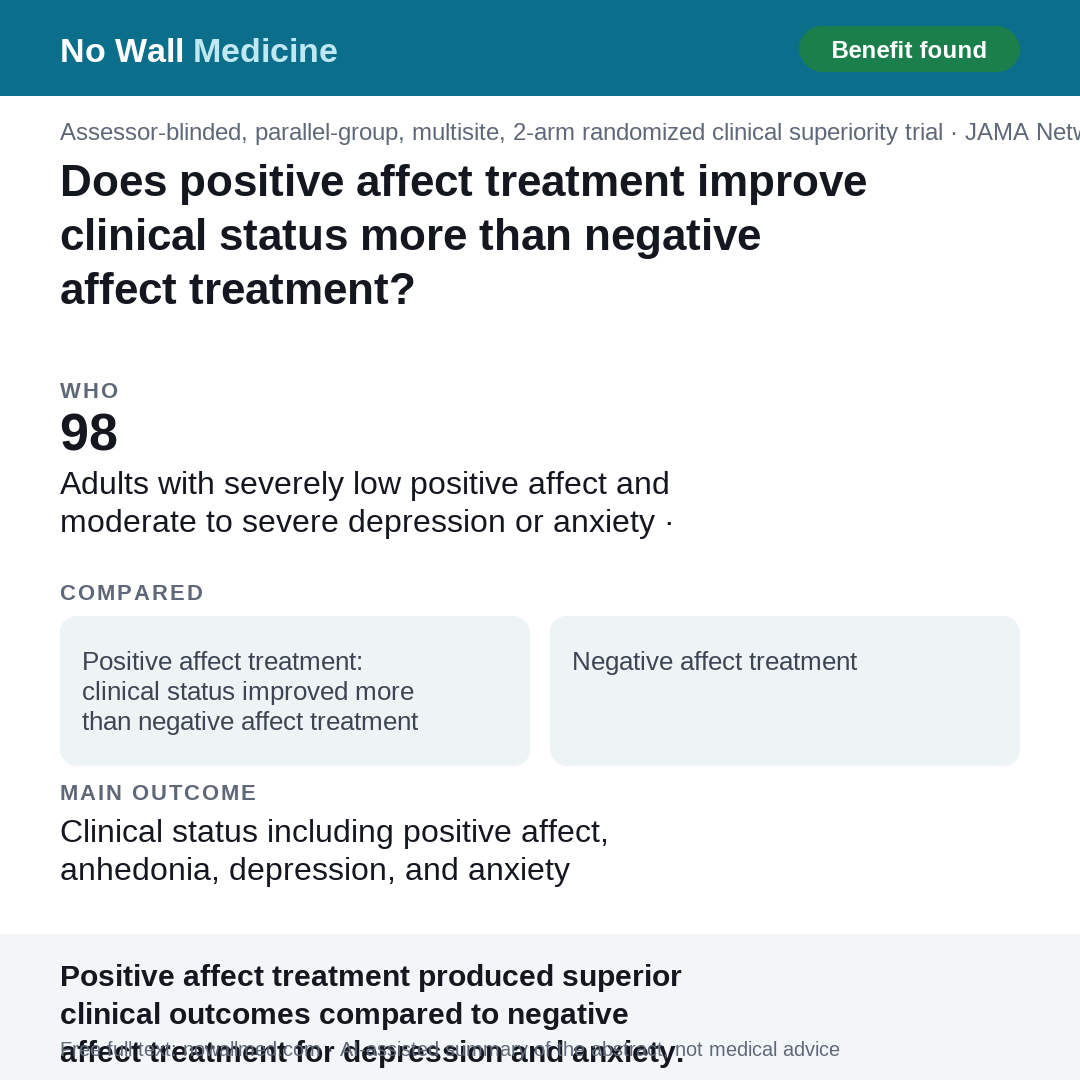
Clinical question: Does positive affect treatment improve clinical status more than negative affect treatment?
Why it matters: Mechanistic research is limited regarding how targeting impaired reward processing can reduce risk factors like suicidality and relapse in depression and anxiety.
Key points
- The study compared 98 adults with low positive affect and depression or anxiety receiving either positive affect treatment or negative affect treatment.
- Positive affect treatment showed greater improvements in clinical status than negative affect treatment and maintained better scores at a 1-month follow-up.
- Six of seven self-reported reward and threat measures mediated clinical improvements, but no behavioral or physiological measures did.
Headline and key points written with AI from the paper’s abstract, with every number checked against it. Read the paper before relying on them.
Topics
Cite this article
Meuret AE, Rosenfield D, Wang E, Hough CM, Ritz T, Craske MG. Positive Affect Treatment for Depression, Anxiety, and Low Positive Affect: A Randomized Clinical Trial. JAMA Netw Open. 2026. doi:10.1001/jamanetworkopen.2026.7403
Spotted a mistake? Suggest a correction