Shared prize incentives increased seat belt use among connected vehicle customers in a randomized trial
Behavioral Interventions for Increasing Seat Belt Use and Decreasing Distracted Driving Using Telematics: A National Randomized Trial
Randomized controlled trialBenefit found
Can behavioral interventions increase seat belt use and decrease distracted driving using telematics?
Who
1139
General Motors connected vehicle customers in the United States · United States
Compared
88.3%control
89.4%behavioral engagement
89.5%behavioral engagement plus raffle
91.3%behavioral engagement plus shared pot
Main outcome
seat belt use rate
Bottom line: A behavioral intervention with a shared pot incentive increased seat belt use rates among connected vehicle customers.
Am J Public Health · 2025-03-13Download image
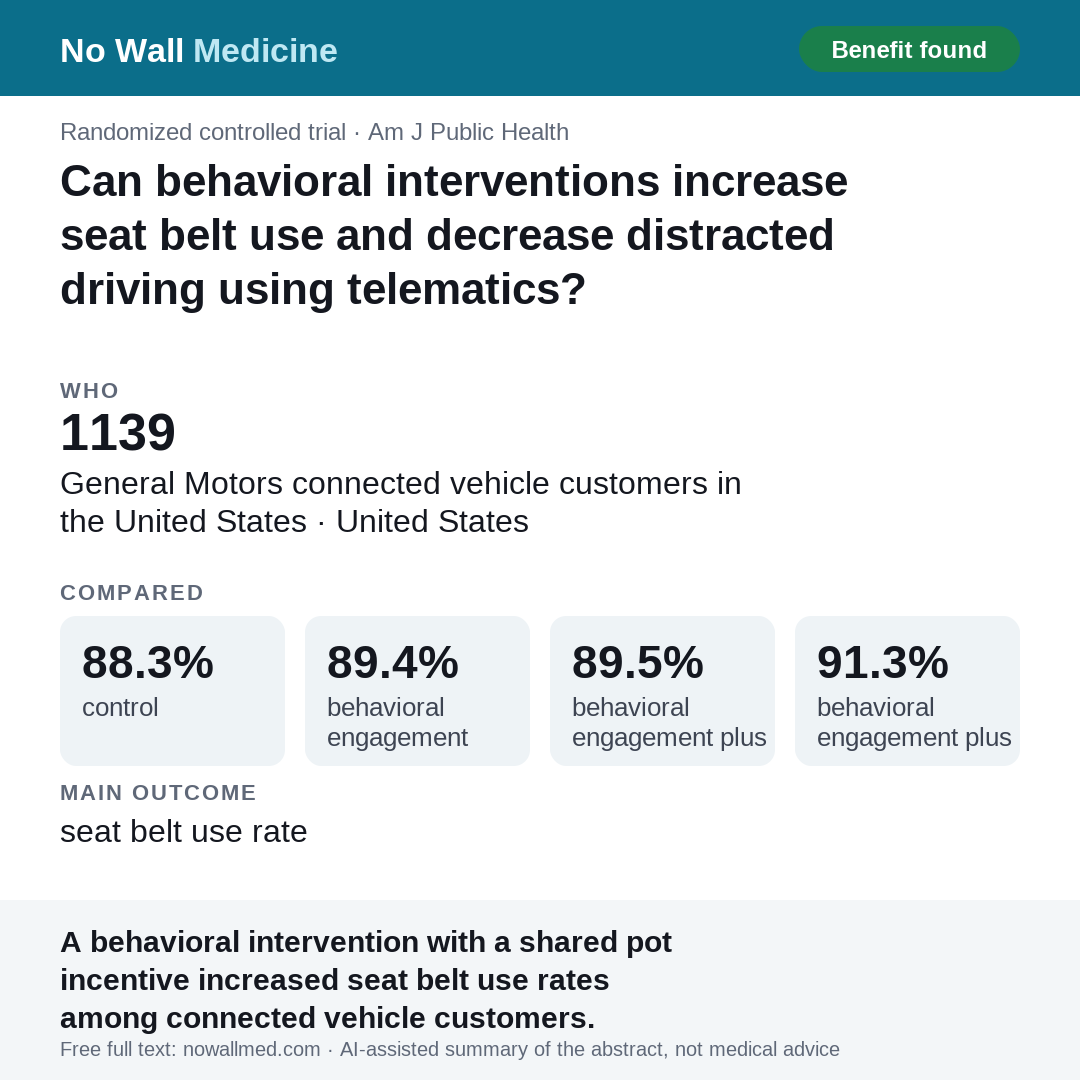
Clinical question: Can behavioral interventions increase seat belt use and decrease distracted driving using telematics?
Why it matters: It was unknown if low-cost, scalable virtual interventions could effectively encourage seat belt use and discourage handheld phone use while driving.
Key points
- Researchers randomized 1139 General Motors connected vehicle customers to one of four 10-week groups to test behavioral interventions for seat belt use and distracted driving.
- The shared prize group had a 91.3% seat belt buckling rate, compared to 89.5% in the raffle group, 89.4% in the behavioral engagement group, and 88.3% in the control group.
- The interventions did not result in significant differences in handheld phone use while driving.
Headline and key points written with AI from the paper’s abstract, with every number checked against it. Read the paper before relying on them.
Topics
Cite this article
Ebert JP, Yan R, Friday S, Small D, McDonald CC, Bartolozzi K. Behavioral Interventions for Increasing Seat Belt Use and Decreasing Distracted Driving Using Telematics: A National Randomized Trial. Am J Public Health. 2025. doi:10.2105/AJPH.2024.307980
Spotted a mistake? Suggest a correction
Top studies every Monday
The week’s key trials and guidelines in your specialties, by email. Free.
Get the weekly digest