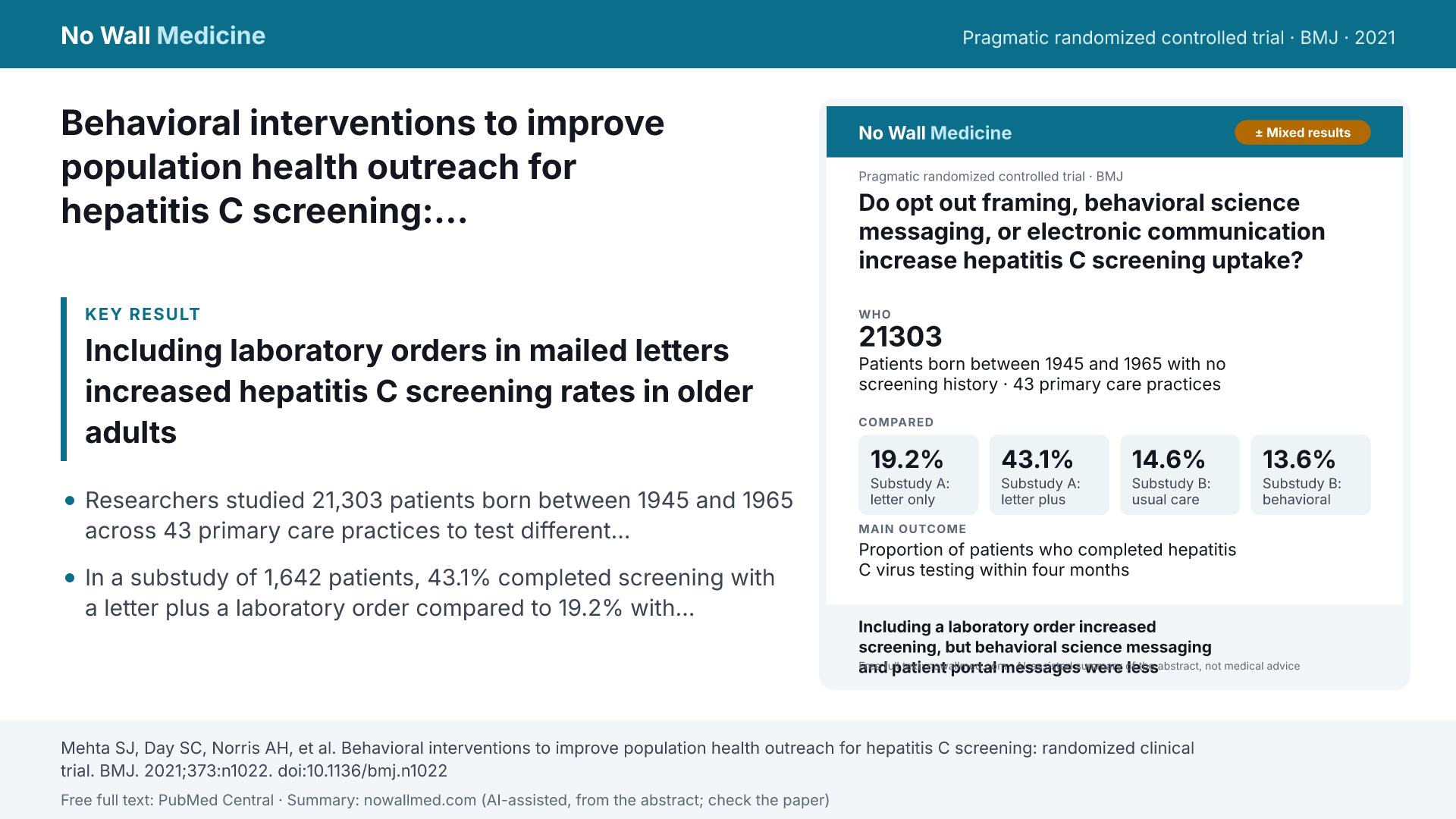
Including laboratory orders in mailed letters increased hepatitis C screening rates in older adults
Behavioral interventions to improve population health outreach for hepatitis C screening: randomized clinical trial
Pragmatic randomized controlled trialMixed results
Do opt out framing, behavioral science messaging, or electronic communication increase hepatitis C screening uptake?
Who
21303
Patients born between 1945 and 1965 with no screening history · 43 primary care practices in Philadelphia, Pennsylvania, USA
Compared
19.2%Substudy A: letter only (95% confidence interval 16.5% to 21.9%)
43.1%Substudy A: letter plus laboratory order (39.7% to 46.4%)
14.6%Substudy B: usual care content (13.9% to 15.3%)
13.6%Substudy B: behavioral science content (13.0% to 14.3%)
Main outcome
Proportion of patients who completed hepatitis C virus testing within four months
Bottom line: Including a laboratory order increased screening, but behavioral science messaging and patient portal messages were less effective than mailed letters.
BMJ · 2021-05-18Download image
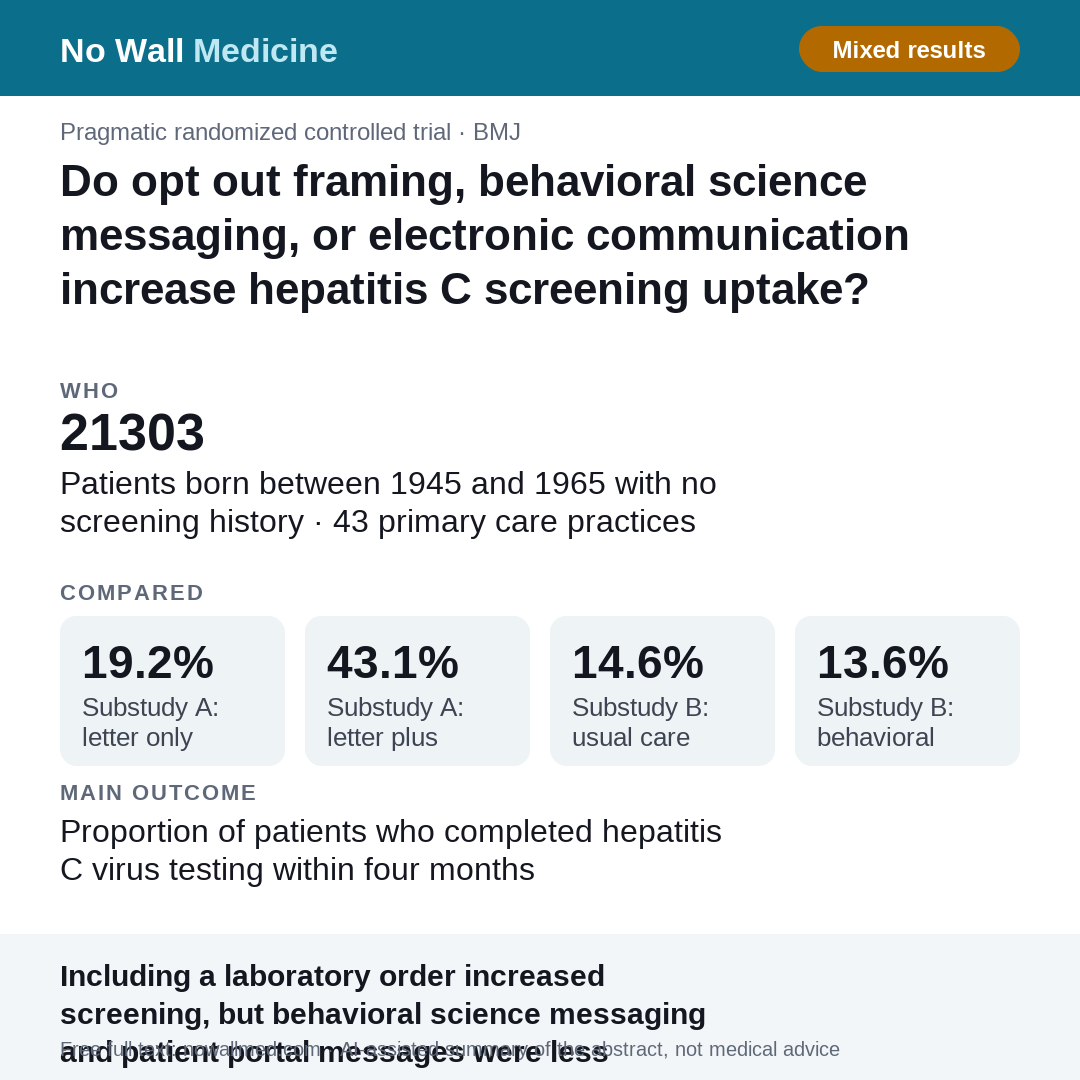
Clinical question: Do opt out framing, behavioral science messaging, or electronic communication increase hepatitis C screening uptake?
Why it matters: It is unknown whether opt out framing, behavioral science messaging, or electronic communication increases the uptake of hepatitis C virus screening in older populations.
Key points
- Researchers studied 21,303 patients born between 1945 and 1965 across 43 primary care practices to test different outreach methods for hepatitis C virus screening.
- In a substudy of 1,642 patients, 43.1% completed screening with a letter plus a laboratory order compared to 19.2% with a letter only.
- Among active patient portal users, 17.8% completed screening after receiving a letter compared to 13.8% after receiving a patient portal message.
Headline and key points written with AI from the paper’s abstract, with every number checked against it. Read the paper before relying on them.
Was this summary helpful?
Abstract
Objective
To evaluate whether opt out framing, messaging incorporating behavioral science concepts, or electronic communication increases the uptake of hepatitis C virus (HCV) screening in patients born between 1945 and 1965. Design
Pragmatic randomized controlled trial. Setting
43 primary care practices from one academic health system (Philadelphia, PA, USA) between April 2019 and May 2020. Participants
Patients born between 1945 and 1965 with no history of screening and at least two primary care visits in the two years before the enrollment period. Interventions
This multilevel trial was divided into two studies. Substudy A included 1656 eligible patients of 17 primary care clinicians who were randomized in a 1:1 ratio to a mailed letter about HCV screening (letter only), or a similar letter with a laboratory order for HCV screening (letter+order). Substudy B included the remaining 19 837 eligible patients followed by 417 clinicians. Active electronic patient portal users were randomized 1:5 to receive a mailed letter about HCV screening (letter), or an electronic patient portal message with similar content (patient portal); inactive patient portal users were mailed a letter. In a factorial design, patients in substudy B were also randomized 1:1 to receive standard content (usual care), or content based on principles of social norming, anticipated regret, reciprocity, and commitment (behavioral content). Main outcome measures
Proportion of patients who completed HCV testing within four months. Results
21 303 patients were included in the intention-to-treat analysis. Among the 1642 patients in substudy A, 19.2% (95% confidence interval 16.5% to 21.9%) completed screening in the letter only arm and 43.1% (39.7% to 46.4%) in the letter+order arm (P<0.001). Among the 19 661 patients in substudy B, 14.6% (13.9% to 15.3%) completed screening with usual care content and 13.6% (13.0% to 14.3%) with behavioral science content (P=0.06). Among active patient portal users, 17.8% (16.0% to 19.5%) completed screening after receiving a letter and 13.8% (13.1% to 14.5%) after receiving a patient portal message (P<0.001). Conclusions
Opt out framing and effort reduction by including a signed laboratory order with outreach increased screening for HCV. Behavioral science messaging content did not increase uptake, and mailed letters achieved a greater response rate than patient portal messages. Trial registration
ClinicalTrials.gov NCT03712553.
Abstract reproduced under the article’s CC BY NC licence.
Subject terms
Cite this article
Mehta SJ, Day SC, Norris AH, Sung J, Reitz C, Wollack C. Behavioral interventions to improve population health outreach for hepatitis C screening: randomized clinical trial. BMJ. 2021. doi:10.1136/bmj.n1022
Spotted a mistake? Suggest a correction