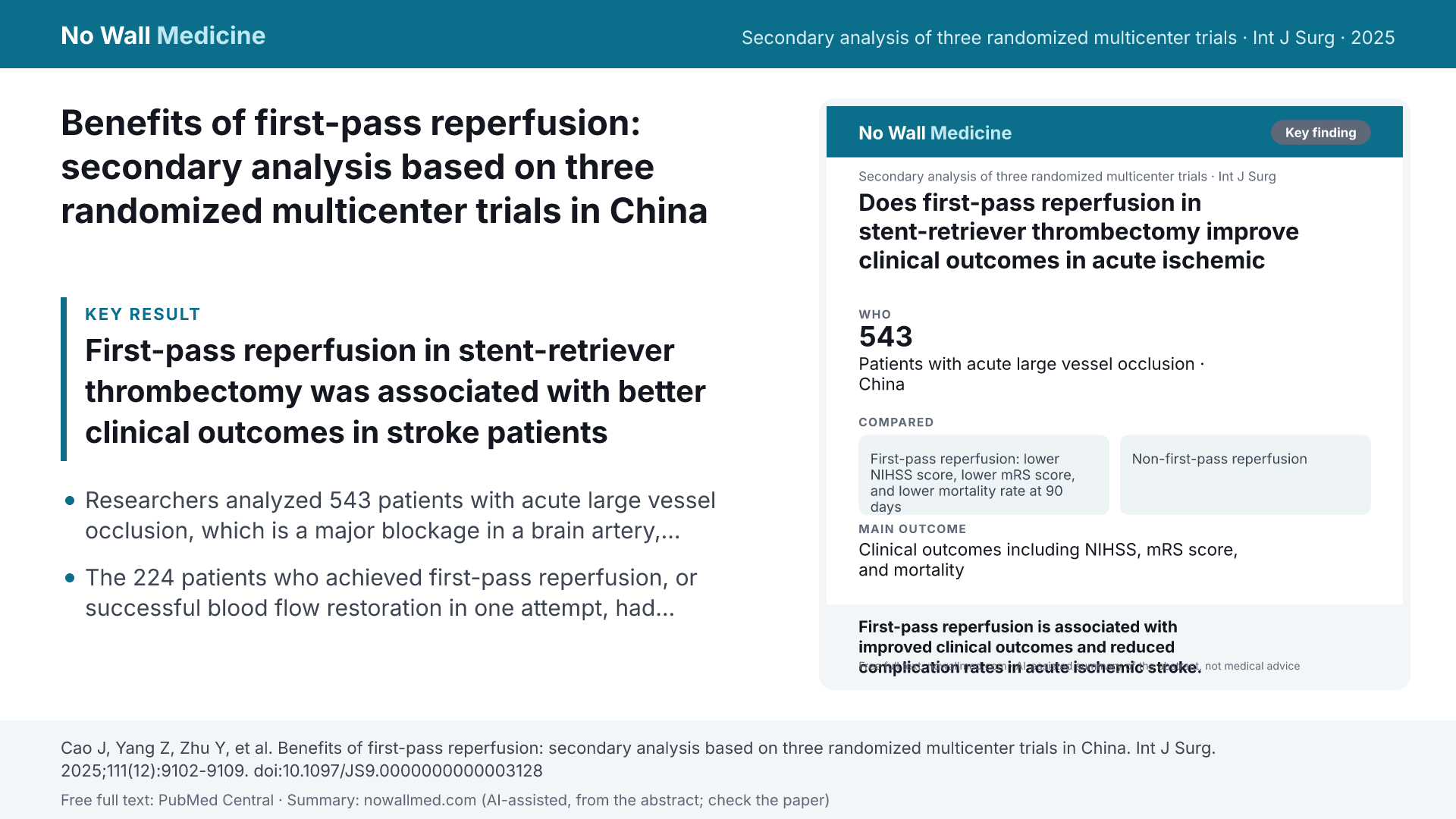
First-pass reperfusion in stent-retriever thrombectomy was associated with better clinical outcomes in stroke patients
Benefits of first-pass reperfusion: secondary analysis based on three randomized multicenter trials in China
Secondary analysis of three randomized multicenter trialsBenefit found
Does first-pass reperfusion in stent-retriever thrombectomy improve clinical outcomes in acute ischemic stroke?
Who
543
Patients with acute large vessel occlusion · China
Compared
First-pass reperfusion: lower NIHSS score, lower mRS score, and lower mortality rate at 90 days
Non-first-pass reperfusion
Main outcome
Clinical outcomes including NIHSS, mRS score, and mortality
Bottom line: First-pass reperfusion is associated with improved clinical outcomes and reduced complication rates in acute ischemic stroke.
Int J Surg · 2025-08-06Download image
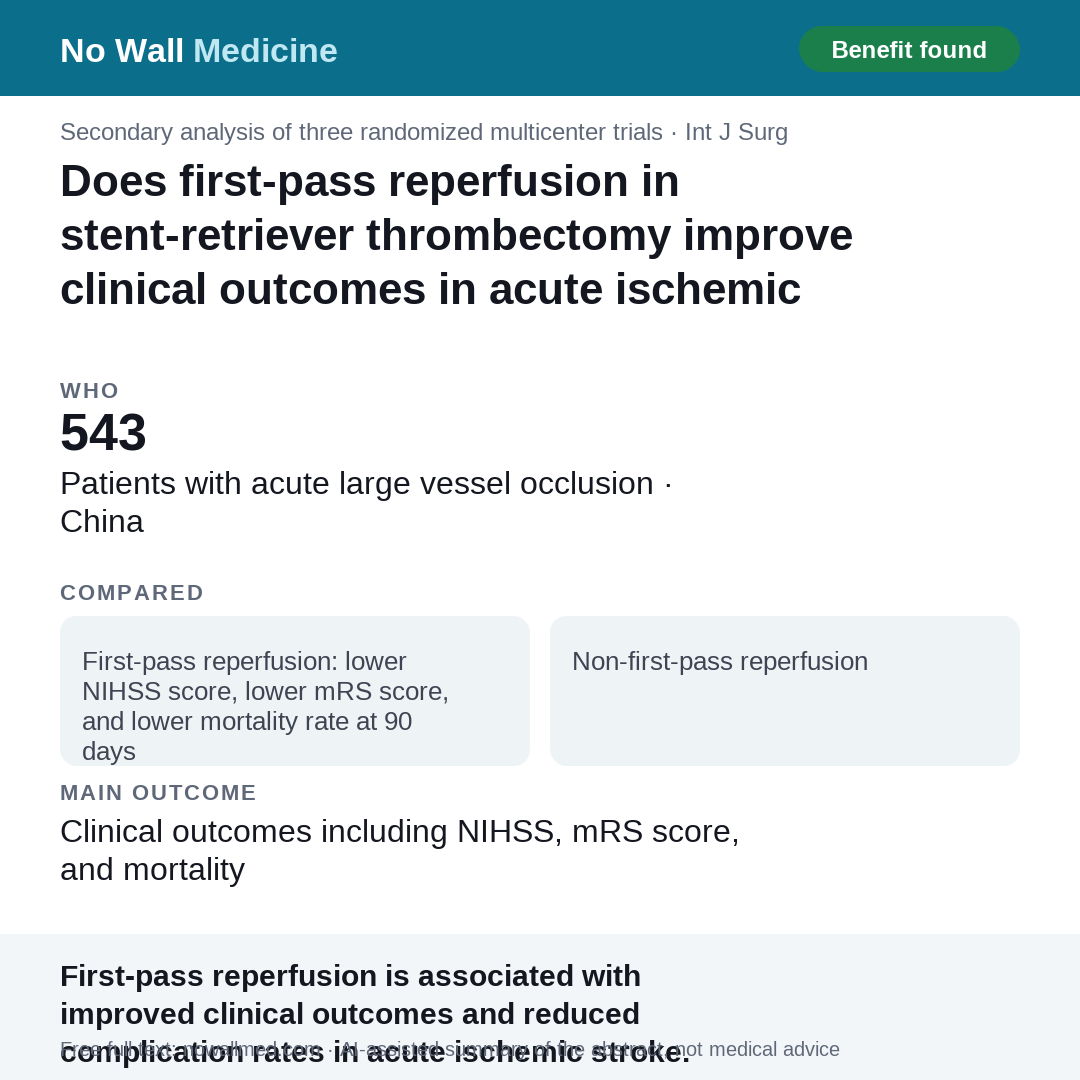
Clinical question: Does first-pass reperfusion in stent-retriever thrombectomy improve clinical outcomes in acute ischemic stroke?
Why it matters: The clinical significance of achieving successful blood flow restoration in a single attempt during stent-retriever thrombectomy for acute ischemic stroke needed systematic evaluation.
Key points
- Researchers analyzed 543 patients with acute large vessel occlusion, which is a major blockage in a brain artery, from three randomized multicenter trials.
- The 224 patients who achieved first-pass reperfusion, or successful blood flow restoration in one attempt, had lower NIHSS and mRS scores and lower mortality at 90 days.
- Successful first-pass reperfusion was associated with lower rates of symptomatic intracranial hemorrhage, which is bleeding in the brain, and embolization into new territory.
Headline and key points written with AI from the paper’s abstract, with every number checked against it. Read the paper before relying on them.
Was this summary helpful?
Subject terms
Cite this article
Cao J, Yang Z, Zhu Y, Ke K, Zhang M, Lin H. Benefits of first-pass reperfusion: secondary analysis based on three randomized multicenter trials in China. Int J Surg. 2025. doi:10.1097/JS9.0000000000003128
Spotted a mistake? Suggest a correction
Top studies every Monday
The week’s key trials and guidelines in your specialties, plus any topics you follow. By email, free.
Get the weekly digest