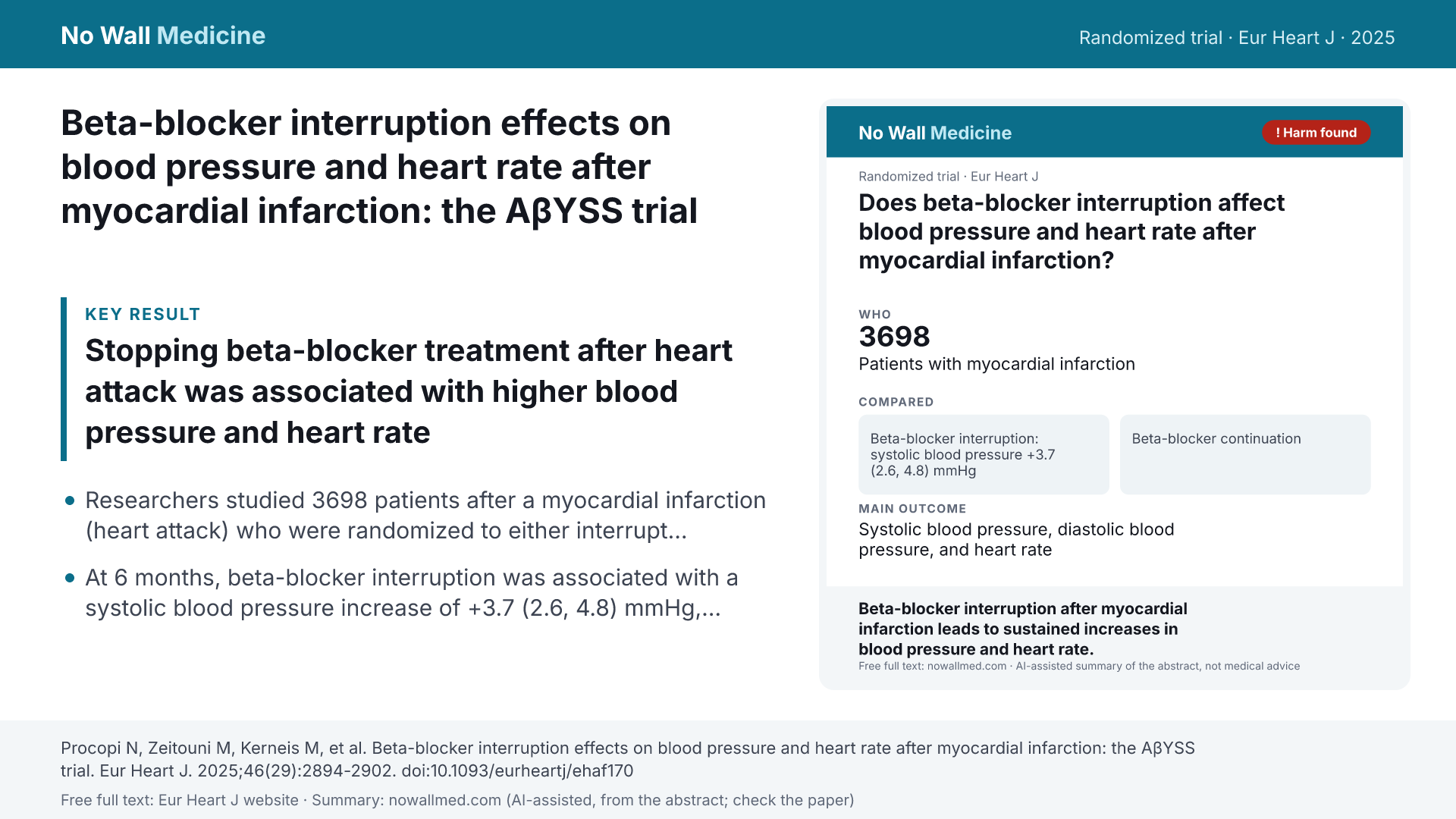
Stopping beta-blocker treatment after heart attack was associated with higher blood pressure and heart rate
Beta-blocker interruption effects on blood pressure and heart rate after myocardial infarction: the AβYSS trial
Randomized trialHarm found
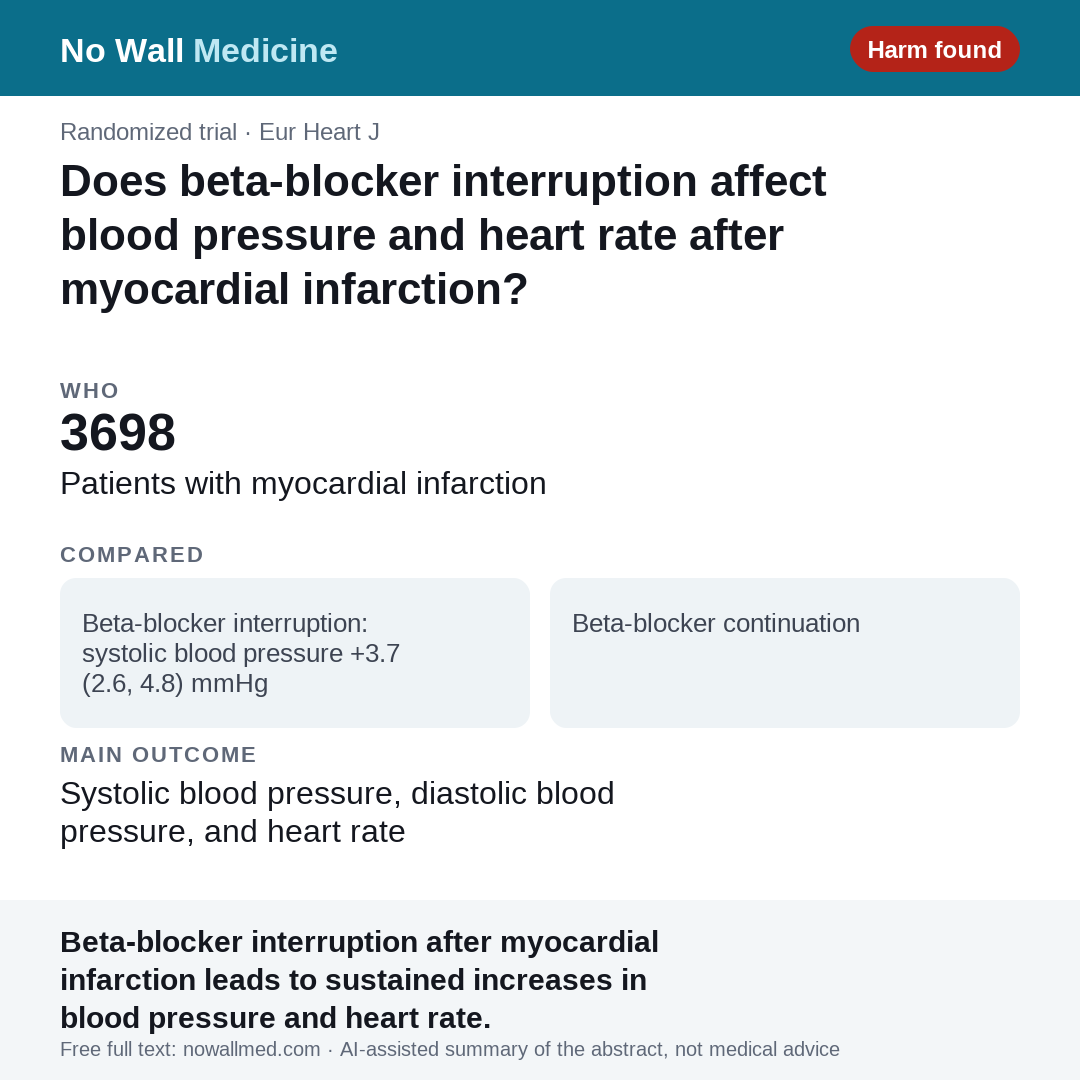
Does beta-blocker interruption affect blood pressure and heart rate after myocardial infarction?
Who
3698
Patients with myocardial infarction
Compared
Beta-blocker interruption: systolic blood pressure +3.7 (2.6, 4.8) mmHg
Beta-blocker continuation
Main outcome
Systolic blood pressure, diastolic blood pressure, and heart rate
Result: systolic BP +3.7 (95% CI 2.6, 4.8) mmHg
Bottom line: Beta-blocker interruption after myocardial infarction leads to sustained increases in blood pressure and heart rate.
Eur Heart J · 2025-05-22Download image
Clinical question: Does beta-blocker interruption affect blood pressure and heart rate after myocardial infarction?
Why it matters: It was unknown how interrupting beta-blocker therapy after an uncomplicated heart attack affects blood pressure, heart rate, and clinical outcomes.
Key points
- Researchers studied 3698 patients after a myocardial infarction (heart attack) who were randomized to either interrupt or continue beta-blocker treatment.
- At 6 months, beta-blocker interruption was associated with a systolic blood pressure increase of +3.7 (2.6, 4.8) mmHg, a diastolic blood pressure increase of +3.3 (2.6, 4.0) mmHg, and a resting heart rate increase of +10 [9, 11) b.p.m.
- Patients with a history of hypertension had a higher risk of the primary endpoint of death, heart attack, stroke, or cardiovascular hospitalization compared to those without hypertension.
Headline and key points written with AI from the paper’s abstract, with every number checked against it. Read the paper before relying on them.
Was this summary helpful?
Subject terms
Cite this article
Procopi N, Zeitouni M, Kerneis M, Cayla G, Ferrari E, Range G. Beta-blocker interruption effects on blood pressure and heart rate after myocardial infarction: the AβYSS trial. Eur Heart J. 2025. doi:10.1093/eurheartj/ehaf170
Spotted a mistake? Suggest a correction