Beta-blocker interruption effects on blood pressure and heart rate after myocardial infarction: the AβYSS trial
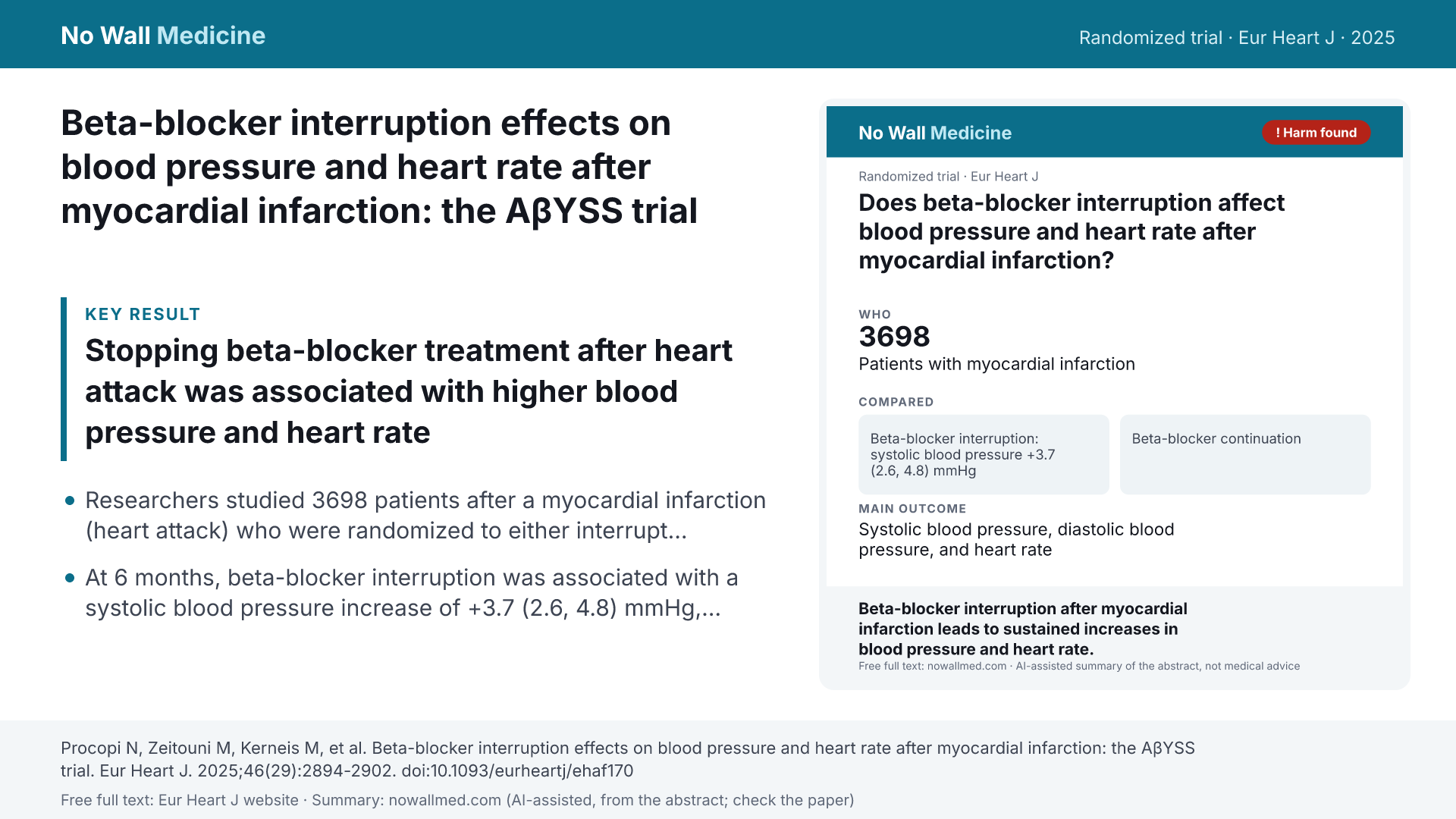
Key result: Stopping beta-blocker treatment after heart attack was associated with higher blood pressure and heart rate
Randomized trialHarm found
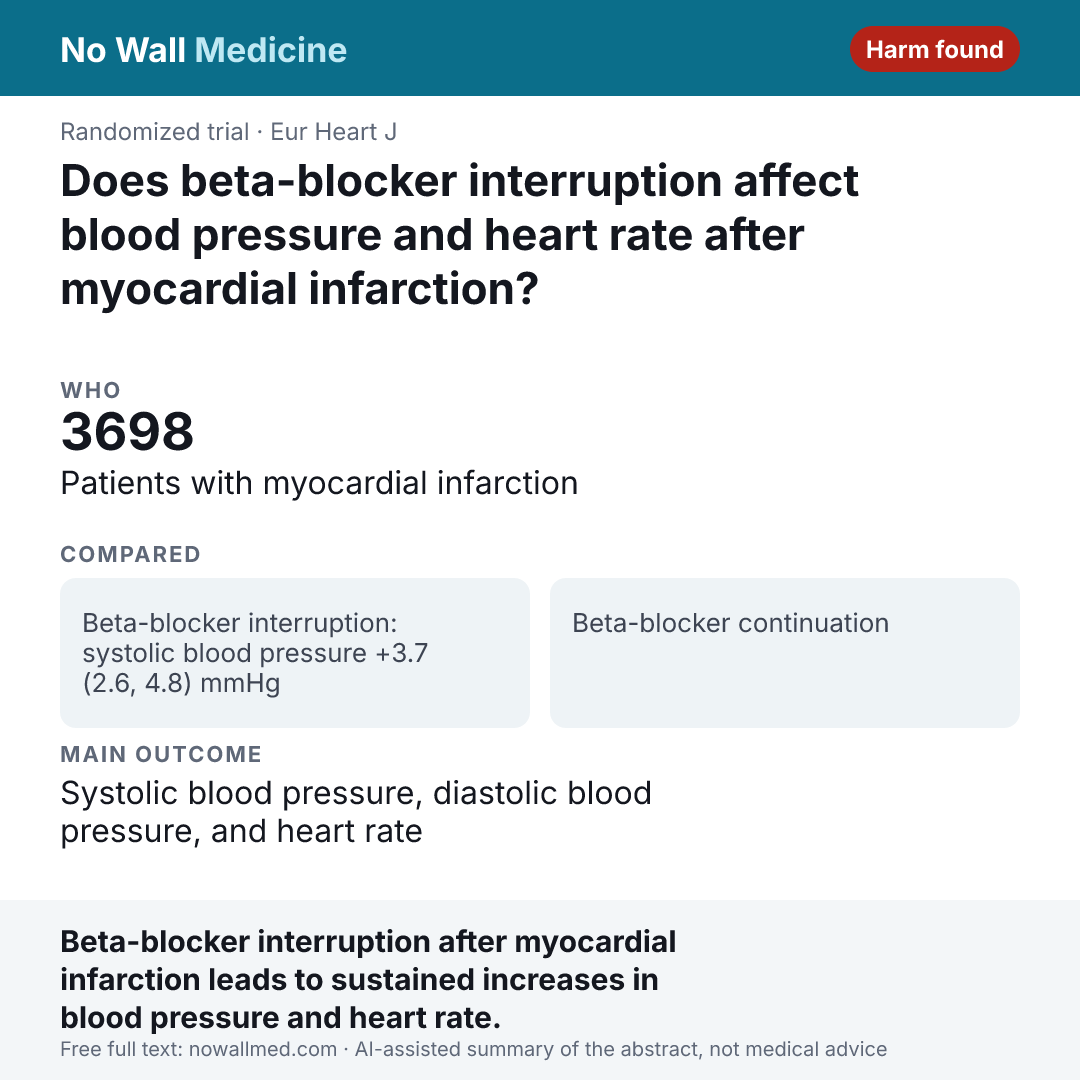
Does beta-blocker interruption affect blood pressure and heart rate after myocardial infarction?
Who
3698
Patients with myocardial infarction
Compared
Beta-blocker interruption: systolic blood pressure +3.7 (2.6, 4.8) mmHg
Beta-blocker continuation
Main outcome
Systolic blood pressure, diastolic blood pressure, and heart rate
Result: systolic BP +3.7 (95% CI 2.6, 4.8) mmHg
Bottom line: Beta-blocker interruption after myocardial infarction leads to sustained increases in blood pressure and heart rate.
Eur Heart J · 2025-05-22 · Save PNG
Key points
- Researchers studied 3698 patients after a myocardial infarction (heart attack) who were randomized to either interrupt or continue beta-blocker treatment.
- At 6 months, beta-blocker interruption was associated with a systolic blood pressure increase of +3.7 (2.6, 4.8) mmHg, a diastolic blood pressure increase of +3.3 (2.6, 4.0) mmHg, and a resting heart rate increase of +10 [9, 11) b.p.m.
- Patients with a history of hypertension had a higher risk of the primary endpoint of death, heart attack, stroke, or cardiovascular hospitalization compared to those without hypertension.
Discussion prompts
- Would these patients look like yours? Who was left out?
- Is the main outcome one that matters to patients?
- Is the difference large enough to change what you do?
Cite: Procopi N, Zeitouni M, Kerneis M, et al. Beta-blocker interruption effects on blood pressure and heart rate after myocardial infarction: the AβYSS trial. Eur Heart J. 2025;46(29):2894-2902. doi:10.1093/eurheartj/ehaf170
Free full text: Eur Heart J website · Summary and visual abstract: nowallmed.com/a/beta-blocker-interruption-effects-on-blood-pressure-and-heart-rate-fhfx8b/ (AI-assisted from the abstract; check the paper before relying on it).