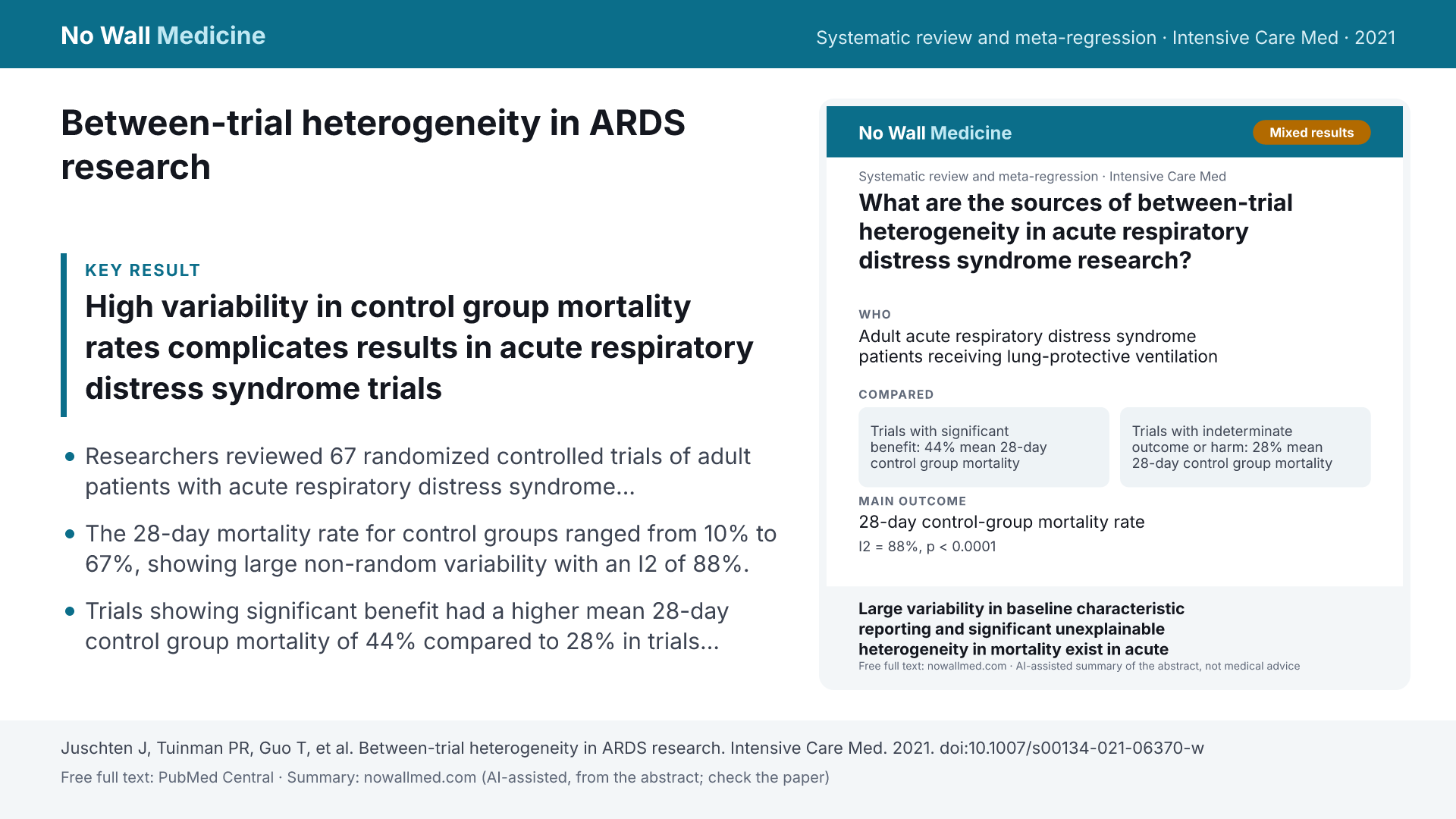
High variability in control group mortality rates complicates results in acute respiratory distress syndrome trials
Between-trial heterogeneity in ARDS research
Systematic review and meta-regressionMixed results
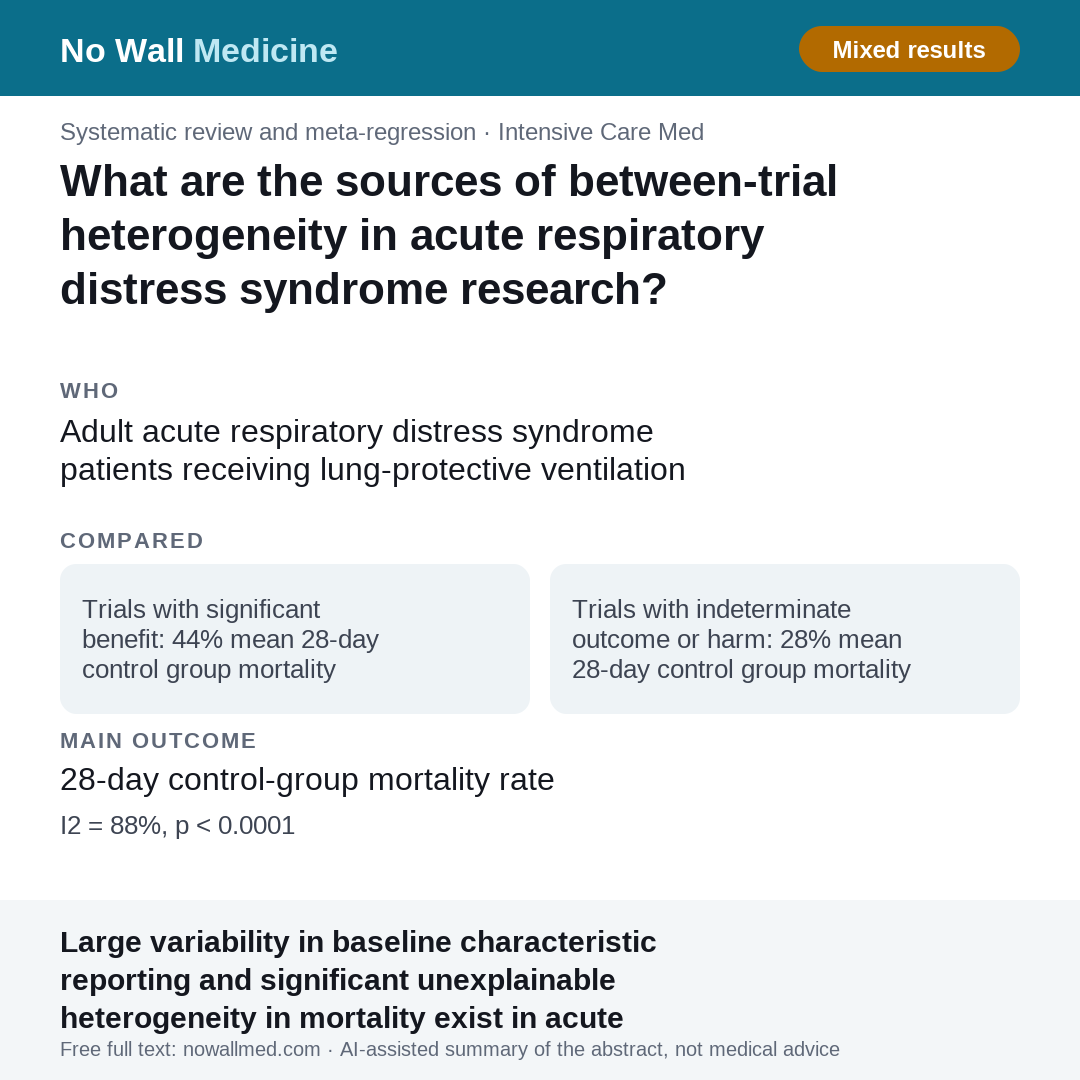
What are the sources of between-trial heterogeneity in acute respiratory distress syndrome research?
Who
Adult acute respiratory distress syndrome patients receiving lung-protective ventilation
Compared
Trials with significant benefit: 44% mean 28-day control group mortality
Trials with indeterminate outcome or harm: 28% mean 28-day control group mortality
Main outcome
28-day control-group mortality rate
Result: I2 = 88%, p < 0.0001
Bottom line: Large variability in baseline characteristic reporting and significant unexplainable heterogeneity in mortality exist in acute respiratory distress syndrome research.
Limitation: Large non-random heterogeneity in reported 28-day control-group mortality rates.
Intensive Care Med · 2021-03-13Download image
Clinical question: What are the sources of between-trial heterogeneity in acute respiratory distress syndrome research?
Why it matters: Conflicting results in acute respiratory distress syndrome research may stem from inconsistent reporting of baseline patient characteristics and high variability in control group mortality.
Key points
- Researchers reviewed 67 randomized controlled trials of adult patients with acute respiratory distress syndrome receiving lung-protective ventilation published between 2000 and 2019.
- The 28-day mortality rate for control groups ranged from 10% to 67%, showing large non-random variability with an I2 of 88%.
- Trials showing significant benefit had a higher mean 28-day control group mortality of 44% compared to 28% in trials with indeterminate outcomes or harm.
Headline and key points written with AI from the paper’s abstract, with every number checked against it. Read the paper before relying on them.
Was this summary helpful?
Subject terms
Cite this article
Juschten J, Tuinman PR, Guo T, et al. Between-trial heterogeneity in ARDS research. Intensive Care Med. 2021. doi:10.1007/s00134-021-06370-w
Spotted a mistake? Suggest a correction