Between-trial heterogeneity in ARDS research
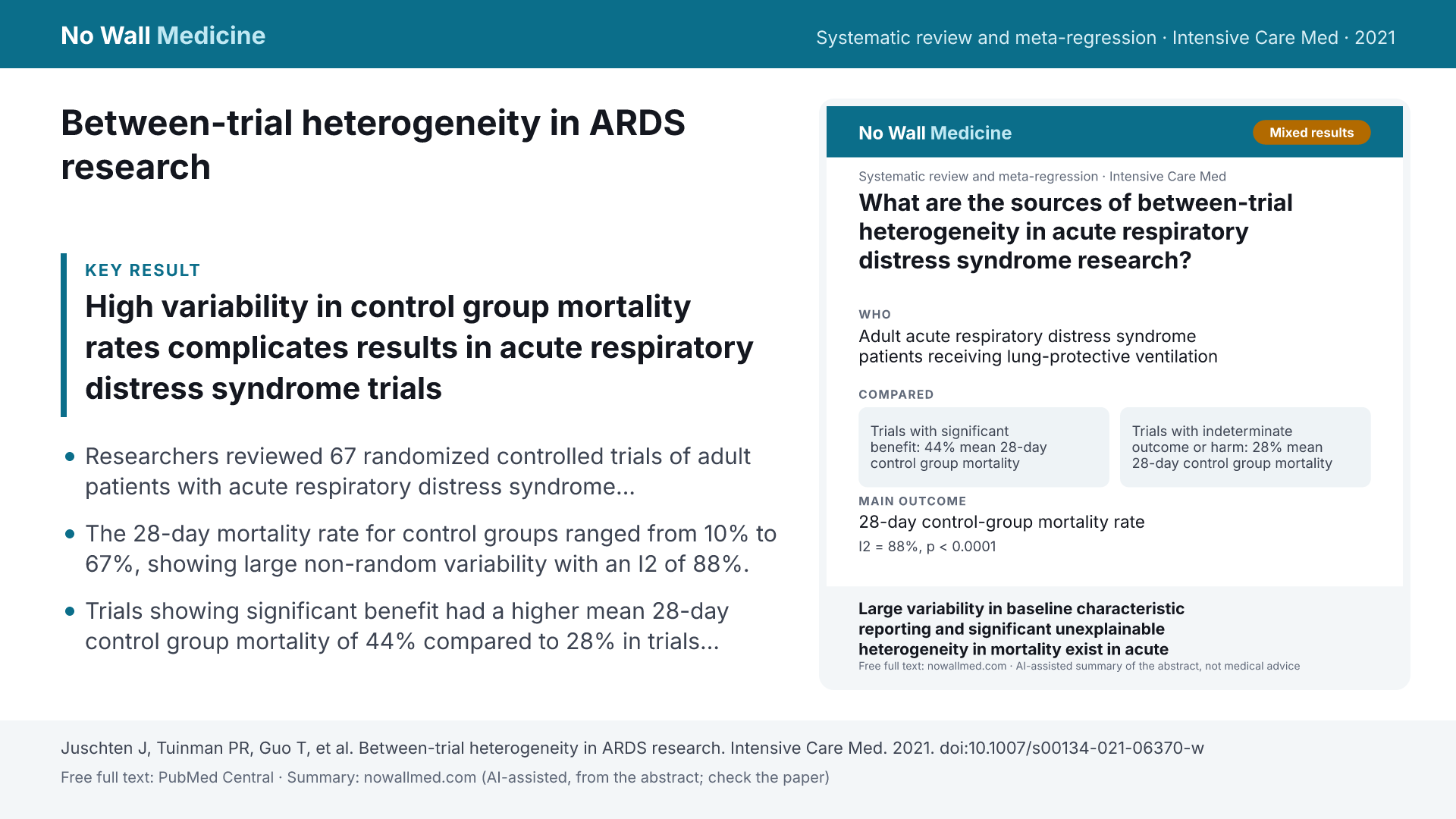
Key result: High variability in control group mortality rates complicates results in acute respiratory distress syndrome trials
Systematic review and meta-regressionMixed results
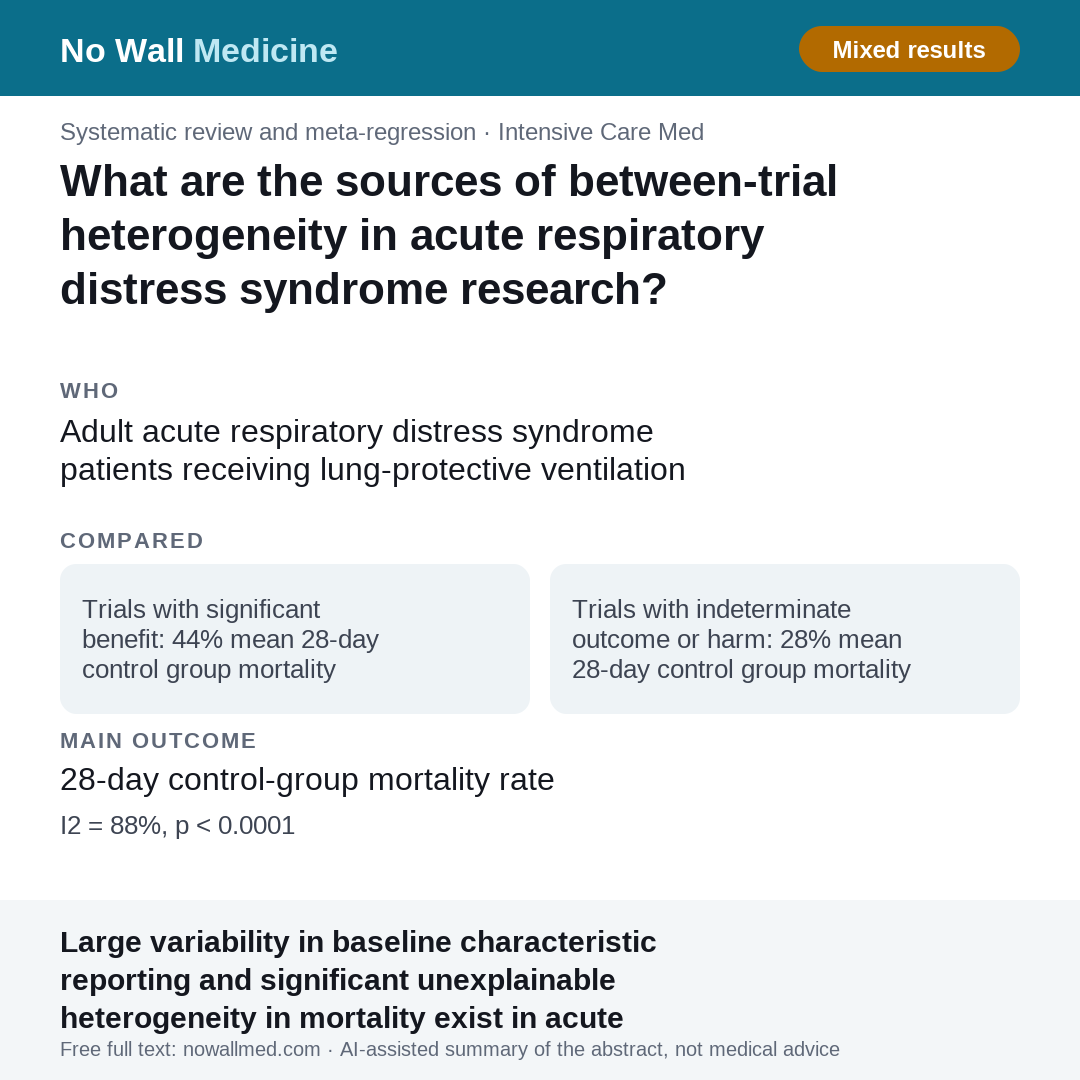
What are the sources of between-trial heterogeneity in acute respiratory distress syndrome research?
Who
Adult acute respiratory distress syndrome patients receiving lung-protective ventilation
Compared
Trials with significant benefit: 44% mean 28-day control group mortality
Trials with indeterminate outcome or harm: 28% mean 28-day control group mortality
Main outcome
28-day control-group mortality rate
Result: I2 = 88%, p < 0.0001
Bottom line: Large variability in baseline characteristic reporting and significant unexplainable heterogeneity in mortality exist in acute respiratory distress syndrome research.
Limitation: Large non-random heterogeneity in reported 28-day control-group mortality rates.
Intensive Care Med · 2021-03-13Download image
Key points
- Researchers reviewed 67 randomized controlled trials of adult patients with acute respiratory distress syndrome receiving lung-protective ventilation published between 2000 and 2019.
- The 28-day mortality rate for control groups ranged from 10% to 67%, showing large non-random variability with an I2 of 88%.
- Trials showing significant benefit had a higher mean 28-day control group mortality of 44% compared to 28% in trials with indeterminate outcomes or harm.
Why it matters: Conflicting results in acute respiratory distress syndrome research may stem from inconsistent reporting of baseline patient characteristics and high variability in control group mortality.
Discussion prompts
- Would these patients look like yours? Who was left out?
- Is the main outcome one that matters to patients?
- Is the difference large enough to change what you do?
Cite: Juschten J, Tuinman PR, Guo T, et al. Between-trial heterogeneity in ARDS research. Intensive Care Med. 2021. doi:10.1007/s00134-021-06370-w
Free full text: PubMed Central · Summary and visual abstract: nowallmed.com/a/between-trial-heterogeneity-in-ards-asmuc1/ (AI-assisted from the abstract; check the paper before relying on it).