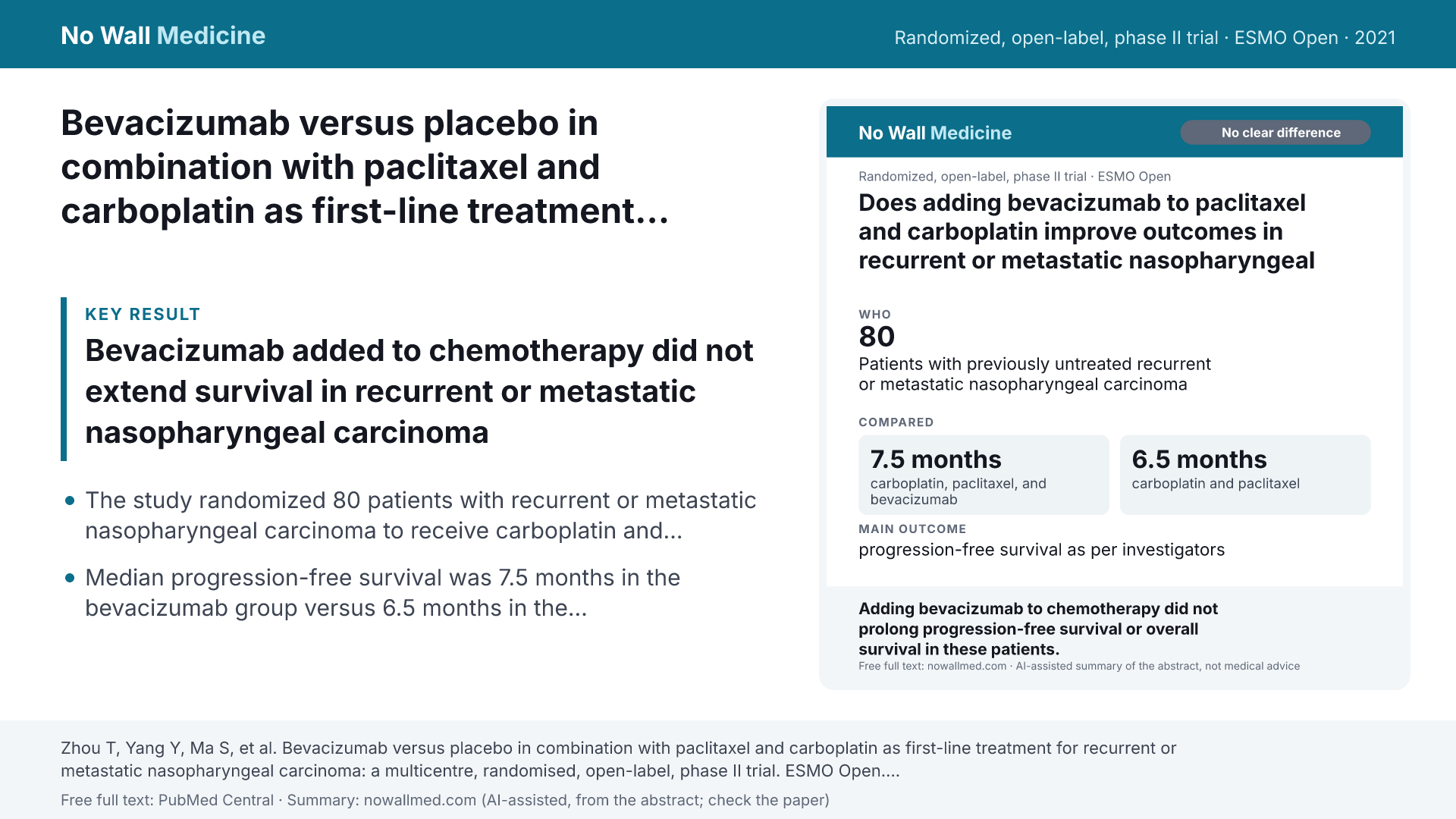
Bevacizumab added to chemotherapy did not extend survival in recurrent or metastatic nasopharyngeal carcinoma
Bevacizumab versus placebo in combination with paclitaxel and carboplatin as first-line treatment for recurrent or metastatic nasopharyngeal carcinoma: a multicentre, randomised, open-label, phase II trial
Randomized, open-label, phase II trialNo clear difference
Does adding bevacizumab to paclitaxel and carboplatin improve outcomes in recurrent or metastatic nasopharyngeal carcinoma?
Who
80
Patients with previously untreated recurrent or metastatic nasopharyngeal carcinoma
Compared
7.5 monthscarboplatin, paclitaxel, and bevacizumab
6.5 monthscarboplatin and paclitaxel
Main outcome
progression-free survival as per investigators
Bottom line: Adding bevacizumab to chemotherapy did not prolong progression-free survival or overall survival in these patients.
ESMO Open · 2021-11-24Download image
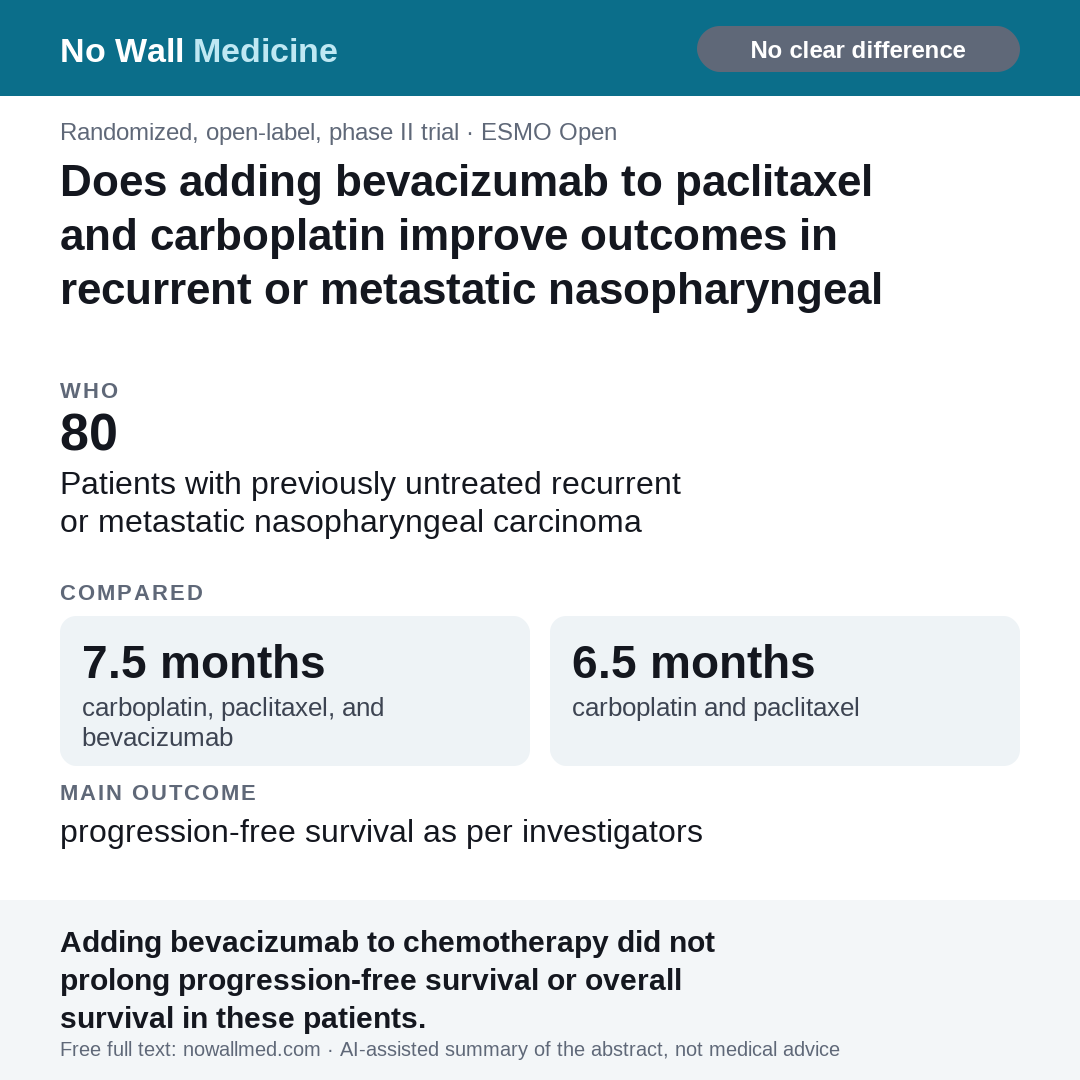
Clinical question: Does adding bevacizumab to paclitaxel and carboplatin improve outcomes in recurrent or metastatic nasopharyngeal carcinoma?
Why it matters: The value of anti-angiogenesis antibody therapy, which targets the growth of new blood vessels, remains unknown for recurrent or metastatic nasopharyngeal carcinoma.
Key points
- The study randomized 80 patients with recurrent or metastatic nasopharyngeal carcinoma to receive carboplatin and paclitaxel with or without bevacizumab.
- Median progression-free survival was 7.5 months in the bevacizumab group versus 6.5 months in the chemotherapy-only group (P = 0.148).
- Median overall survival was 21.0 months in the bevacizumab group compared to 24.7 months in the chemotherapy-only group (P = 0.326).
Headline and key points written with AI from the paper’s abstract, with every number checked against it. Read the paper before relying on them.
Was this summary helpful?
Subject terms
Cite this article
Zhou T, Yang Y, Ma S, et al. Bevacizumab versus placebo in combination with paclitaxel and carboplatin as first-line treatment for recurrent or metastatic nasopharyngeal carcinoma: a multicentre, randomised, open-label, phase II trial. ESMO Open. 2021. doi:10.1016/j.esmoop.2021.100313
Spotted a mistake? Suggest a correction