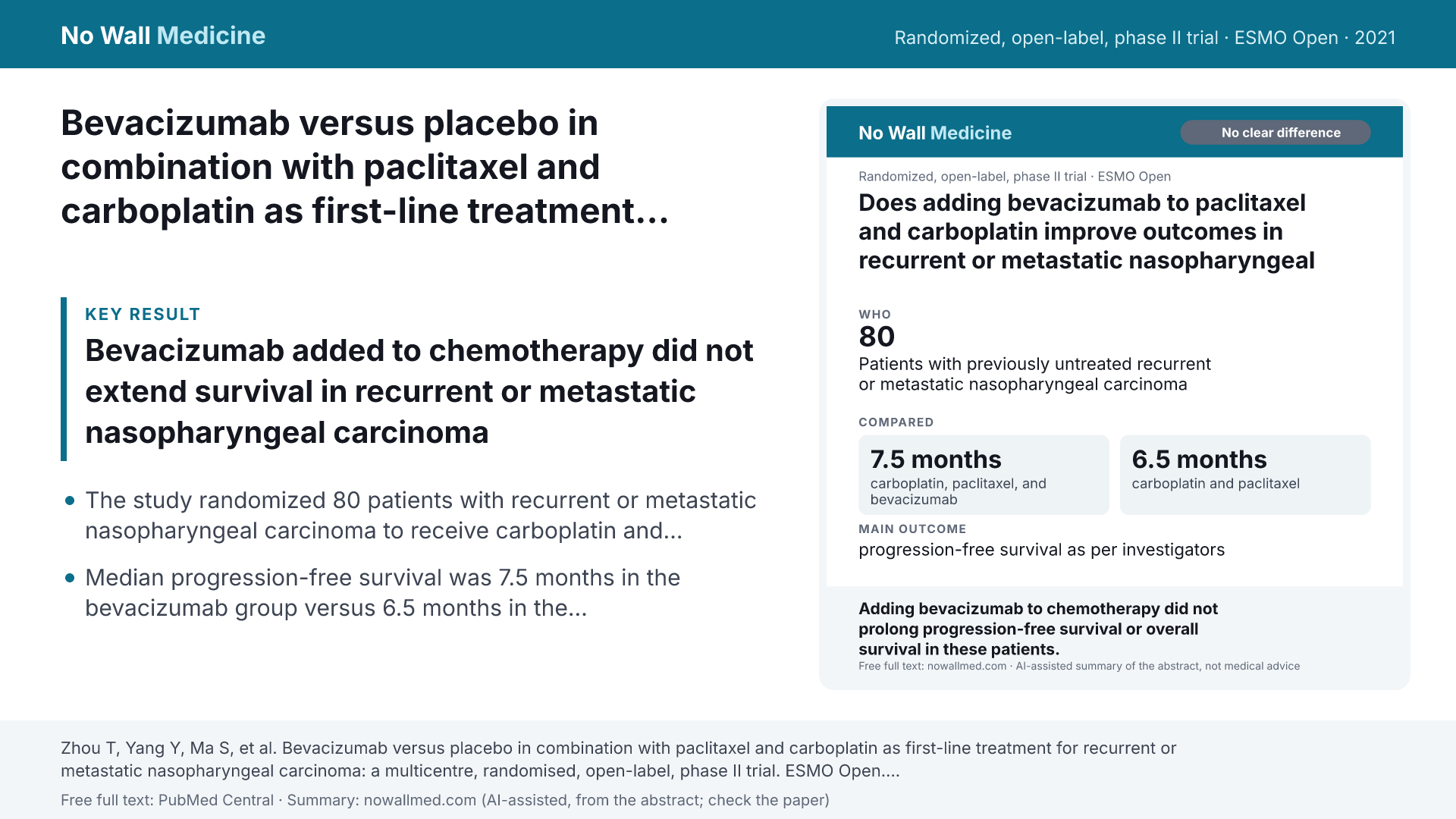
Bevacizumab versus placebo in combination with paclitaxel and carboplatin as first-line treatment for recurrent or metastatic nasopharyngeal carcinoma: a multicentre, randomised, open-label, phase II trial
Key result: Bevacizumab added to chemotherapy did not extend survival in recurrent or metastatic nasopharyngeal carcinoma
Key points
- The study randomized 80 patients with recurrent or metastatic nasopharyngeal carcinoma to receive carboplatin and paclitaxel with or without bevacizumab.
- Median progression-free survival was 7.5 months in the bevacizumab group versus 6.5 months in the chemotherapy-only group (P = 0.148).
- Median overall survival was 21.0 months in the bevacizumab group compared to 24.7 months in the chemotherapy-only group (P = 0.326).
Why it matters: The value of anti-angiogenesis antibody therapy, which targets the growth of new blood vessels, remains unknown for recurrent or metastatic nasopharyngeal carcinoma.
Discussion prompts
- Would these patients look like yours? Who was left out?
- Is the main outcome one that matters to patients?
- Is the difference large enough to change what you do?
Cite: Zhou T, Yang Y, Ma S, et al. Bevacizumab versus placebo in combination with paclitaxel and carboplatin as first-line treatment for recurrent or metastatic nasopharyngeal carcinoma: a multicentre, randomised, open-label, phase II trial. ESMO Open. 2021;6(6):100313. doi:10.1016/j.esmoop.2021.100313
Free full text: PubMed Central · Summary and visual abstract: nowallmed.com/a/bevacizumab-versus-placebo-in-combination-with-paclitaxel-and-dpnsnb/ (AI-assisted from the abstract; check the paper before relying on it).