Beyond Physical Capacity: Factors Associated With Real-world Walking Activity After Stroke
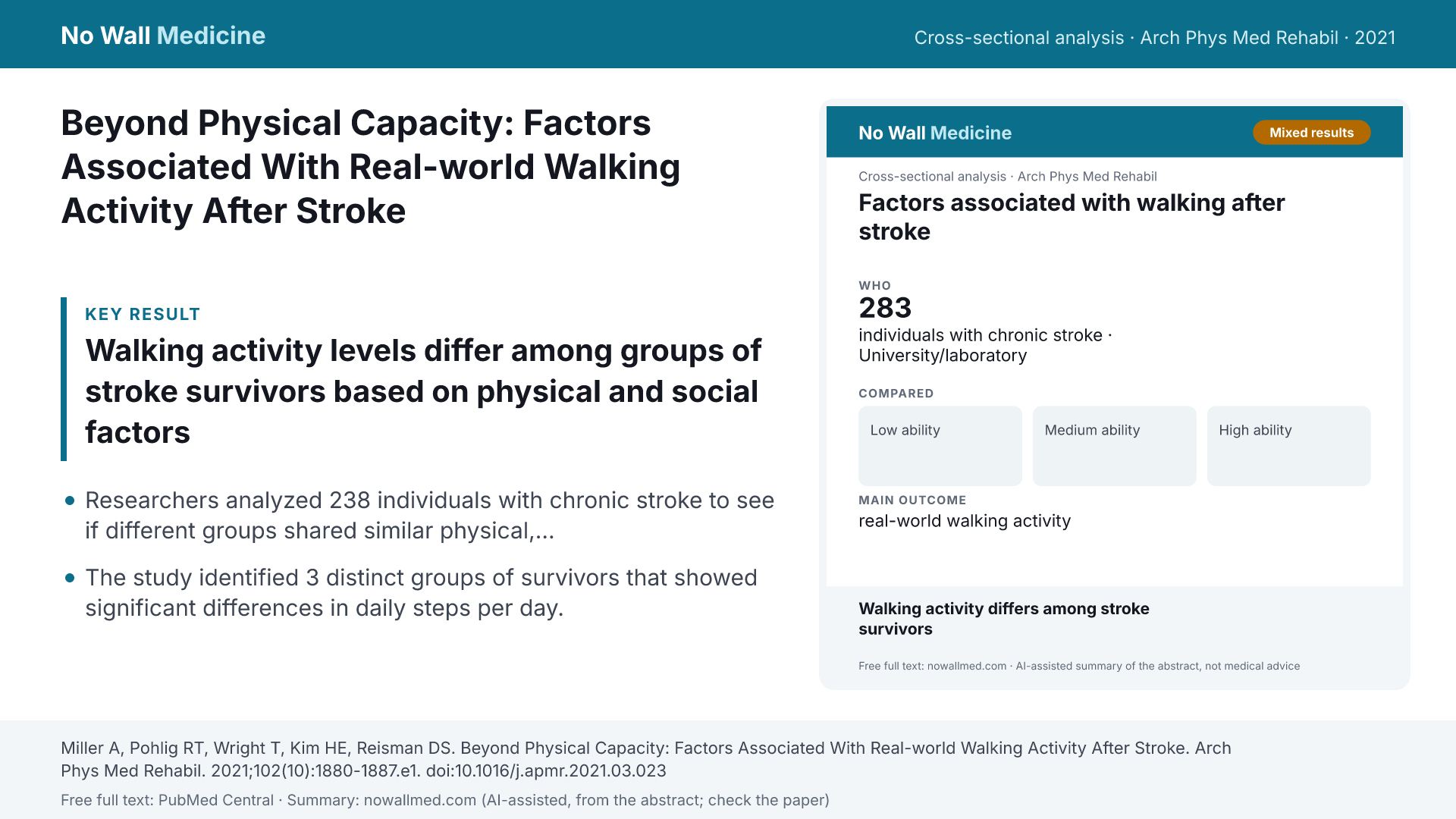
Key result: Walking activity levels differ among groups of stroke survivors based on physical and social factors
Cross-sectional analysisMixed results
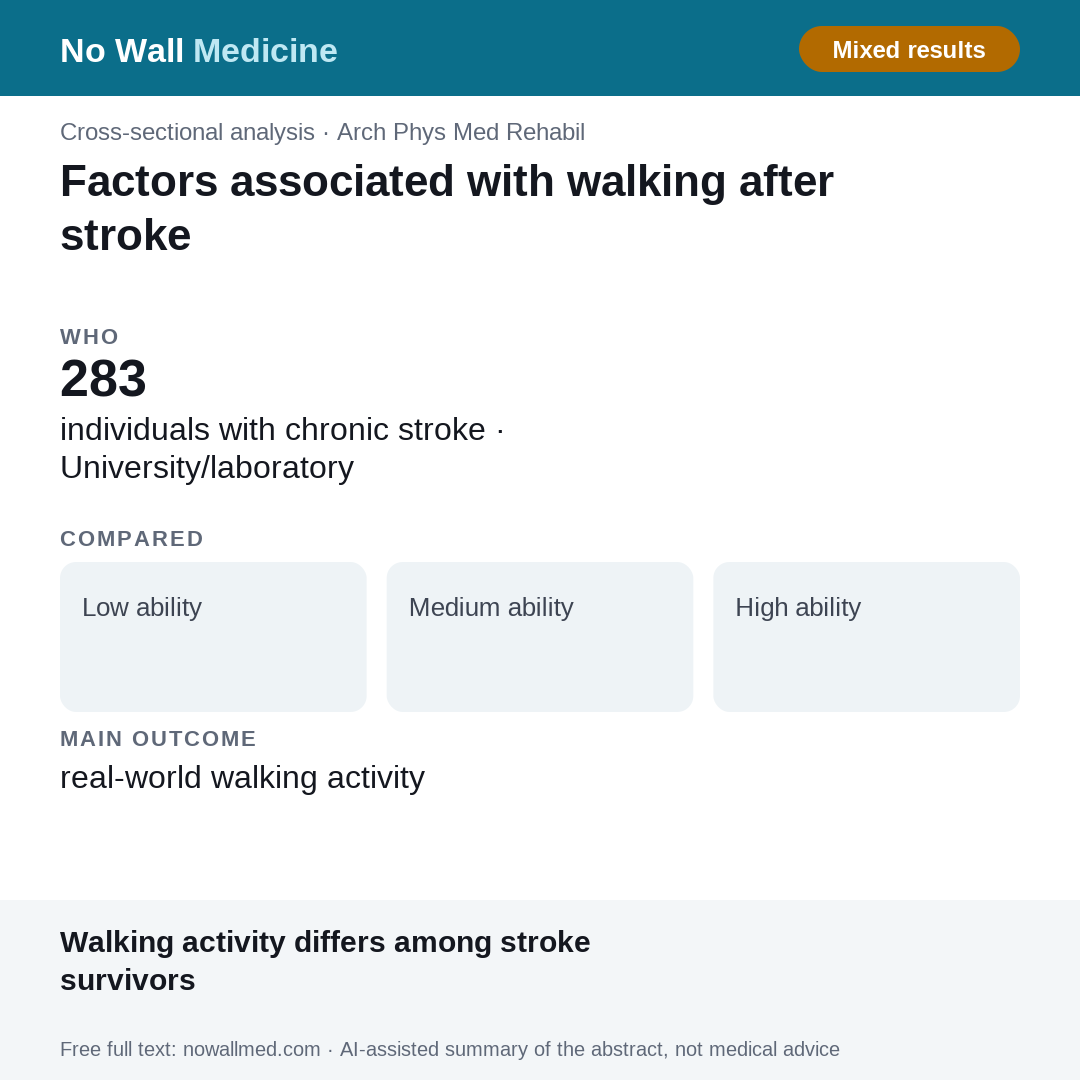
Factors associated with walking after stroke
Who
283
individuals with chronic stroke · University/laboratory
Compared
Low ability
Medium ability
High ability
Main outcome
real-world walking activity
Bottom line: Walking activity differs among stroke survivors
Arch Phys Med Rehabil · 2021-04-21Download image
Key points
- Researchers analyzed 238 individuals with chronic stroke to see if different groups shared similar physical, psychosocial, cognitive, and environmental characteristics.
- The study identified 3 distinct groups of survivors that showed significant differences in daily steps per day.
- Lower walking ability, lower confidence in balance, lower cognitive abilities, and greater area deprivation were associated with lower daily steps per day.
Why it matters: It was unknown how combinations of physical, psychosocial, cognitive, and environmental factors relate to the amount of real-world walking activity performed by stroke survivors.
Discussion prompts
- Would these patients look like yours? Who was left out?
- Is the main outcome one that matters to patients?
- Is the difference large enough to change what you do?
Cite: Miller A, Pohlig RT, Wright T, Kim HE, Reisman DS. Beyond Physical Capacity: Factors Associated With Real-world Walking Activity After Stroke. Arch Phys Med Rehabil. 2021. doi:10.1016/j.apmr.2021.03.023
Free full text: PubMed Central · Summary and visual abstract: nowallmed.com/a/beyond-physical-capacity-factors-associated-with-real-world-walking-hpqbzm/ (AI-assisted from the abstract; check the paper before relying on it).