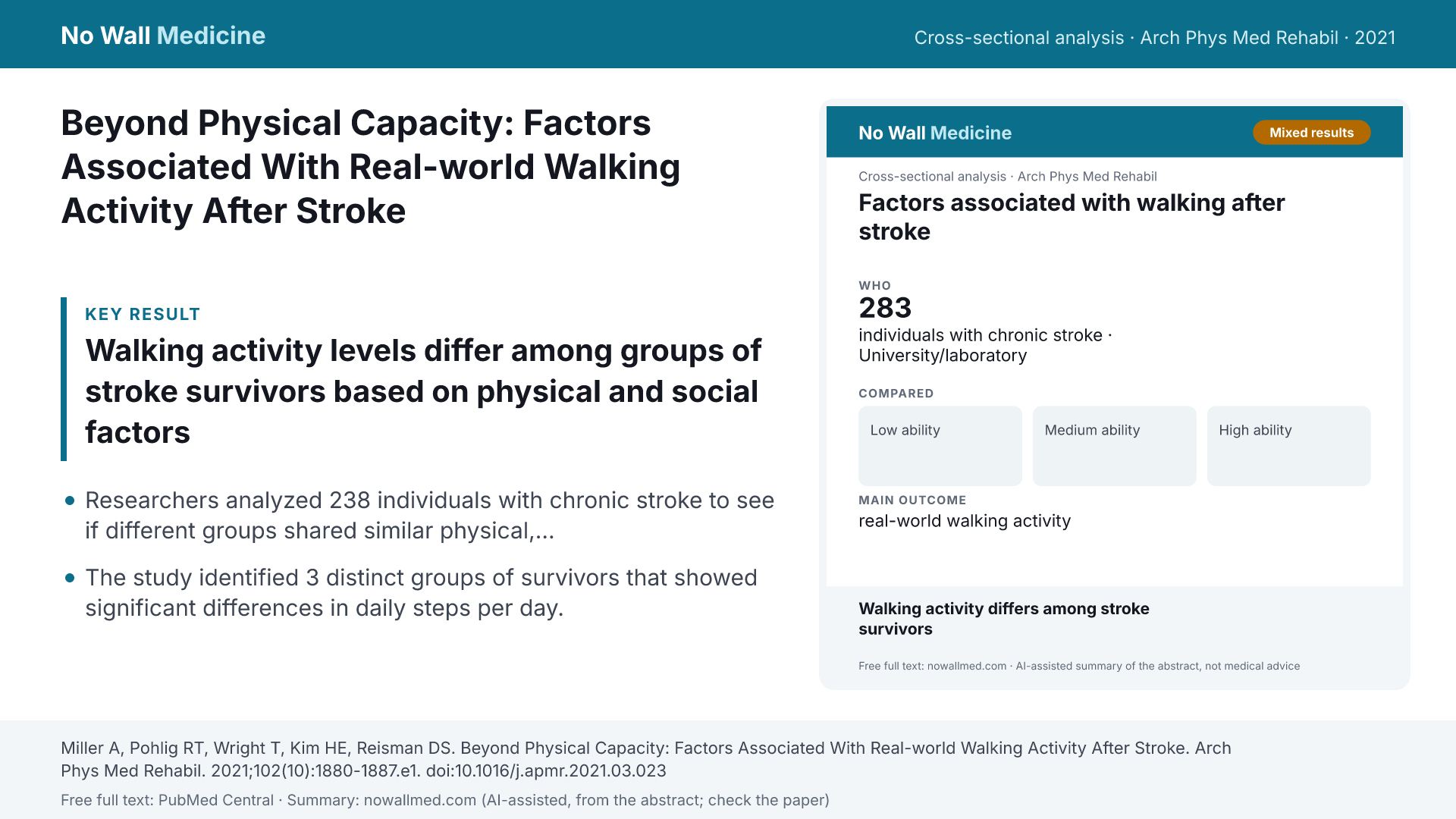
Walking activity levels differ among groups of stroke survivors based on physical and social factors
Beyond Physical Capacity: Factors Associated With Real-world Walking Activity After Stroke
Cross-sectional analysisMixed results
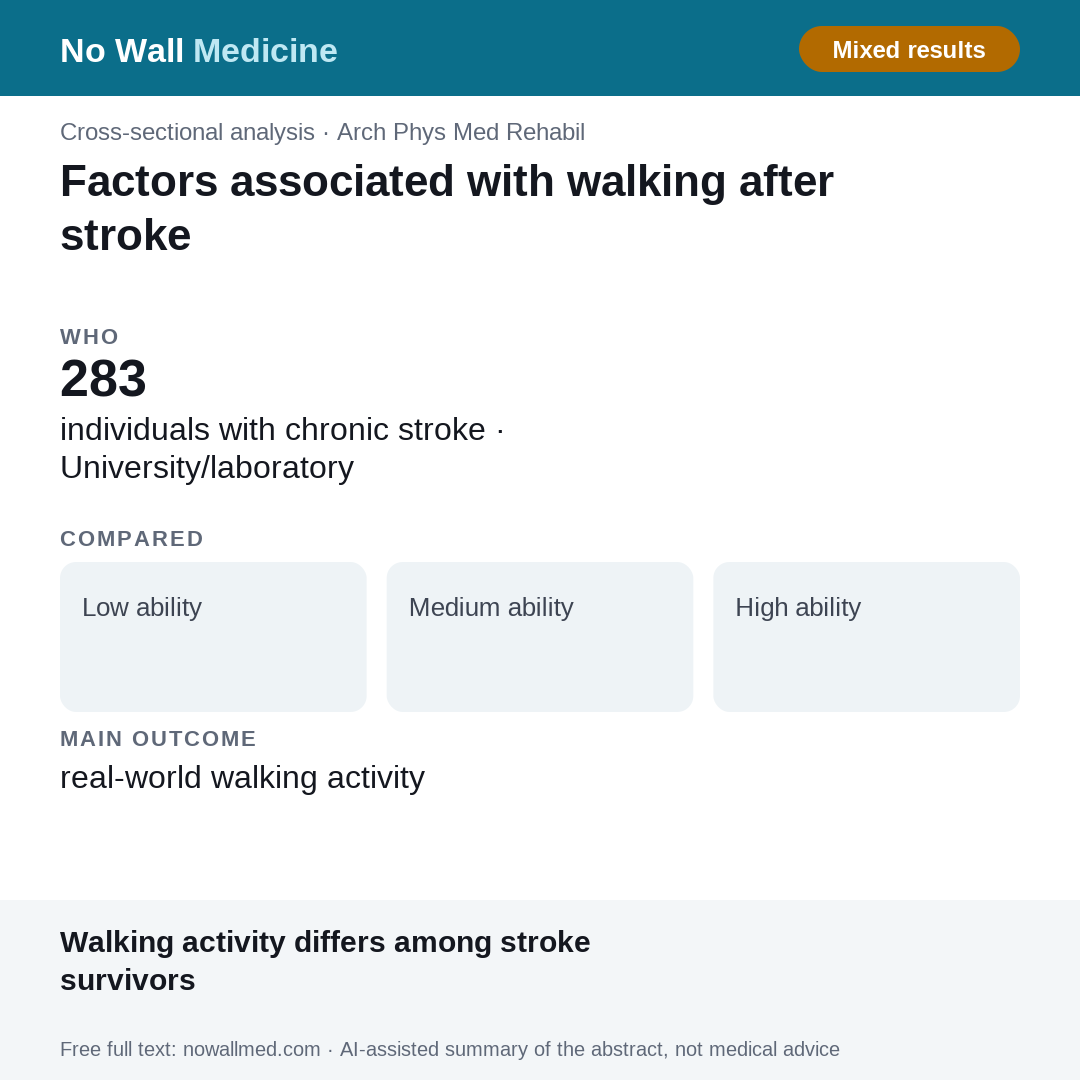
Factors associated with walking after stroke
Who
283
individuals with chronic stroke · University/laboratory
Compared
Low ability
Medium ability
High ability
Main outcome
real-world walking activity
Bottom line: Walking activity differs among stroke survivors
Arch Phys Med Rehabil · 2021-04-21Download image
Why it matters: It was unknown how combinations of physical, psychosocial, cognitive, and environmental factors relate to the amount of real-world walking activity performed by stroke survivors.
Key points
- Researchers analyzed 238 individuals with chronic stroke to see if different groups shared similar physical, psychosocial, cognitive, and environmental characteristics.
- The study identified 3 distinct groups of survivors that showed significant differences in daily steps per day.
- Lower walking ability, lower confidence in balance, lower cognitive abilities, and greater area deprivation were associated with lower daily steps per day.
Headline and key points written with AI from the paper’s abstract, with every number checked against it. Read the paper before relying on them.
Was this summary helpful?
Subject terms
Cite this article
Miller A, Pohlig RT, Wright T, Kim HE, Reisman DS. Beyond Physical Capacity: Factors Associated With Real-world Walking Activity After Stroke. Arch Phys Med Rehabil. 2021. doi:10.1016/j.apmr.2021.03.023
Spotted a mistake? Suggest a correction