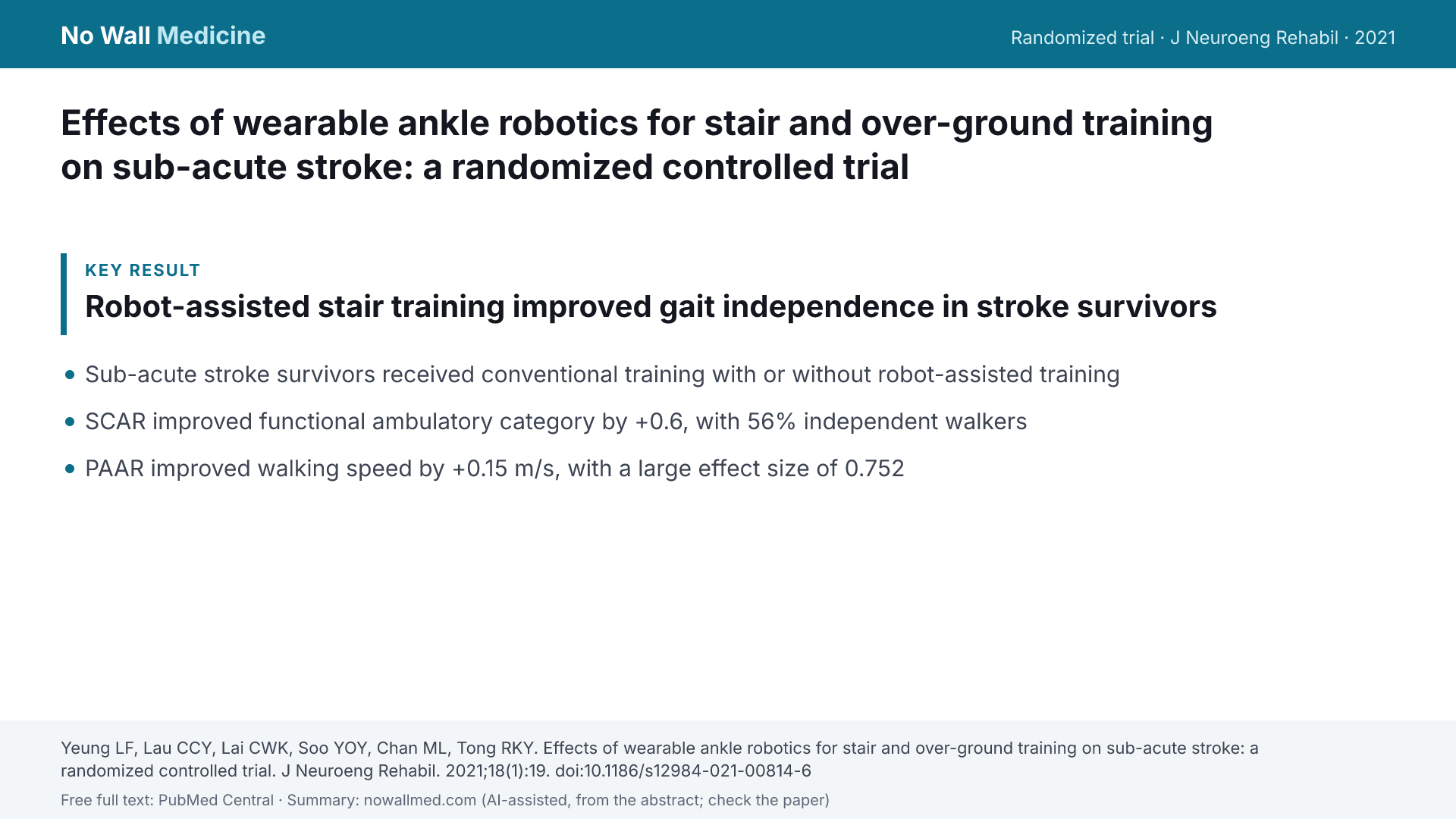
Robot-assisted stair training improved gait independence in stroke survivors
Effects of wearable ankle robotics for stair and over-ground training on sub-acute stroke: a randomized controlled trial
Why it matters: Conventional training effectiveness for stroke rehabilitation was unclear
Key points
- Sub-acute stroke survivors received conventional training with or without robot-assisted training.
- SCAR improved functional ambulatory category by +0.6, with 56% independent walkers.
- PAAR improved walking speed by +0.15 m/s, with a large effect size of 0.752.
Headline and key points written with AI from the paper’s abstract, with every number checked against it. Read the paper before relying on them.
Was this summary helpful?
Subject terms
Cite this article
Yeung LF, Lau CCY, Lai CWK, Soo YOY, Chan ML, Tong RKY. Effects of wearable ankle robotics for stair and over-ground training on sub-acute stroke: a randomized controlled trial. J Neuroeng Rehabil. 2021. doi:10.1186/s12984-021-00814-6
Spotted a mistake? Suggest a correction