Effects of wearable ankle robotics for stair and over-ground training on sub-acute stroke: a randomized controlled trial
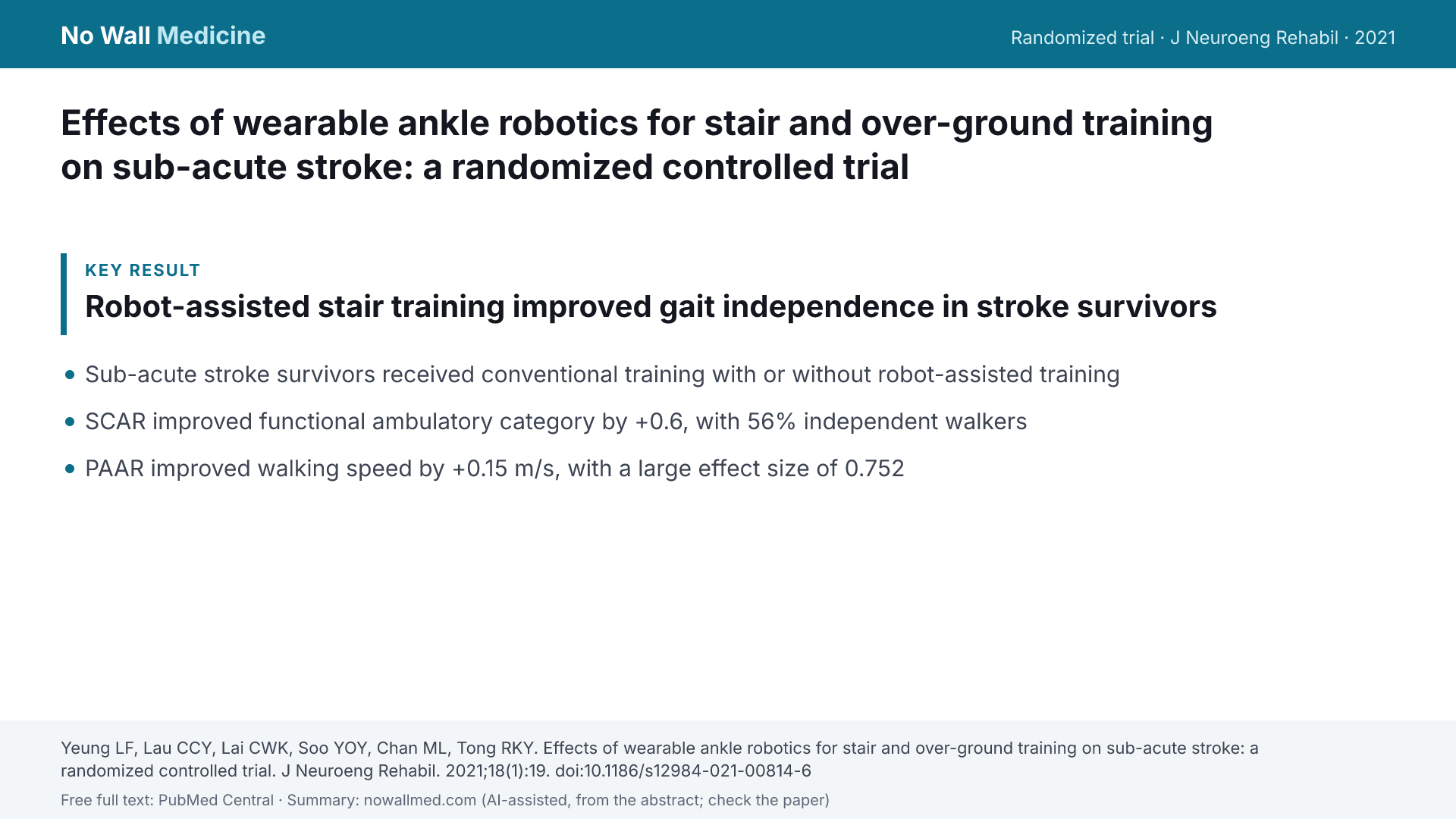
Key result: Robot-assisted stair training improved gait independence in stroke survivors
Key points
- Sub-acute stroke survivors received conventional training with or without robot-assisted training.
- SCAR improved functional ambulatory category by +0.6, with 56% independent walkers.
- PAAR improved walking speed by +0.15 m/s, with a large effect size of 0.752.
Discussion prompts
- Would these patients look like yours? Who was left out?
- Is the main outcome one that matters to patients?
- Is the difference large enough to change what you do?
Cite: Yeung LF, Lau CCY, Lai CWK, Soo YOY, Chan ML, Tong RKY. Effects of wearable ankle robotics for stair and over-ground training on sub-acute stroke: a randomized controlled trial. J Neuroeng Rehabil. 2021;18(1):19. doi:10.1186/s12984-021-00814-6
Free full text: PubMed Central · Summary and visual abstract: nowallmed.com/a/effects-of-wearable-ankle-robotics-for-stair-and-over-ground-training-11mxv7l/ (AI-assisted from the abstract; check the paper before relying on it).