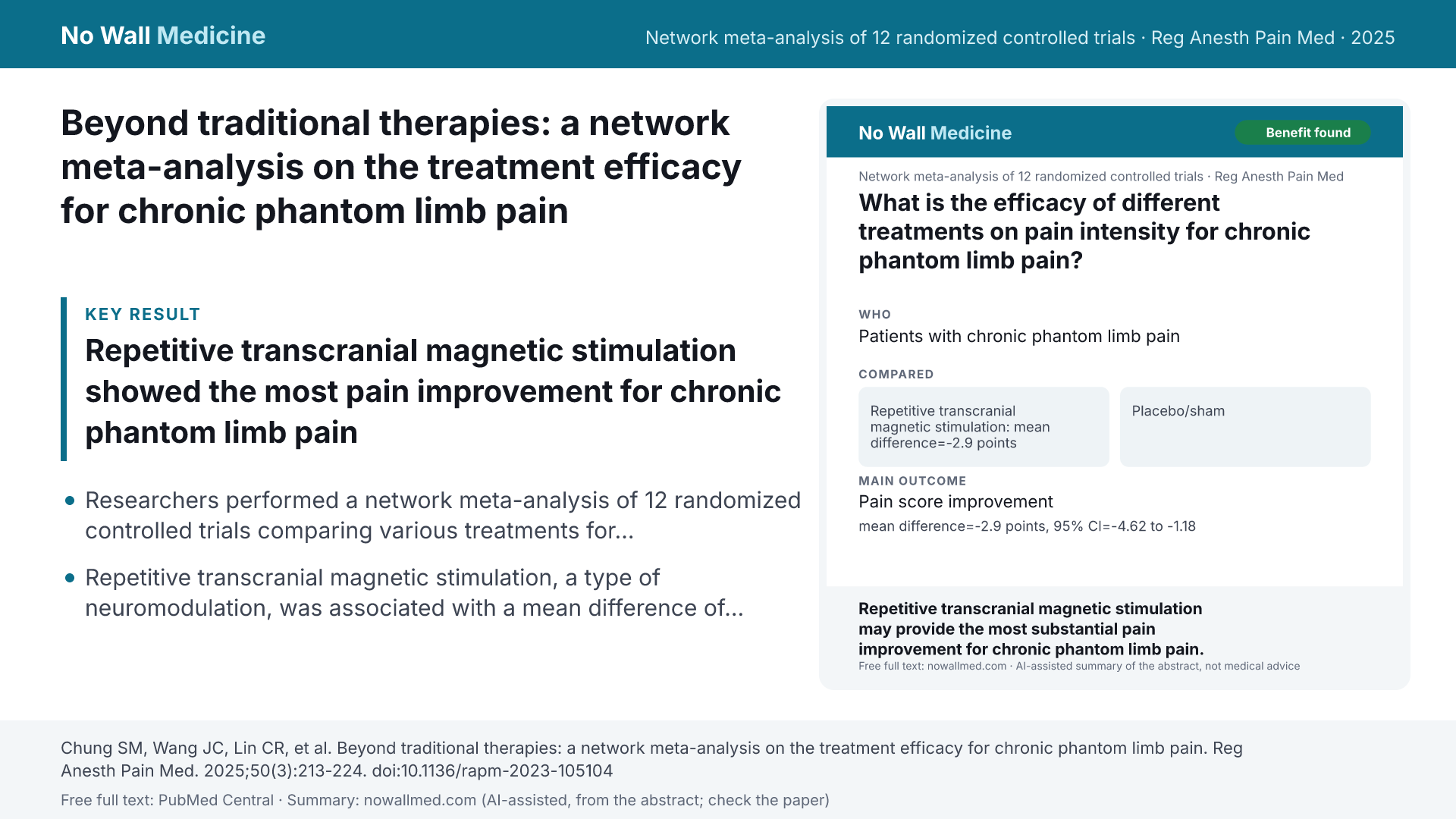
Repetitive transcranial magnetic stimulation showed the most pain improvement for chronic phantom limb pain
Beyond traditional therapies: a network meta-analysis on the treatment efficacy for chronic phantom limb pain
Network meta-analysis of 12 randomized controlled trialsBenefit found
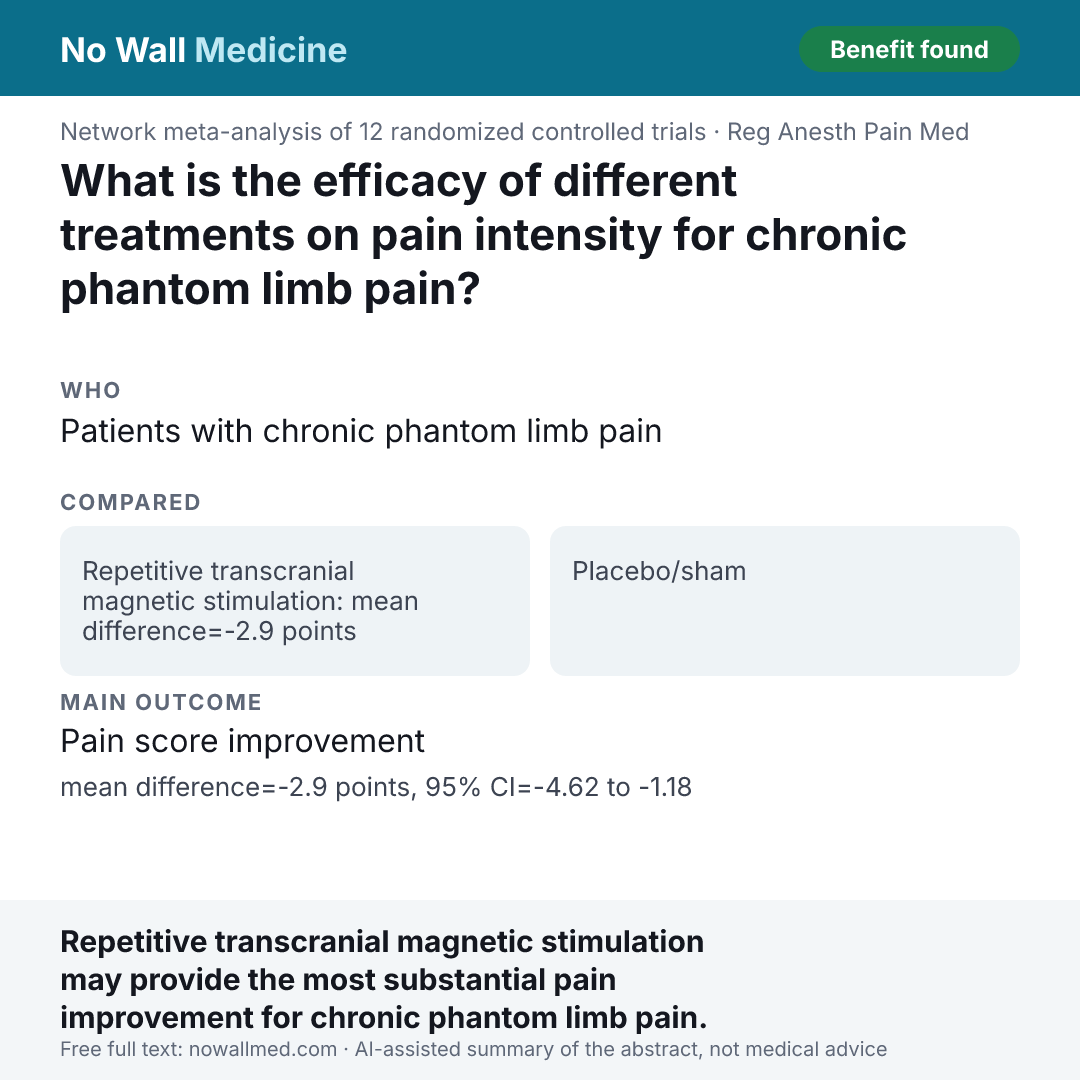
What is the efficacy of different treatments on pain intensity for chronic phantom limb pain?
Who
Patients with chronic phantom limb pain
Compared
Repetitive transcranial magnetic stimulation: mean difference=-2.9 points
Placebo/sham
Main outcome
Pain score improvement
Result: mean difference=-2.9 points, 95% CI=-4.62 to -1.18
Bottom line: Repetitive transcranial magnetic stimulation may provide the most substantial pain improvement for chronic phantom limb pain.
Limitation: Paucity of studies, varying patient characteristics, and absence of long-term results.
Reg Anesth Pain Med · 2025-03-05 · Save PNG
Clinical question: What is the efficacy of different treatments on pain intensity for chronic phantom limb pain?
Why it matters: The optimal intervention for managing chronic phantom limb pain remains unclear because traditional therapies often fail to provide sufficient relief.
Key points
- Researchers performed a network meta-analysis of 12 randomized controlled trials comparing various treatments for chronic phantom limb pain, which is pain felt in a limb that is no longer there.
- Repetitive transcranial magnetic stimulation, a type of neuromodulation, was associated with a mean difference of -2.9 points in pain scores compared to placebo or sham groups.
- The use of morphine was associated with a significant increase in the rate of adverse events with an odds ratio of 6.04.
Limitation the authors note: The authors noted a paucity of studies, varying patient characteristics across trials, and an absence of long-term results.
Headline and key points written with AI from the paper’s abstract, with every number checked against it. Read the paper before relying on them.
Was this summary helpful?
Abstract
Background
Phantom limb pain (PLP) frequently affects individuals with limb amputations. When PLP evolves into its chronic phase, known as chronic PLP, traditional therapies often fall short in providing sufficient relief. The optimal intervention for chronic PLP remains unclear. Objective
The objectives of this network meta-analysis (NMA) were to examine the efficacy of different treatments on pain intensity for patients with chronic PLP. Evidence review
We searched Medline, EMBASE, Cochrane CENTRAL, Scopus, and CINAHL EBSCO, focusing on randomized controlled trials (RCTs) that evaluated interventions such as neuromodulation, neural block, pharmacological methods, and alternative treatments. An NMA was conducted based on the Preferred Reporting Items for Systematic Reviews and Meta-Analyses guidelines. The primary outcome was pain score improvement, and the secondary outcomes were adverse events. Findings
The NMA, incorporating 12 RCTs, indicated that neuromodulation, specifically repetitive transcranial magnetic stimulation, provided the most substantial pain improvement when compared with placebo/sham groups (mean difference=-2.9 points, 95% CI=-4.62 to -1.18; quality of evidence (QoE): moderate). Pharmacological intervention using morphine was associated with a significant increase in adverse event rate (OR=6.04, 95% CI=2.26 to 16.12; QoE: low). Conclusions
The NMA suggests that neuromodulation using repetitive transcranial magnetic stimulation may be associated with significantly larger pain improvement for chronic PLP. However, the paucity of studies, varying patient characteristics across each trial, and absence of long-term results underscore the necessity for more comprehensive, large-scale RCTs. Prospero registration number
CRD42023455949.
Abstract reproduced under the article’s CC BY NC licence.
Subject terms
Headline, design, result, key points, caveat and citation as plain text.
Cite this article
Chung SM, Wang JC, Lin CR, et al. Beyond traditional therapies: a network meta-analysis on the treatment efficacy for chronic phantom limb pain. Reg Anesth Pain Med. 2025;50(3):213-224. doi:10.1136/rapm-2023-105104
Spotted a mistake? Suggest a correction