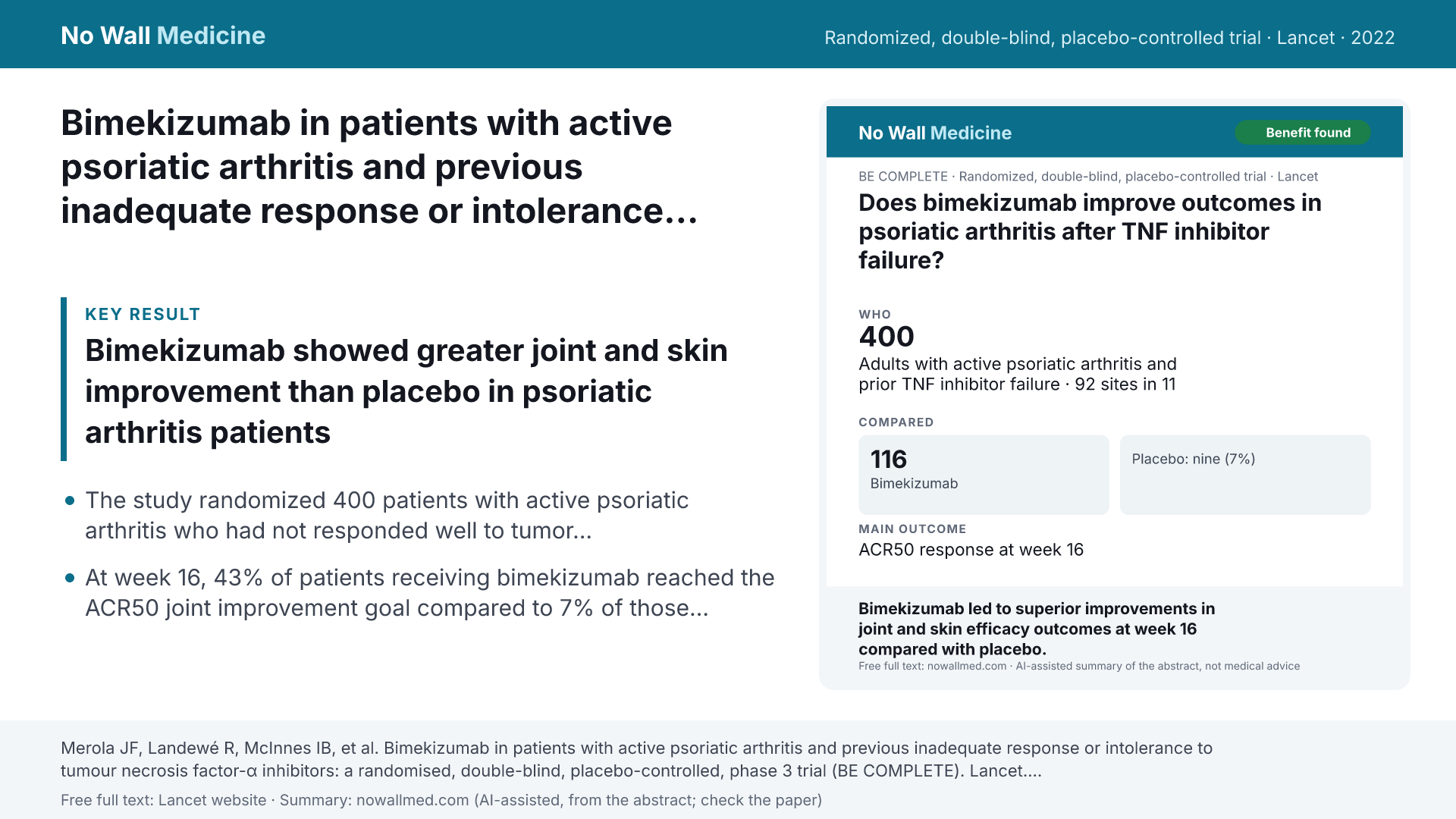
Bimekizumab showed greater joint and skin improvement than placebo in psoriatic arthritis patients
Bimekizumab in patients with active psoriatic arthritis and previous inadequate response or intolerance to tumour necrosis factor-α inhibitors: a randomised, double-blind, placebo-controlled, phase 3 trial (BE COMPLETE)
Same trial (NCT03896581)
Papers we list that report this registered trial, oldest first. Read a secondary analysis alongside the main results.
- Main results
This paper Lancet 2022-12 - Longer follow-up Benefit found
Bimekizumab was associated with sustained improvements in disease impact for patients with psoriatic arthritis Rheumatology 2024-05 - Related analysis Benefit found
Bimekizumab improved pain and fatigue in psoriatic arthritis patients by week 4 RMD Open 2024-09 - Longer follow-up Benefit found
Bimekizumab showed sustained efficacy and safety for three years in patients with psoriatic arthritis Rheumatology 2026-03 - Secondary analysis
Bimekizumab linked to sustained joint and skin improvement in psoriatic arthritis patients Rheumatology 2026-10
Why it matters: Patients with psoriatic arthritis who do not respond to or cannot tolerate tumor necrosis factor-alpha inhibitors need alternative treatment options.
Key points
- The study randomized 400 patients with active psoriatic arthritis who had not responded well to tumor necrosis factor-alpha inhibitors to receive bimekizumab or a placebo.
- At week 16, 43% of patients receiving bimekizumab reached the ACR50 joint improvement goal compared to 7% of those receiving placebo.
- Among patients with significant psoriasis, 69% of those receiving bimekizumab reached the PASI90 skin clearance goal compared to 7% of those receiving placebo.
Headline and key points written with AI from the paper’s abstract, with every number checked against it. Read the paper before relying on them.
Was this summary helpful?
Abstract
Background
Bimekizumab is a monoclonal IgG1 antibody that selectively inhibits interleukin (IL)-17F and IL-17A. This study compared the efficacy and safety of bimekizumab with placebo over 16 weeks in patients with active psoriatic arthritis and previous inadequate response or intolerance to tumour necrosis factor-α (TNFα) inhibitors. Methods
BE COMPLETE was a phase 3, multicentre, randomised, double-blind, placebo-controlled trial conducted across 92 sites (including hospitals, clinics, and research centres) in 11 countries (Australia, Canada, Czech Republic, Germany, Hungary, Italy, Japan, Poland, Russia, the UK, and the USA). Eligible patients were aged 18 years or older with adult-onset psoriatic arthritis (meeting the Classification Criteria for Psoriatic Arthritis for at least 6 months before screening) with a history of inadequate response or intolerance to treatment with one or two TNFα inhibitors for either psoriatic arthritis or psoriasis. We stratified patients with active psoriatic arthritis by region and previous TNFα inhibitor use. Patients were randomly assigned (2:1) to receive subcutaneous bimekizumab 160 mg every 4 weeks or placebo by an interactive-voice and web-response system on the basis of a predetermined randomisation schedule. The primary endpoint was the proportion of patients with 50% or greater improvement in American College of Rheumatology criteria (ACR50) at week 16 (non-responder imputation). Efficacy analyses were done in the randomised population. The safety analysis set comprised patients who received one or more doses of study treatment. This trial was registered at ClinicalTrials.gov, NCT03896581, and is completed. Findings
Between March 28, 2019, and Feb 14, 2022, 556 patients were screened and 400 patients were randomly assigned to bimekizumab 160 mg every 4 weeks (n=267) or placebo (n=133). The primary and all hierarchical secondary endpoints were met at week 16. 116 (43%) of 267 patients receiving bimekizumab reached ACR50, compared with nine (7%) of 133 patients receiving placebo (adjusted odds ratio [OR] 11·1 [95% CI 5·4-23·0], p<0·0001). 121 (69%) of 176 patients with psoriasis affecting at least 3% body surface area at baseline who received bimekizumab reached 90% or greater improvement in the Psoriasis Area and Severity Index (PASI90), compared with six (7%) of 88 patients who received placebo (adjusted OR 30·2 [12·4-73·9], p<0·0001). Treatment-emergent adverse events up to week 16 were reported in 108 (40%) of 267 patients receiving bimekizumab and 44 (33%) of 132 patients receiving placebo. There were no new safety signals and no deaths. Interpretation
Bimekizumab treatment led to superior improvements in joint and skin efficacy outcomes at week 16 compared with placebo in patients with psoriatic arthritis and inadequate response or intolerance to TNFα inhibitors. The safety profile of bimekizumab was consistent with previous phase 3 studies in patients with plaque psoriasis, and studies of IL-17A inhibitors. Funding
UCB Pharma.
Abstract reproduced under the article’s CC BY NC ND licence.
Subject terms
Headline, design, result, key points, caveat and citation as plain text.
Cite this article
Merola JF, Landewé R, McInnes IB, et al. Bimekizumab in patients with active psoriatic arthritis and previous inadequate response or intolerance to tumour necrosis factor-α inhibitors: a randomised, double-blind, placebo-controlled, phase 3 trial (BE COMPLETE). Lancet. 2023;401(10370):38-48. doi:10.1016/S0140-6736(22)02303-0
Spotted a mistake? Suggest a correction