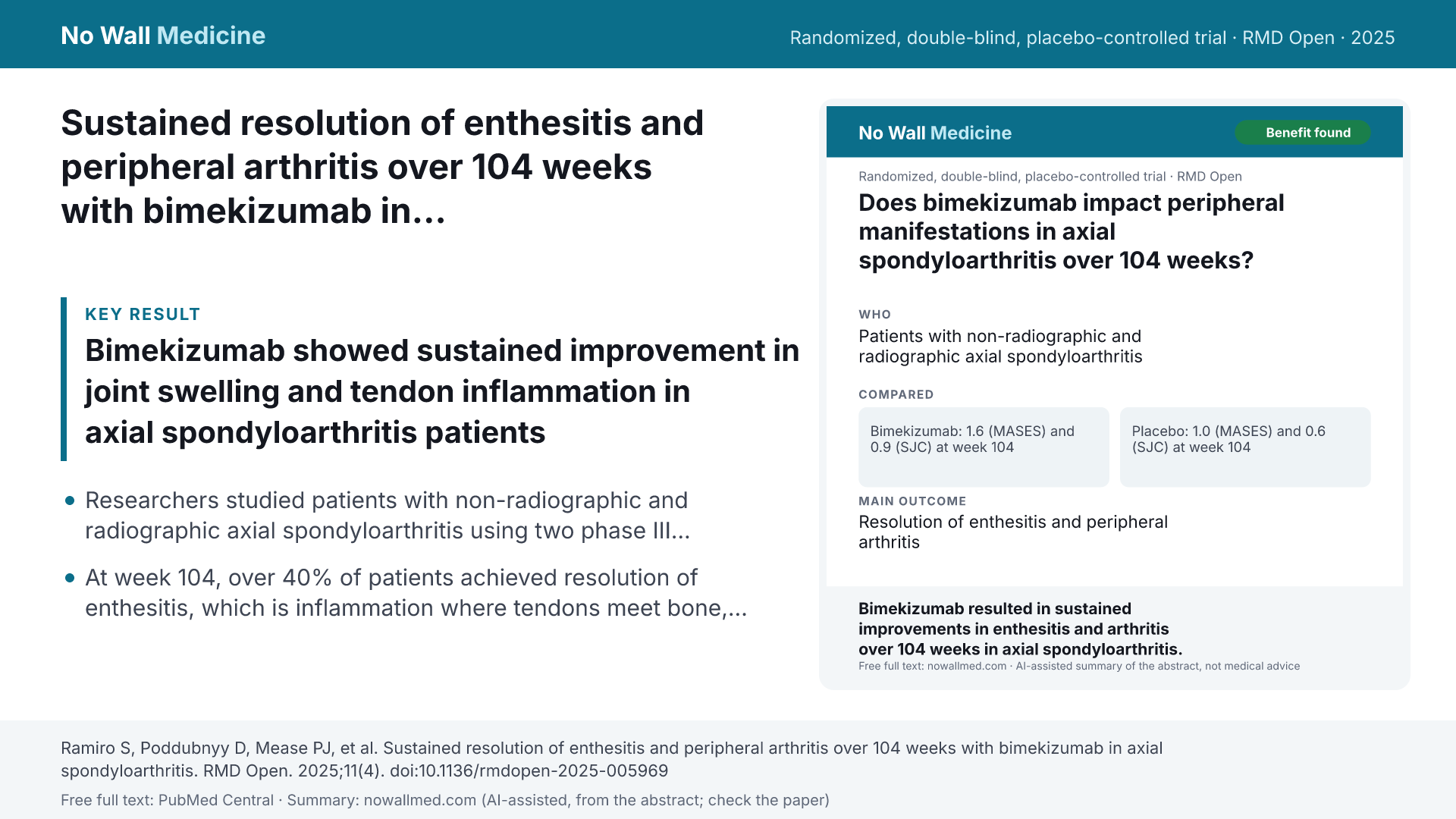
Bimekizumab showed sustained improvement in joint swelling and tendon inflammation in axial spondyloarthritis patients
Sustained resolution of enthesitis and peripheral arthritis over 104 weeks with bimekizumab in axial spondyloarthritis
Randomized, double-blind, placebo-controlled trialBenefit found
Does bimekizumab impact peripheral manifestations in axial spondyloarthritis over 104 weeks?
Who
Patients with non-radiographic and radiographic axial spondyloarthritis
Compared
Bimekizumab: 1.6 (MASES) and 0.9 (SJC) at week 104
Placebo: 1.0 (MASES) and 0.6 (SJC) at week 104
Main outcome
Resolution of enthesitis and peripheral arthritis
Bottom line: Bimekizumab resulted in sustained improvements in enthesitis and arthritis over 104 weeks in axial spondyloarthritis.
RMD Open · 2025-10-22 · Save PNG
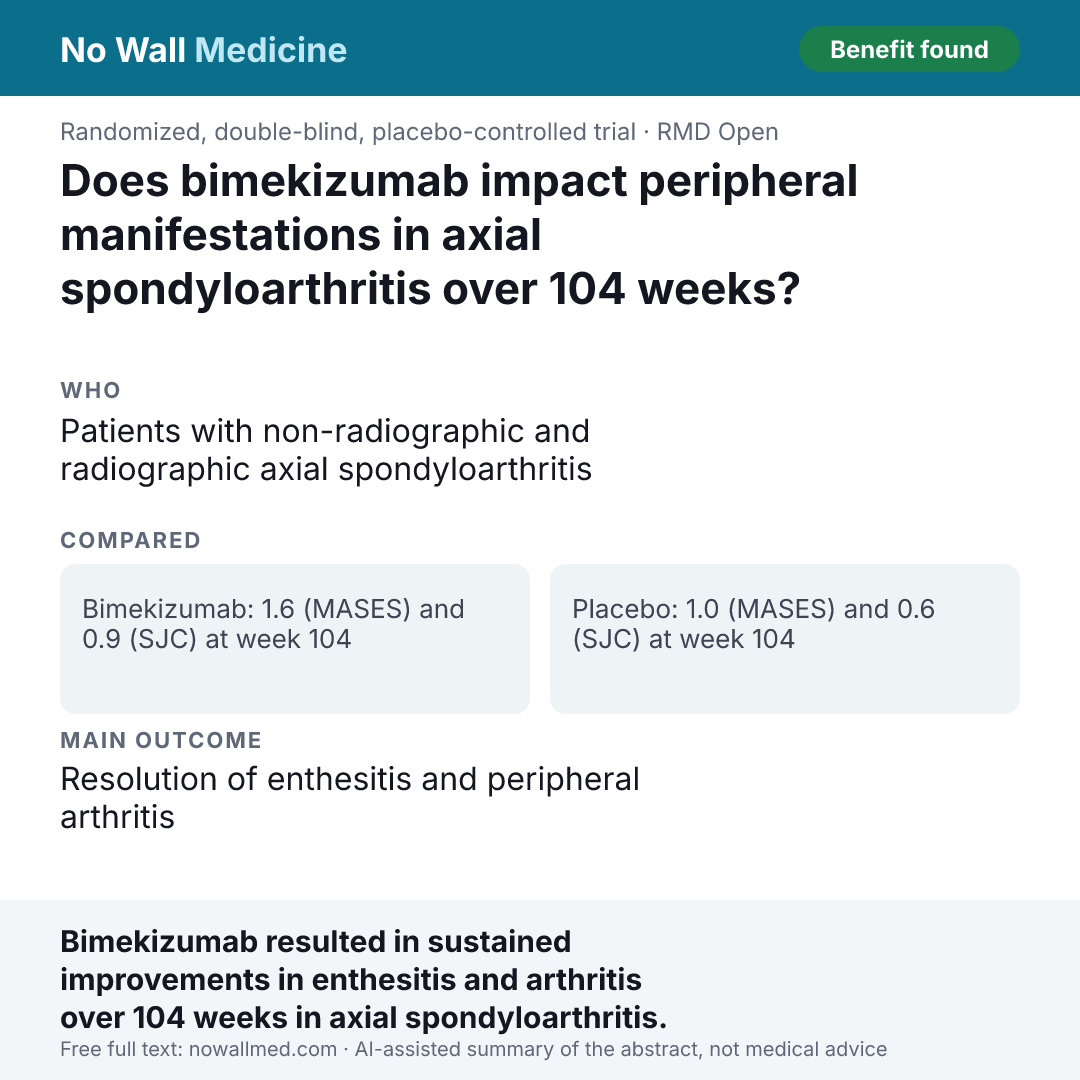
Clinical question: Does bimekizumab impact peripheral manifestations in axial spondyloarthritis over 104 weeks?
Why it matters: The impact of bimekizumab on peripheral manifestations like joint swelling and tendon inflammation over 104 weeks needed to be assessed.
Key points
- Researchers studied patients with non-radiographic and radiographic axial spondyloarthritis using two phase III trials over 104 weeks.
- At week 104, over 40% of patients achieved resolution of enthesitis, which is inflammation where tendons meet bone, and over 60% achieved resolution of arthritis.
- More than 60% of patients reached low disease activity or remission based on the Disease Activity Index for Psoriatic Arthritis by week 52.
Headline and key points written with AI from the paper’s abstract, with every number checked against it. Read the paper before relying on them.
Was this summary helpful?
Abstract
Background
Bimekizumab (BKZ), a monoclonal IgG1 antibody that selectively inhibits interleukin (IL)-17F in addition to IL-17A, has demonstrated 2-year efficacy in non-radiographic axial spondyloarthritis (nr-axSpA) and radiographic axSpA (r-axSpA) phase III studies. Objective
Assess the impact of BKZ on peripheral manifestations to week 104 of those studies. Methods
BE MOBILE 1 (nr-axSpA) and 2 (r-axSpA) each comprised a 16-week double-blind, placebo-controlled period, then all received BKZ 160 mg every 4 weeks for 36 weeks. Patients not meeting withdrawal criteria could enter a combined open-label extension. We report change in enthesitis (Maastricht Ankylosing Spondylitis Enthesitis Score (MASES)) in patients with baseline MASES>0, peripheral arthritis (swollen joint count (SJC)/Disease Activity Index for Psoriatic Arthritis (DAPSA)) in patients with baseline SJC>0 and proportions achieving DAPSA disease states to week 104. Resolution of enthesitis (MASES=0)/arthritis (SJC=0) is reported to week 104 for those with baseline enthesitis/arthritis. We also report associations between peripheral manifestation resolution (MASES=0/SJC=0) and week 104 clinical outcomes in those with baseline enthesitis/arthritis. Results
At baseline, 186/254 (73.2%) and 88/254 (34.6%) patients with nr-axSpA had enthesitis (MASES>0) and arthritis (SJC>0), respectively, compared with 199/332 (59.9%) and 66/332 (19.9%) patients with r-axSpA. Pooled BKZ/placebo-randomised patients with enthesitis (nr-axSpA/r-axSpA) showed average MASES improvement from 4.8/4.3 (baseline) to 1.6/1.3 (week 52) and 1.6/1.0 (week 104). Pooled BKZ/placebo-randomised patients with arthritis showed average SJC improvement from 4.0/4.5 (baseline) to 1.2/0.7 (week 52) and 0.9/0.6 (week 104). Over 60% of patients achieved DAPSA low disease activity/remission by week 52. Over 40%/60% patients achieved resolution of enthesitis (MASES=0)/arthritis (SJC=0) at week 104; enthesitis resolution was associated with larger improvements in week 104 clinical outcomes for patients with r-axSpA. Conclusion
BKZ resulted in sustained improvements in peripheral manifestations to 2 years across the full disease spectrum of axSpA.
Abstract reproduced under the article’s CC BY NC licence.
Subject terms
Headline, design, result, key points, caveat and citation as plain text.
Cite this article
Ramiro S, Poddubnyy D, Mease PJ, et al. Sustained resolution of enthesitis and peripheral arthritis over 104 weeks with bimekizumab in axial spondyloarthritis. RMD Open. 2025;11(4). doi:10.1136/rmdopen-2025-005969
Spotted a mistake? Suggest a correction