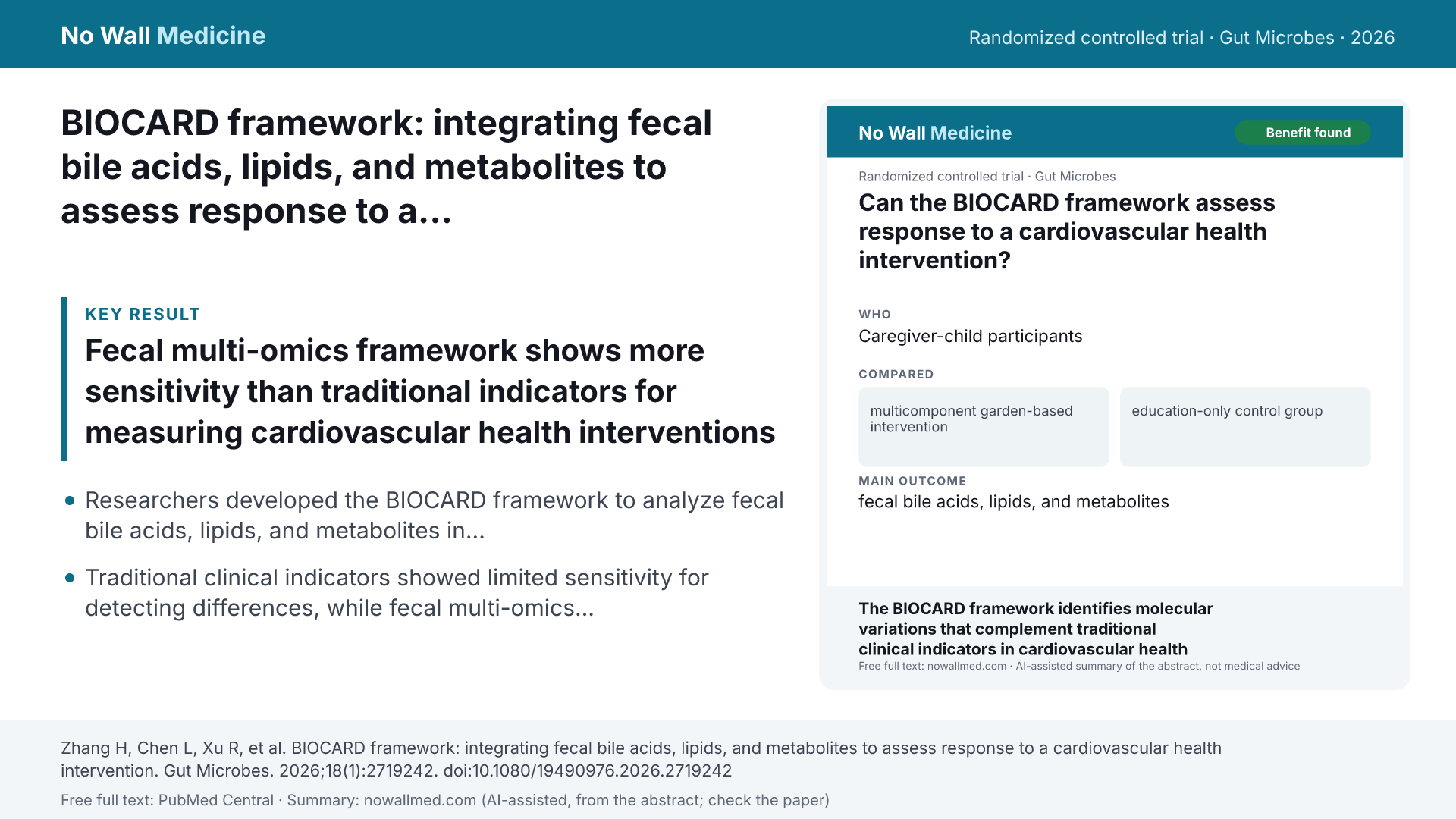
BIOCARD framework: integrating fecal bile acids, lipids, and metabolites to assess response to a cardiovascular health intervention
Key result: Fecal multi-omics framework shows more sensitivity than traditional indicators for measuring cardiovascular health interventions
Key points
- Researchers developed the BIOCARD framework to analyze fecal bile acids, lipids, and metabolites in caregiver-child participants during a 10-week randomized controlled trial.
- Traditional clinical indicators showed limited sensitivity for detecting differences, while fecal multi-omics revealed intervention-associated differences in metabolites, lipids, and bile acids.
- Children showed more apparent molecular variation than parents, and network analysis linked molecular features to blood pressure, body fat, and skin carotenoids.
Why it matters: Conventional clinical and behavioral indicators may not fully capture early molecular responses when evaluating the outcomes of nutritional interventions for cardiovascular disease.
Discussion prompts
- Would these patients look like yours? Who was left out?
- Is the main outcome one that matters to patients?
- Is the difference large enough to change what you do?
Cite: Zhang H, Chen L, Xu R, et al. BIOCARD framework: integrating fecal bile acids, lipids, and metabolites to assess response to a cardiovascular health intervention. Gut Microbes. 2026;18(1):2719242. doi:10.1080/19490976.2026.2719242
Free full text: PubMed Central · Summary and visual abstract: nowallmed.com/a/biocard-framework-integrating-fecal-bile-acids-lipids-and-metabolites-1f21cl4/ (AI-assisted from the abstract; check the paper before relying on it).