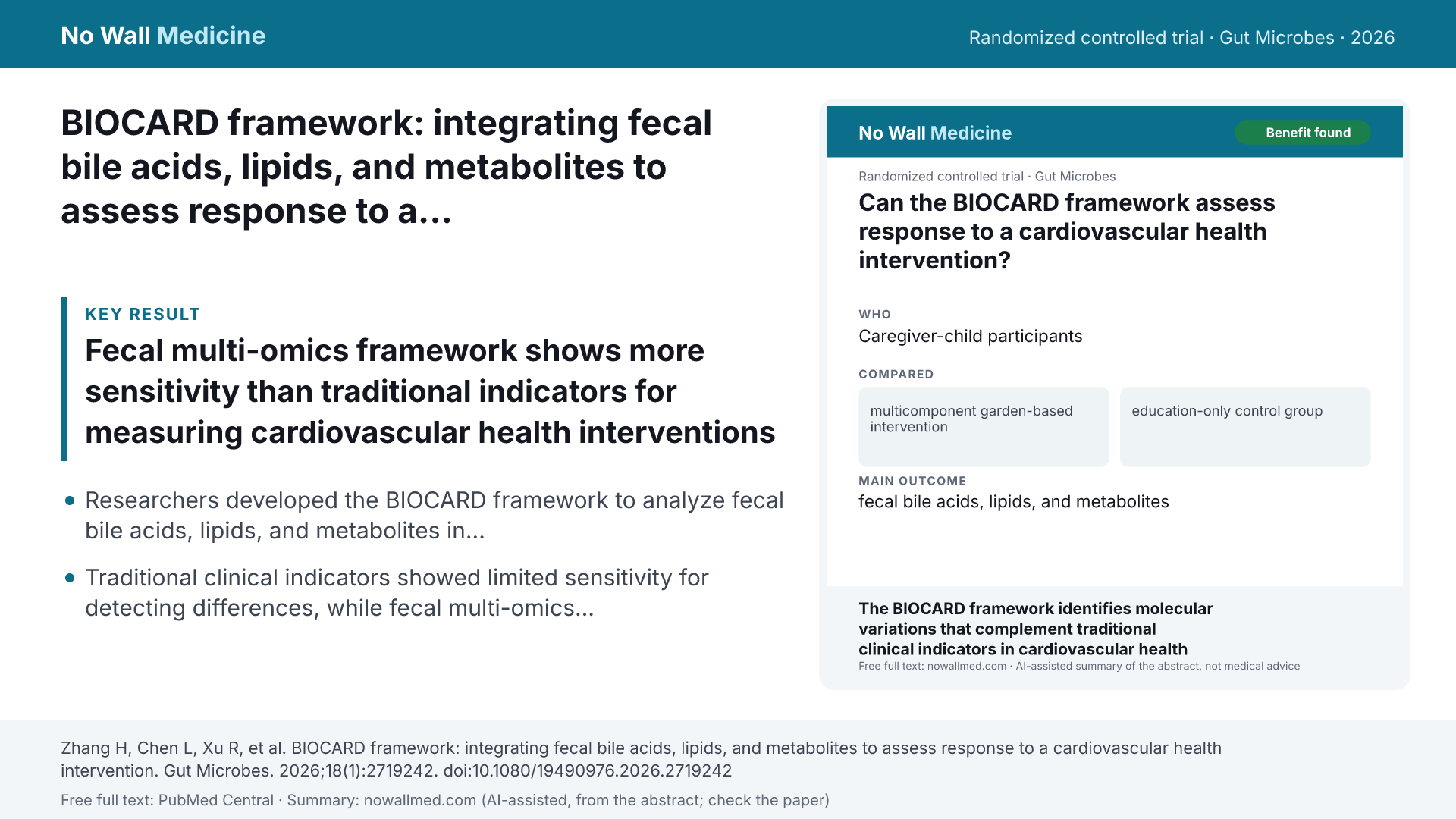
Fecal multi-omics framework shows more sensitivity than traditional indicators for measuring cardiovascular health interventions
BIOCARD framework: integrating fecal bile acids, lipids, and metabolites to assess response to a cardiovascular health intervention
Randomized controlled trialBenefit found
Can the BIOCARD framework assess response to a cardiovascular health intervention?
Who
Caregiver-child participants
Compared
multicomponent garden-based intervention
education-only control group
Main outcome
fecal bile acids, lipids, and metabolites
Bottom line: The BIOCARD framework identifies molecular variations that complement traditional clinical indicators in cardiovascular health interventions.
Limitation: Traditional clinical indicators showed limited sensitivity for detecting intervention-related differences.
Gut Microbes · 2026-08-21Download image

Clinical question: Can the BIOCARD framework assess response to a cardiovascular health intervention?
Why it matters: Conventional clinical and behavioral indicators may not fully capture early molecular responses when evaluating the outcomes of nutritional interventions for cardiovascular disease.
Key points
- Researchers developed the BIOCARD framework to analyze fecal bile acids, lipids, and metabolites in caregiver-child participants during a 10-week randomized controlled trial.
- Traditional clinical indicators showed limited sensitivity for detecting differences, while fecal multi-omics revealed intervention-associated differences in metabolites, lipids, and bile acids.
- Children showed more apparent molecular variation than parents, and network analysis linked molecular features to blood pressure, body fat, and skin carotenoids.
Headline and key points written with AI from the paper’s abstract, with every number checked against it. Read the paper before relying on them.
Was this summary helpful?
Subject terms
Cite this article
Zhang H, Chen L, Xu R, et al. BIOCARD framework: integrating fecal bile acids, lipids, and metabolites to assess response to a cardiovascular health intervention. Gut Microbes. 2026. doi:10.1080/19490976.2026.2719242
Spotted a mistake? Suggest a correction