Biodegradable-Polymer or Durable-Polymer Stents in Patients at High Bleeding Risk: A Randomized, Open-Label Clinical Trial
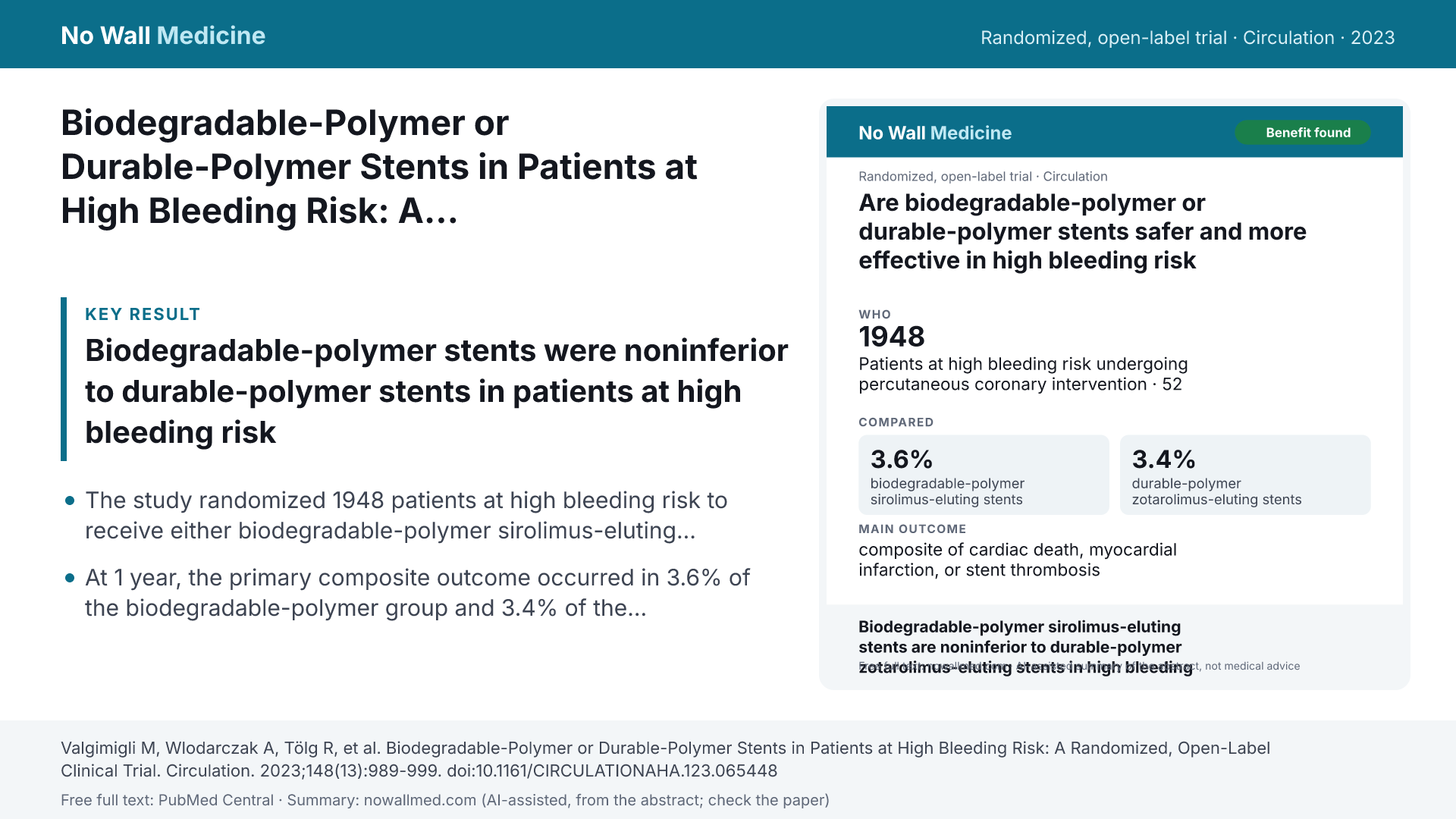
Key result: Biodegradable-polymer stents were noninferior to durable-polymer stents in patients at high bleeding risk
Randomized, open-label trialBenefit found
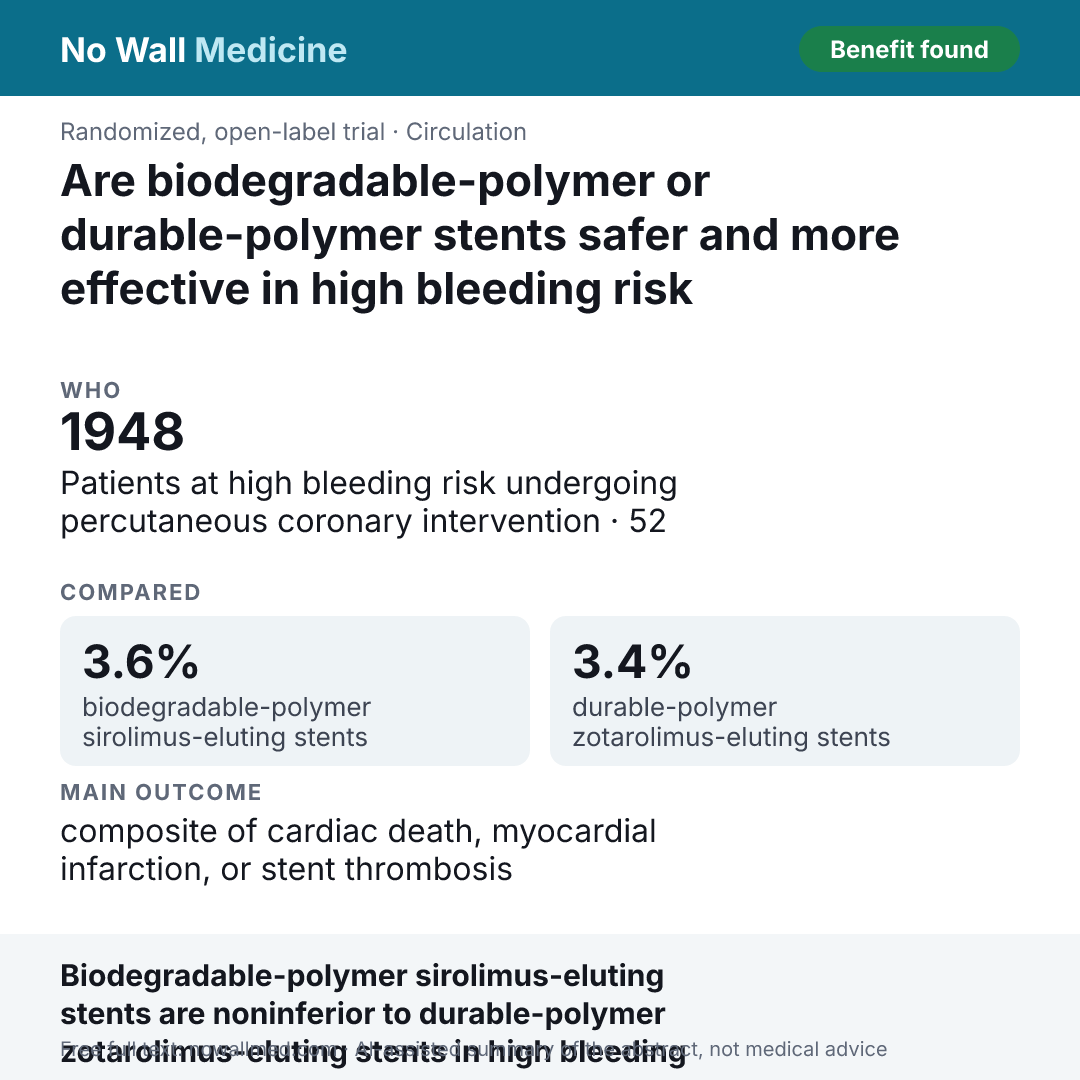
Are biodegradable-polymer or durable-polymer stents safer and more effective in high bleeding risk patients?
Who
1948
Patients at high bleeding risk undergoing percutaneous coronary intervention · 52 hospitals in 18 countries
Compared
3.6%biodegradable-polymer sirolimus-eluting stents (33/969)
3.4%durable-polymer zotarolimus-eluting stents (32/979)
Main outcome
composite of cardiac death, myocardial infarction, or stent thrombosis
Result: risk difference, 0.2 percentage points; upper boundary of the 1-sided 95% CI, 1.8
Bottom line: Biodegradable-polymer sirolimus-eluting stents are noninferior to durable-polymer zotarolimus-eluting stents in high bleeding risk patients.
Circulation · 2023-08-25 · Save PNG
Key points
- The study randomized 1948 patients at high bleeding risk to receive either biodegradable-polymer sirolimus-eluting stents or durable-polymer zotarolimus-eluting stents after a procedure to open blocked heart arteries.
- At 1 year, the primary composite outcome occurred in 3.6% of the biodegradable-polymer group and 3.4% of the durable-polymer group.
- The results showed that biodegradable-polymer stents were noninferior to durable-polymer stents regarding cardiac death, heart attack, or stent thrombosis.
Discussion prompts
- Would these patients look like yours? Who was left out?
- Is the main outcome one that matters to patients?
- Is the difference large enough to change what you do?
Cite: Valgimigli M, Wlodarczak A, Tölg R, et al. Biodegradable-Polymer or Durable-Polymer Stents in Patients at High Bleeding Risk: A Randomized, Open-Label Clinical Trial. Circulation. 2023;148(13):989-999. doi:10.1161/CIRCULATIONAHA.123.065448
Free full text: PubMed Central · Summary and visual abstract: nowallmed.com/a/biodegradable-polymer-or-durable-polymer-stents-in-patients-at-high-1gy6z9m/ (AI-assisted from the abstract; check the paper before relying on it).