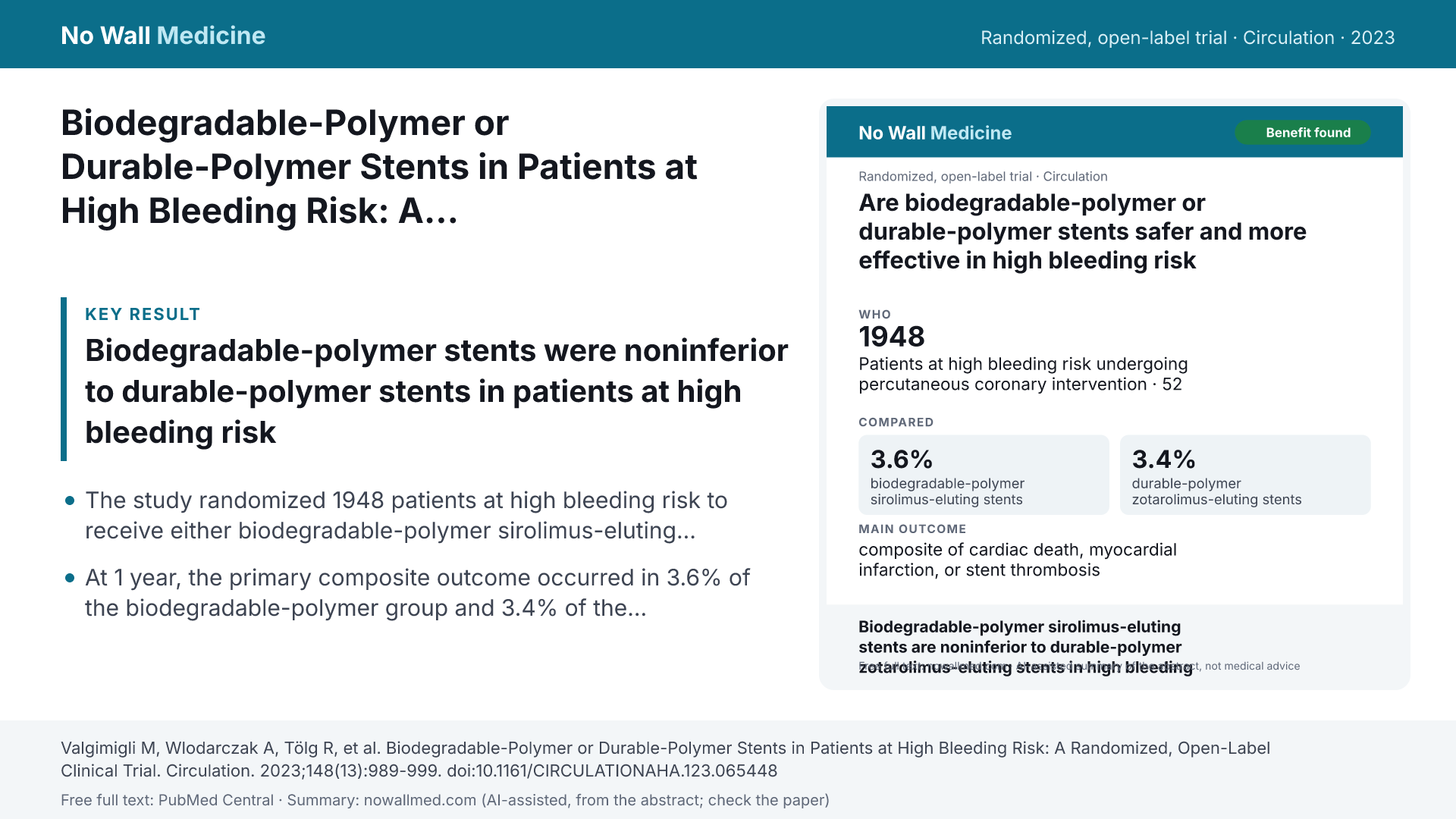
Biodegradable-polymer stents were noninferior to durable-polymer stents in patients at high bleeding risk
Biodegradable-Polymer or Durable-Polymer Stents in Patients at High Bleeding Risk: A Randomized, Open-Label Clinical Trial
Randomized, open-label trialBenefit found
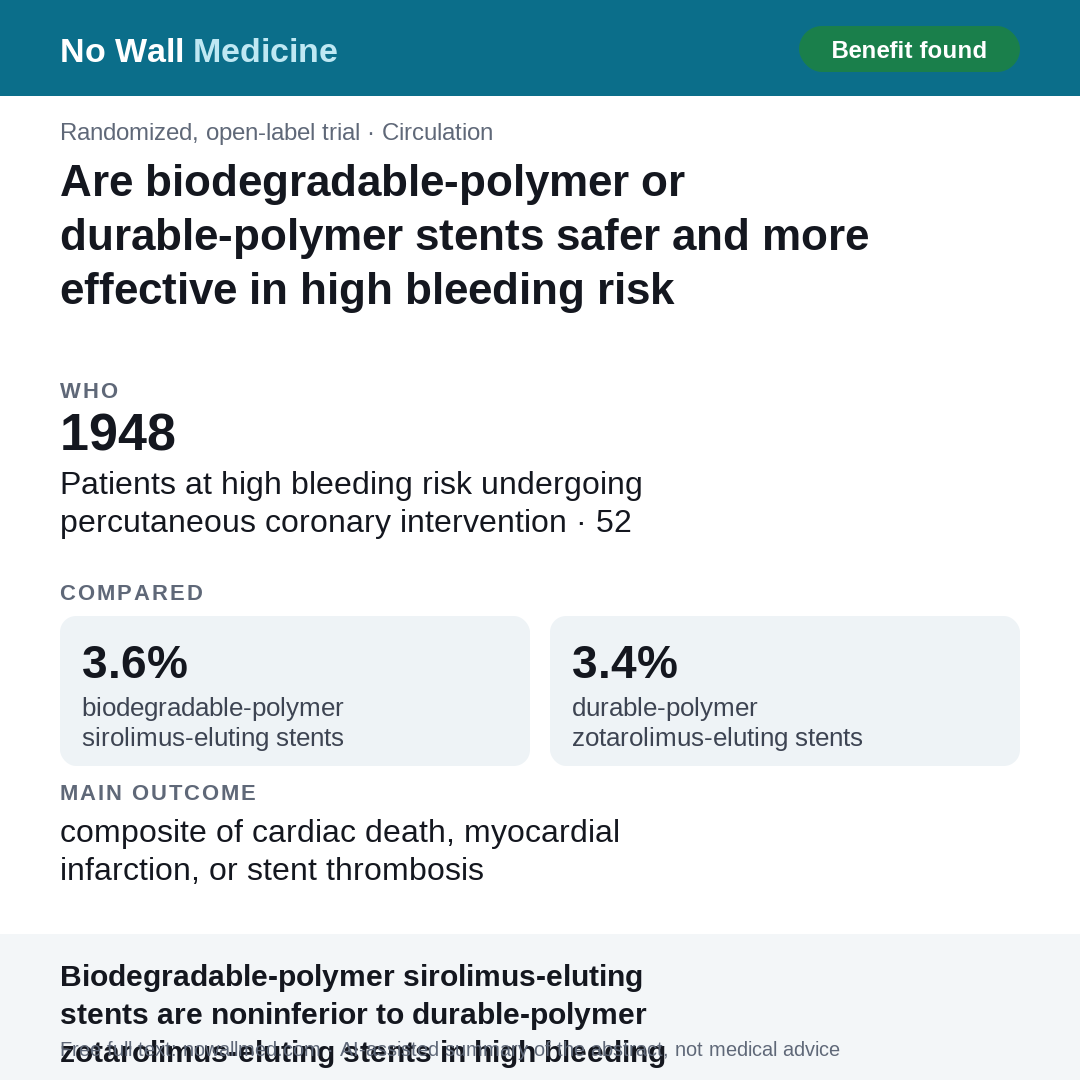
Are biodegradable-polymer or durable-polymer stents safer and more effective in high bleeding risk patients?
Who
1948
Patients at high bleeding risk undergoing percutaneous coronary intervention · 52 hospitals in 18 countries
Compared
3.6%biodegradable-polymer sirolimus-eluting stents (33/969)
3.4%durable-polymer zotarolimus-eluting stents (32/979)
Main outcome
composite of cardiac death, myocardial infarction, or stent thrombosis
Result: risk difference, 0.2 percentage points; upper boundary of the 1-sided 95% CI, 1.8
Bottom line: Biodegradable-polymer sirolimus-eluting stents are noninferior to durable-polymer zotarolimus-eluting stents in high bleeding risk patients.
Circulation · 2023-08-25Download image
Clinical question: Are biodegradable-polymer or durable-polymer stents safer and more effective in high bleeding risk patients?
Why it matters: It was unknown how different stent platforms compare in safety and effectiveness for patients at high bleeding risk receiving only 1 month of dual antiplatelet therapy.
Key points
- The study randomized 1948 patients at high bleeding risk to receive either biodegradable-polymer sirolimus-eluting stents or durable-polymer zotarolimus-eluting stents after a procedure to open blocked heart arteries.
- At 1 year, the primary composite outcome occurred in 3.6% of the biodegradable-polymer group and 3.4% of the durable-polymer group.
- The results showed that biodegradable-polymer stents were noninferior to durable-polymer stents regarding cardiac death, heart attack, or stent thrombosis.
Headline and key points written with AI from the paper’s abstract, with every number checked against it. Read the paper before relying on them.
Was this summary helpful?
Subject terms
Cite this article
Valgimigli M, Wlodarczak A, Tölg R, Merkely B, Kelbæk H, Legutko J. Biodegradable-Polymer or Durable-Polymer Stents in Patients at High Bleeding Risk: A Randomized, Open-Label Clinical Trial. Circulation. 2023. doi:10.1161/CIRCULATIONAHA.123.065448
Spotted a mistake? Suggest a correction