Low-dose biodegradable polymer stent was noninferior to second-generation stents for coronary artery disease
Randomized Comparison of Novel Low-Dose Sirolimus-Eluting Biodegradable Polymer Stent vs Second-Generation DES: TARGET-IV NA Trial
Single-blind, randomized noninferiority trialBenefit found
Is biodegradable polymer sirolimus-eluting stent noninferior to second-generation drug-eluting stents?
Who
1720
Patients undergoing percutaneous coronary intervention for coronary syndromes · North America and Europe
Compared
3.4%Biodegradable polymer sirolimus-eluting stent
3.3%Second-generation drug-eluting stents
Main outcome
Target lesion failure at 12 months
Result: absolute risk difference 0.13%, upper bound 97.5% CI: 2.03
Bottom line: The biodegradable polymer sirolimus-eluting stent was noninferior to second-generation drug-eluting stents regarding target lesion failure at 12 months.
JACC · 2024-10-30Download image
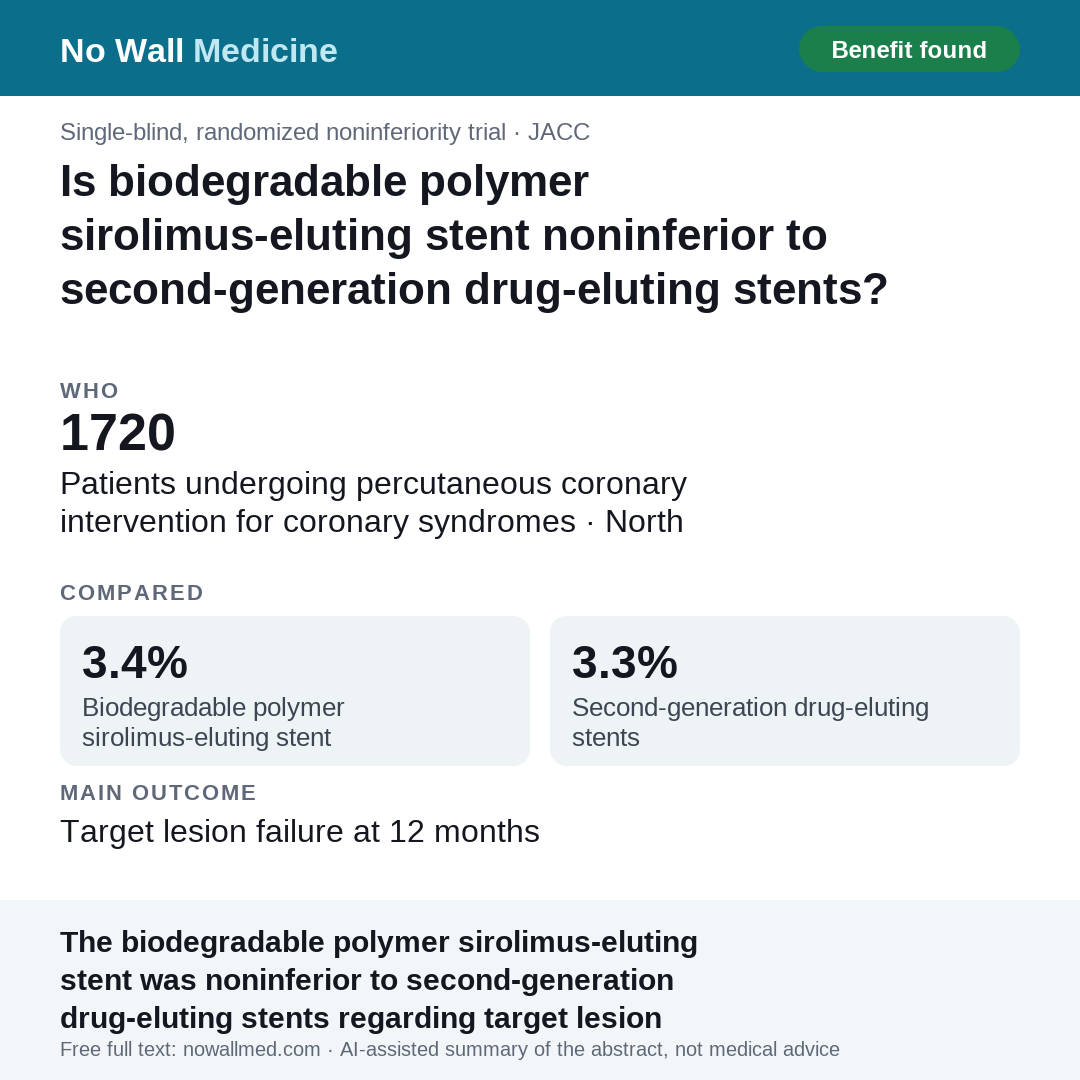
Clinical question: Is biodegradable polymer sirolimus-eluting stent noninferior to second-generation drug-eluting stents?
Why it matters: Durable polymers on drug-eluting stents may delay healing and inhibit the regrowth of the vessel lining.
Key points
- The trial randomized 1,720 patients with coronary syndromes to receive either a biodegradable polymer sirolimus-eluting stent or a second-generation drug-eluting stent.
- At 12 months, the rate of target lesion failure was 3.4% for the biodegradable polymer stent compared to 3.3% for the control group.
- The mean in-stent late lumen loss, a measure of vessel narrowing, was 0.149 ± 0.263 mm for the biodegradable polymer stent and 0.327 ± 0.463 mm for the control.
Headline and key points written with AI from the paper’s abstract, with every number checked against it. Read the paper before relying on them.
Topics
Cite this article
Yeh RW, Bertrand OF, Mahmud E, Barbato E, Falah B, Issever MO. Randomized Comparison of Novel Low-Dose Sirolimus-Eluting Biodegradable Polymer Stent vs Second-Generation DES: TARGET-IV NA Trial. JACC. 2024. doi:10.1016/j.jacc.2024.10.074
Spotted a mistake? Suggest a correction
Top studies every Monday
The week’s key trials and guidelines in your specialties, by email. Free.
Get the weekly digest