Biodegradable and durable polymer stents showed similar rates of neoatherosclerosis after three years
Long-term effect of biodegradable vs. durable polymer everolimus-eluting stents on neoatherosclerosis in ST-segment elevation myocardial infarction: the CONNECT trial
Randomized controlled trialNo clear difference
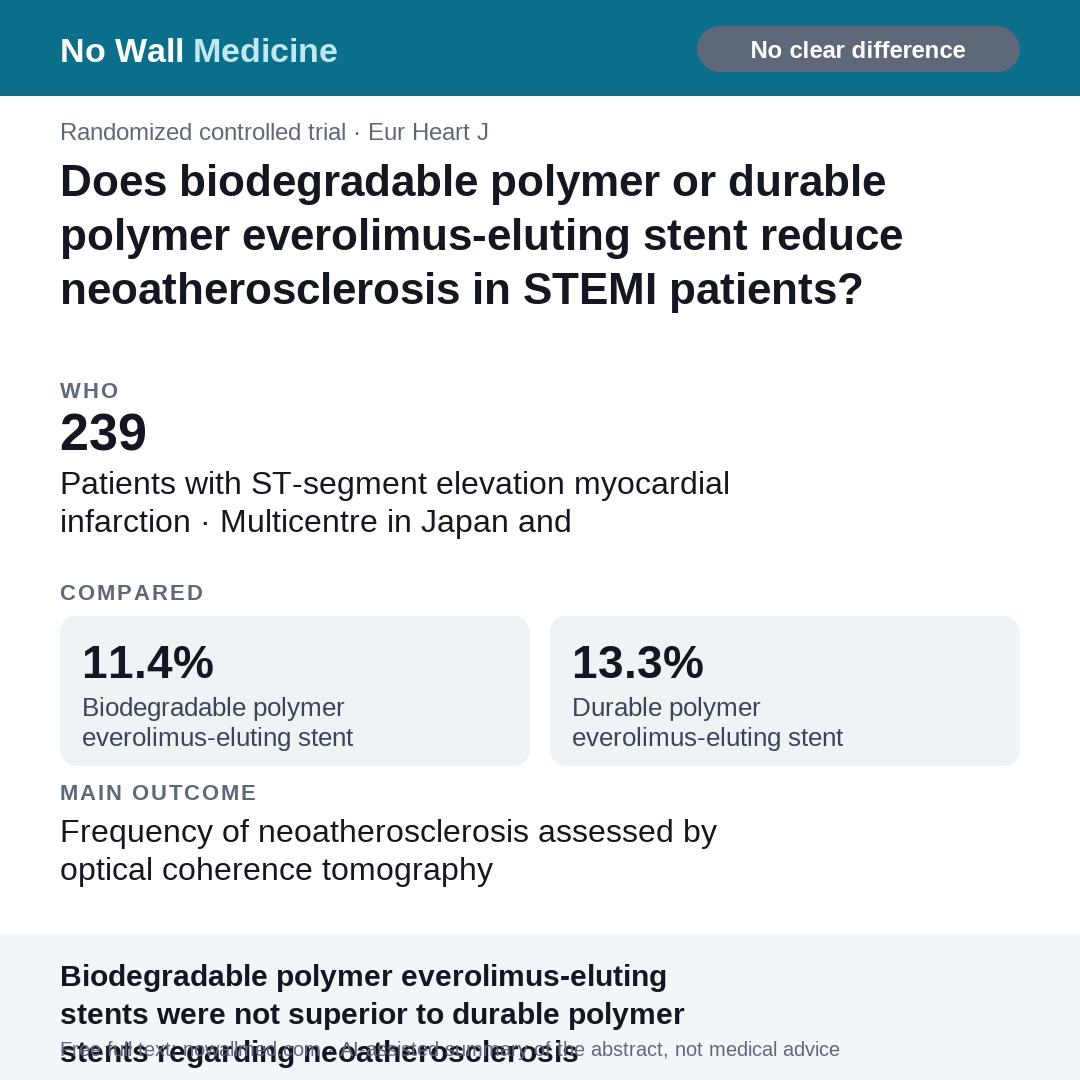
Does biodegradable polymer or durable polymer everolimus-eluting stent reduce neoatherosclerosis in STEMI patients?
Who
239
Patients with ST-segment elevation myocardial infarction · Multicentre in Japan and Switzerland
Compared
11.4%Biodegradable polymer everolimus-eluting stent
13.3%Durable polymer everolimus-eluting stent
Main outcome
Frequency of neoatherosclerosis assessed by optical coherence tomography
Result: odds ratio 0.83 (95% confidence interval 0.33-2.04)
Bottom line: Biodegradable polymer everolimus-eluting stents were not superior to durable polymer stents regarding neoatherosclerosis frequency at 3 years.
Eur Heart J · 2024-09-01Download image
Clinical question: Does biodegradable polymer or durable polymer everolimus-eluting stent reduce neoatherosclerosis in STEMI patients?
Why it matters: It is unclear whether biodegradable polymer stents are superior to durable polymer stents regarding the long-term occurrence of neoatherosclerosis after stent implantation.
Key points
- The CONNECT trial randomized 239 patients with ST-segment elevation myocardial infarction to receive either biodegradable polymer or durable polymer everolimus-eluting stents.
- At 3 years, neoatherosclerosis frequency was 11.4% for biodegradable polymer stents and 13.3% for durable polymer stents, which was not a statistically significant difference.
- Target lesion failure rates were similar between the biodegradable polymer group (5.9%) and the durable polymer group (6.0%).
Headline and key points written with AI from the paper’s abstract, with every number checked against it. Read the paper before relying on them.
Topics
Cite this article
Taniwaki M, Häner JD, Kakizaki R, Ohno Y, Yahagi K, Higuchi Y. Long-term effect of biodegradable vs. durable polymer everolimus-eluting stents on neoatherosclerosis in ST-segment elevation myocardial infarction: the CONNECT trial. Eur Heart J. 2024. doi:10.1093/eurheartj/ehae589
Spotted a mistake? Suggest a correction
Top studies every Monday
The week’s key trials and guidelines in your specialties, by email. Free.
Get the weekly digest