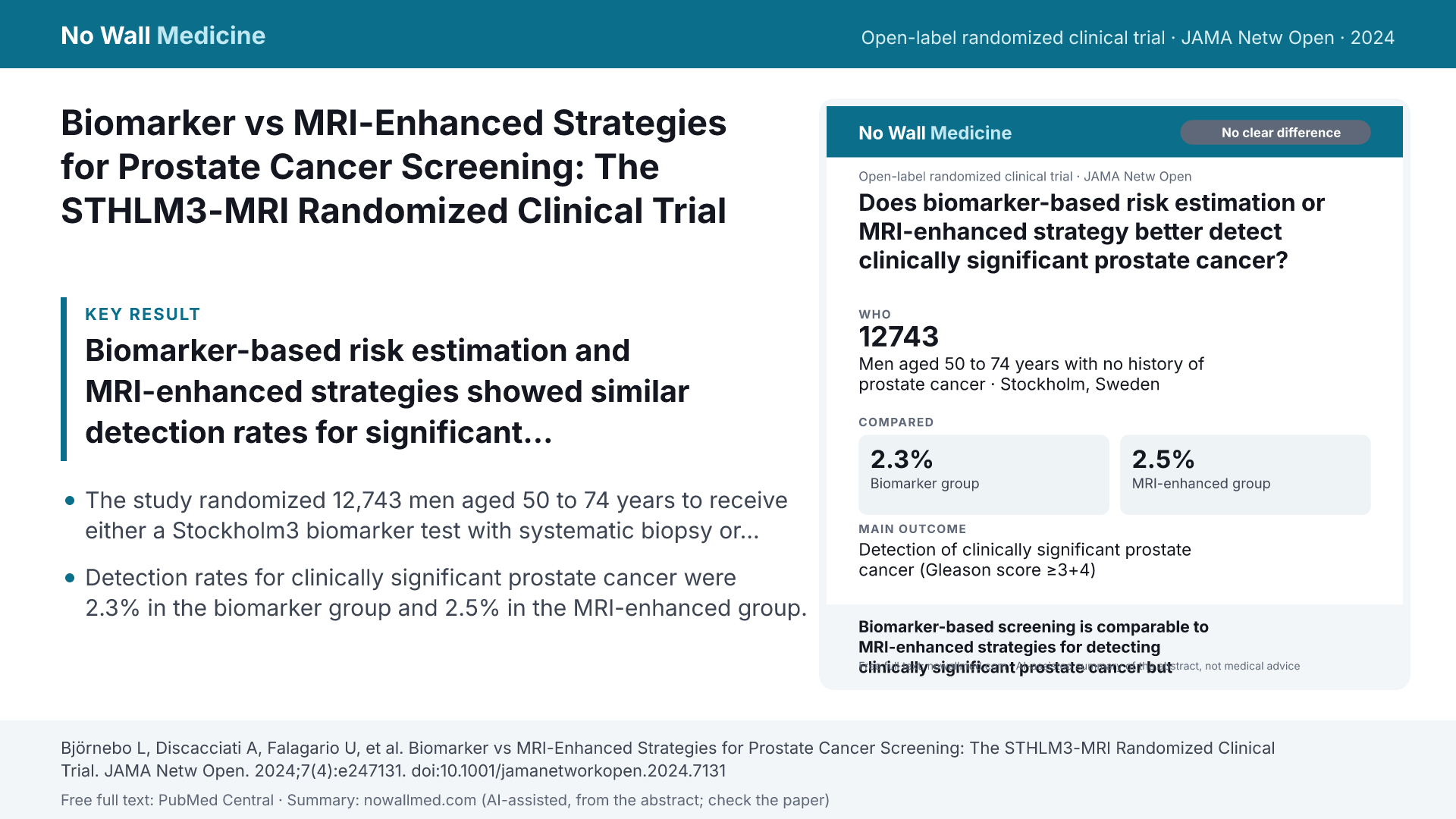
Biomarker-based risk estimation and MRI-enhanced strategies showed similar detection rates for significant prostate cancer
Biomarker vs MRI-Enhanced Strategies for Prostate Cancer Screening: The STHLM3-MRI Randomized Clinical Trial
Open-label randomized clinical trialNo clear difference
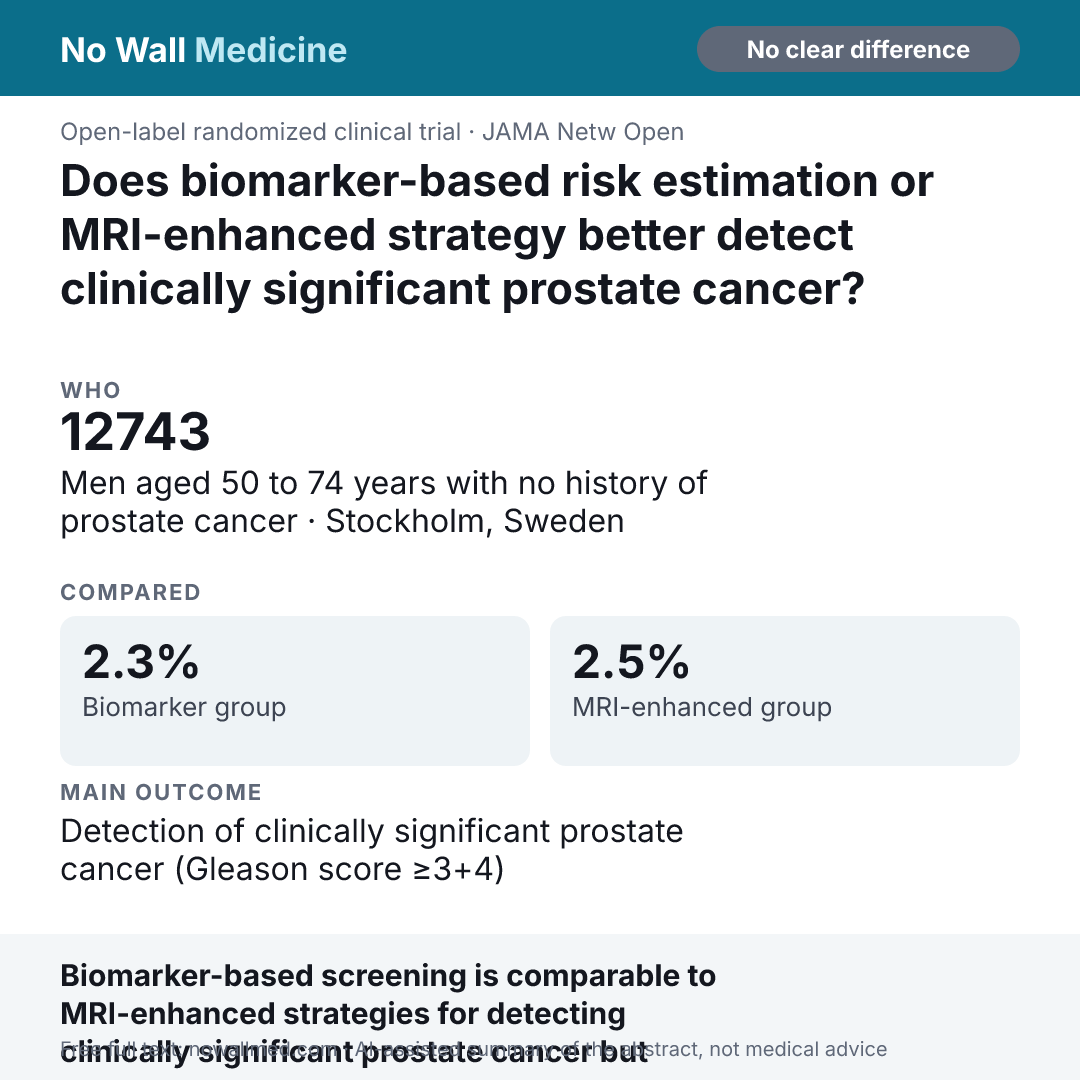
Does biomarker-based risk estimation or MRI-enhanced strategy better detect clinically significant prostate cancer?
Who
12743
Men aged 50 to 74 years with no history of prostate cancer · Stockholm, Sweden
Compared
2.3%Biomarker group
2.5%MRI-enhanced group
Main outcome
Detection of clinically significant prostate cancer (Gleason score ≥3+4)
Result: relative proportion 0.92 (95% CI 0.73-1.15)
Bottom line: Biomarker-based screening is comparable to MRI-enhanced strategies for detecting clinically significant prostate cancer but results in more biopsies.
JAMA Netw Open · 2024-04-01 · Save PNG
Same trial (NCT03377881)
Papers we list that report this registered trial, oldest first. Read a secondary analysis alongside the main results.
- Secondary analysis
Repeat prostate cancer screening with PSA testing and MRI found low rates of significant cancer JAMA Netw Open 2024-02 - Main results No clear difference
This paper JAMA Netw Open 2024-04
Clinical question: Does biomarker-based risk estimation or MRI-enhanced strategy better detect clinically significant prostate cancer?
Key points
- The study randomized 12,743 men aged 50 to 74 years to receive either a Stockholm3 biomarker test with systematic biopsy or a PSA test followed by MRI and biopsies.
- Detection rates for clinically significant prostate cancer were 2.3% in the biomarker group and 2.5% in the MRI-enhanced group.
- The biomarker group had more biopsies performed at 6.3% compared to 4.4% in the MRI-enhanced group and detected more indolent cancers at 1.2% versus 0.5%.
Headline and key points written with AI from the paper’s abstract, with every number checked against it. Read the paper before relying on them.
Was this summary helpful?
Subject terms
Headline, design, result, key points, caveat and citation as plain text.
Cite this article
Björnebo L, Discacciati A, Falagario U, et al. Biomarker vs MRI-Enhanced Strategies for Prostate Cancer Screening: The STHLM3-MRI Randomized Clinical Trial. JAMA Netw Open. 2024;7(4):e247131. doi:10.1001/jamanetworkopen.2024.7131
Spotted a mistake? Suggest a correction