Pilot study shows a three-step screening process for prostate cancer is feasible
Population-based randomized trial of screening for clinically significant prostate cancer ProScreen: a pilot study
Population-based randomized pilot trialBenefit found
Is a stepwise screening algorithm feasible for detecting clinically significant prostate cancer?
Who
399
Men aged 65 years
Compared
Invited men: 158 (40%) participated
Participants: 5 diagnosed with clinically significant prostate cancer (3%)
Main outcome
Feasibility of screening algorithm and cancer detection
Bottom line: The stepwise screening protocol is feasible for detecting clinically significant cancer with reduced biopsies.
Limitation: Participation was suboptimal.
BJU Int · 2022-01-08Download image
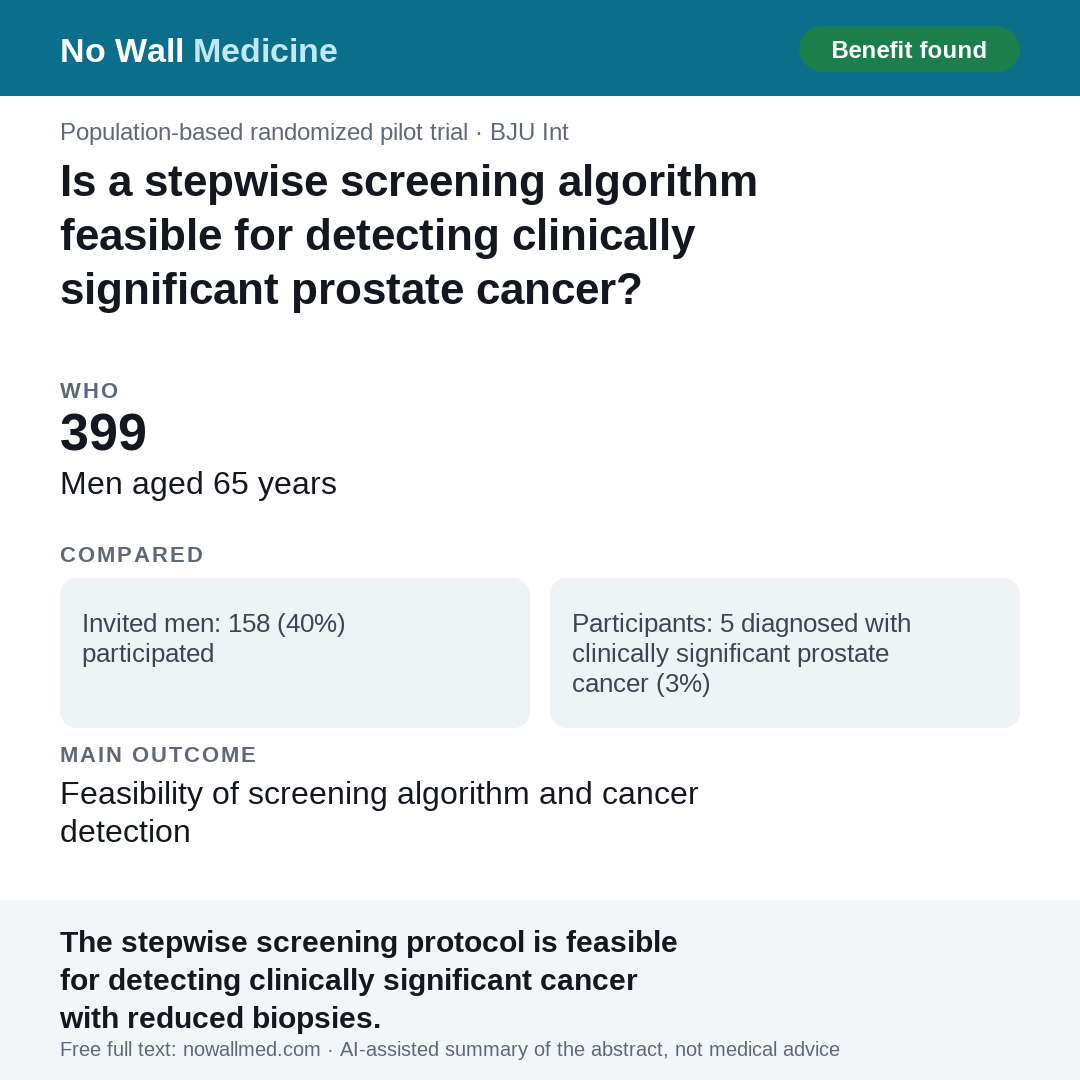
Clinical question: Is a stepwise screening algorithm feasible for detecting clinically significant prostate cancer?
Why it matters: It is unknown if a multi-step screening protocol using PSA, a kallikrein panel, and MRI can minimize overdiagnosis while still detecting clinically significant prostate cancer.
Key points
- Researchers studied 400 men aged 65 years to evaluate a screening algorithm using prostate-specific antigen (PSA), a kallikrein panel, and magnetic resonance imaging (MRI).
- The three-step testing process was associated with a 56% reduction in biopsies compared to using PSA alone.
- Of the 158 men who participated, 5 were diagnosed with clinically significant prostate cancer, which is cancer with a Gleason Grade Group of 2 or higher.
Headline and key points written with AI from the paper’s abstract, with every number checked against it. Read the paper before relying on them.
Was this summary helpful?
Subject terms
Cite this article
Rannikko A, Leht M, Mirtti T, Kenttämies A, Tolonen T, Rinta-Kiikka I. Population-based randomized trial of screening for clinically significant prostate cancer ProScreen: a pilot study. BJU Int. 2022. doi:10.1111/bju.15683
Spotted a mistake? Suggest a correction
Top studies every Monday
The week’s key trials and guidelines in your specialties, plus any topics you follow. By email, free.
Get the weekly digest