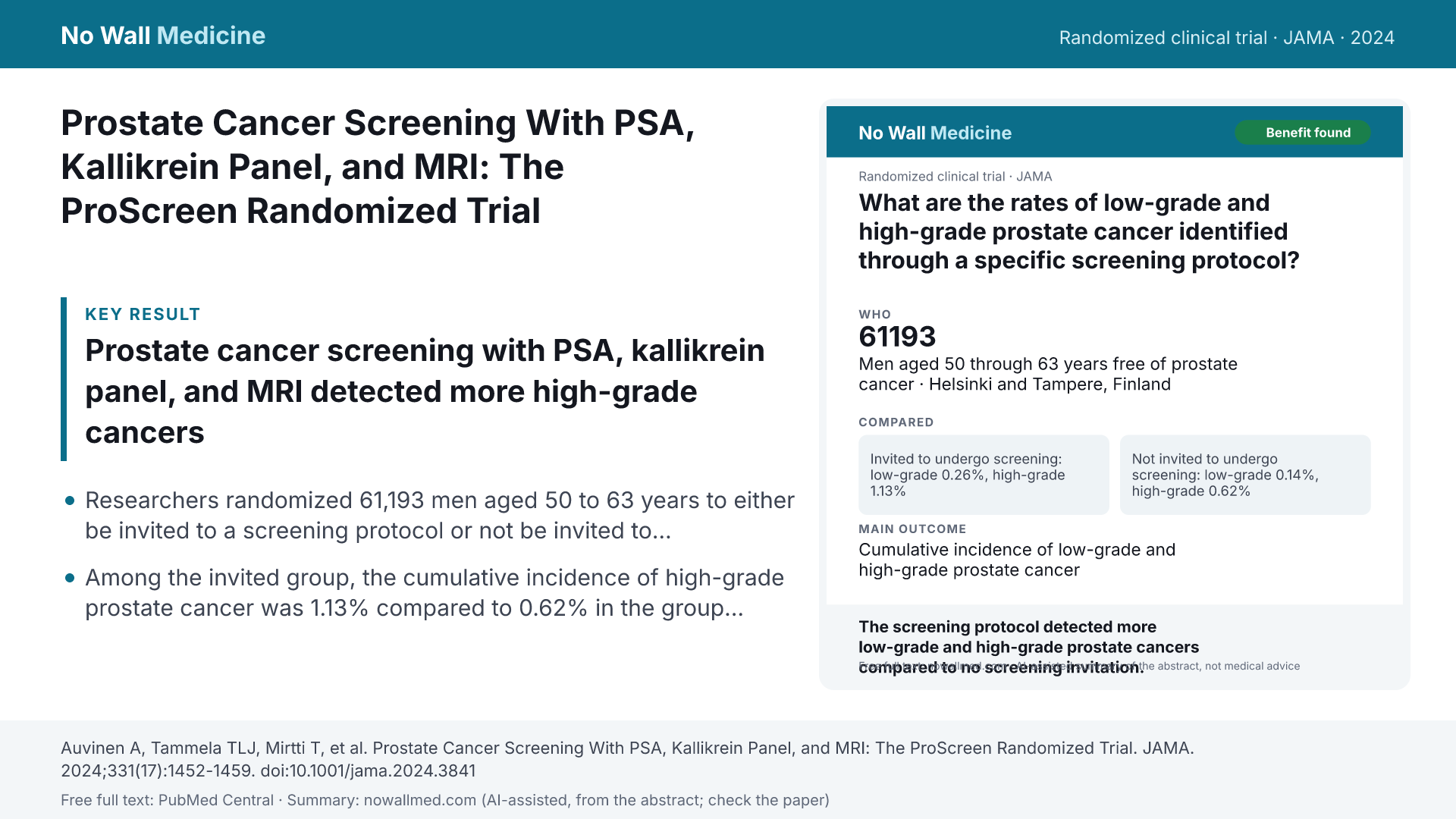
Prostate cancer screening with PSA, kallikrein panel, and MRI detected more high-grade cancers
Prostate Cancer Screening With PSA, Kallikrein Panel, and MRI: The ProScreen Randomized Trial
Randomized clinical trialBenefit found
What are the rates of low-grade and high-grade prostate cancer identified through a specific screening protocol?
Who
61193
Men aged 50 through 63 years free of prostate cancer · Helsinki and Tampere, Finland
Compared
Invited to undergo screening: low-grade 0.26%, high-grade 1.13%
Not invited to undergo screening: low-grade 0.14%, high-grade 0.62%
Main outcome
Cumulative incidence of low-grade and high-grade prostate cancer
Result: risk difference 0.11% (95% CI, 0.03%-0.20%) for low-grade and 0.51% (95% CI, 0.33%-0.70%) for high-grade cancer
Bottom line: The screening protocol detected more low-grade and high-grade prostate cancers compared to no screening invitation.
JAMA · 2024-04-06 · Save PNG
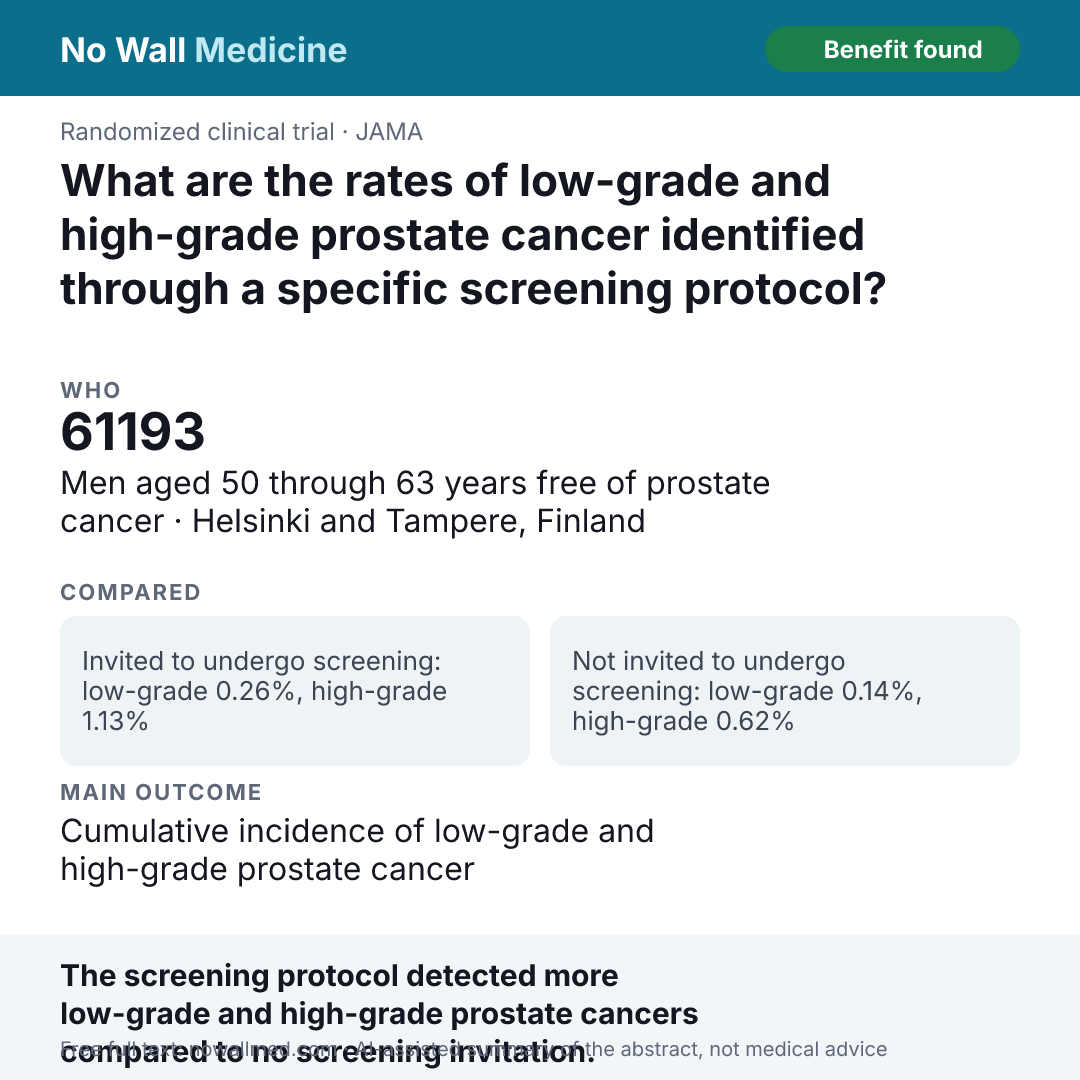
Clinical question: What are the rates of low-grade and high-grade prostate cancer identified through a specific screening protocol?
Why it matters: Prostate-specific antigen screening can detect prostate cancer that is not clinically important, creating a need to evaluate multi-step screening protocols.
Key points
- Researchers randomized 61,193 men aged 50 to 63 years to either be invited to a screening protocol or not be invited to undergo screening.
- Among the invited group, the cumulative incidence of high-grade prostate cancer was 1.13% compared to 0.62% in the group not invited.
- The screening protocol resulted in 1 additional high-grade cancer per 196 men and 1 low-grade cancer per 909 men detected compared to the control group.
Headline and key points written with AI from the paper’s abstract, with every number checked against it. Read the paper before relying on them.
Was this summary helpful?
Subject terms
Headline, design, result, key points, caveat and citation as plain text.
Cite this article
Auvinen A, Tammela TLJ, Mirtti T, et al. Prostate Cancer Screening With PSA, Kallikrein Panel, and MRI: The ProScreen Randomized Trial. JAMA. 2024;331(17):1452-1459. doi:10.1001/jama.2024.3841
Spotted a mistake? Suggest a correction