Biomimetic Stents for Infrainguinal Peripheral Arterial Disease: Systematic Review and Meta-Analysis
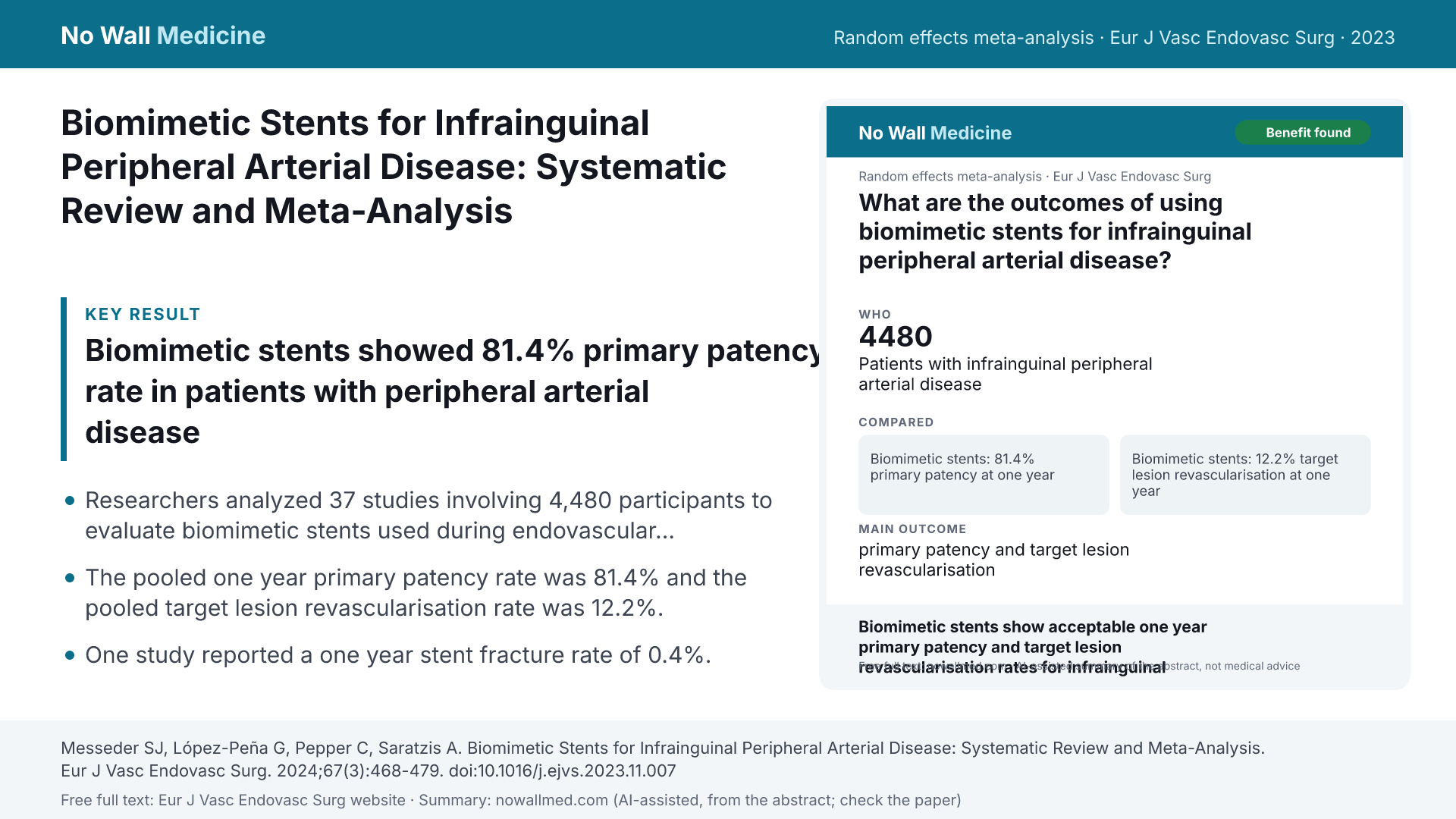
Key result: Biomimetic stents showed 81.4% primary patency rate in patients with peripheral arterial disease
Random effects meta-analysisBenefit found
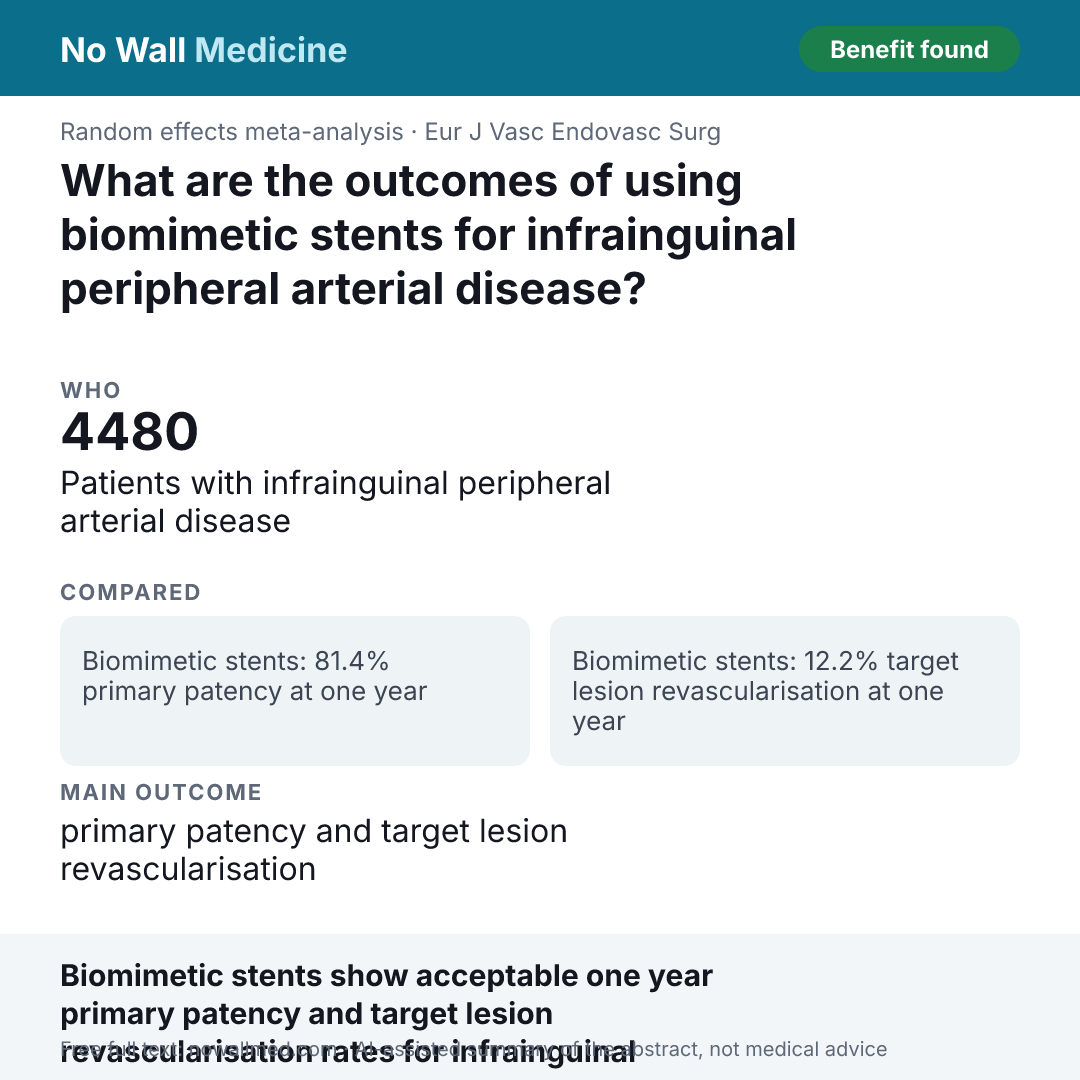
What are the outcomes of using biomimetic stents for infrainguinal peripheral arterial disease?
Who
4480
Patients with infrainguinal peripheral arterial disease
Compared
Biomimetic stents: 81.4% primary patency at one year
Biomimetic stents: 12.2% target lesion revascularisation at one year
Main outcome
primary patency and target lesion revascularisation
Result: primary patency 81.4% (95% CI 78.7 - 83.9%)
Bottom line: Biomimetic stents show acceptable one year primary patency and target lesion revascularisation rates for infrainguinal peripheral arterial disease.
Eur J Vasc Endovasc Surg · 2023-11-04 · Save PNG
Key points
- Researchers analyzed 37 studies involving 4,480 participants to evaluate biomimetic stents used during endovascular treatment for peripheral arterial disease in the leg arteries.
- The pooled one year primary patency rate was 81.4% and the pooled target lesion revascularisation rate was 12.2%.
- One study reported a one year stent fracture rate of 0.4%.
Discussion prompts
- Would these patients look like yours? Who was left out?
- Is the main outcome one that matters to patients?
- Is the difference large enough to change what you do?
Cite: Messeder SJ, López-Peña G, Pepper C, Saratzis A. Biomimetic Stents for Infrainguinal Peripheral Arterial Disease: Systematic Review and Meta-Analysis. Eur J Vasc Endovasc Surg. 2024;67(3):468-479. doi:10.1016/j.ejvs.2023.11.007
Free full text: Eur J Vasc Endovasc Surg website · Summary and visual abstract: nowallmed.com/a/biomimetic-stents-for-infrainguinal-peripheral-arterial-disease-19pd763/ (AI-assisted from the abstract; check the paper before relying on it).