Birth Outcomes Associated With Assisted Vaginal Birth in an Occipito-Posterior Position: Secondary Analyses of a Randomised Controlled Trial and Cohort Study
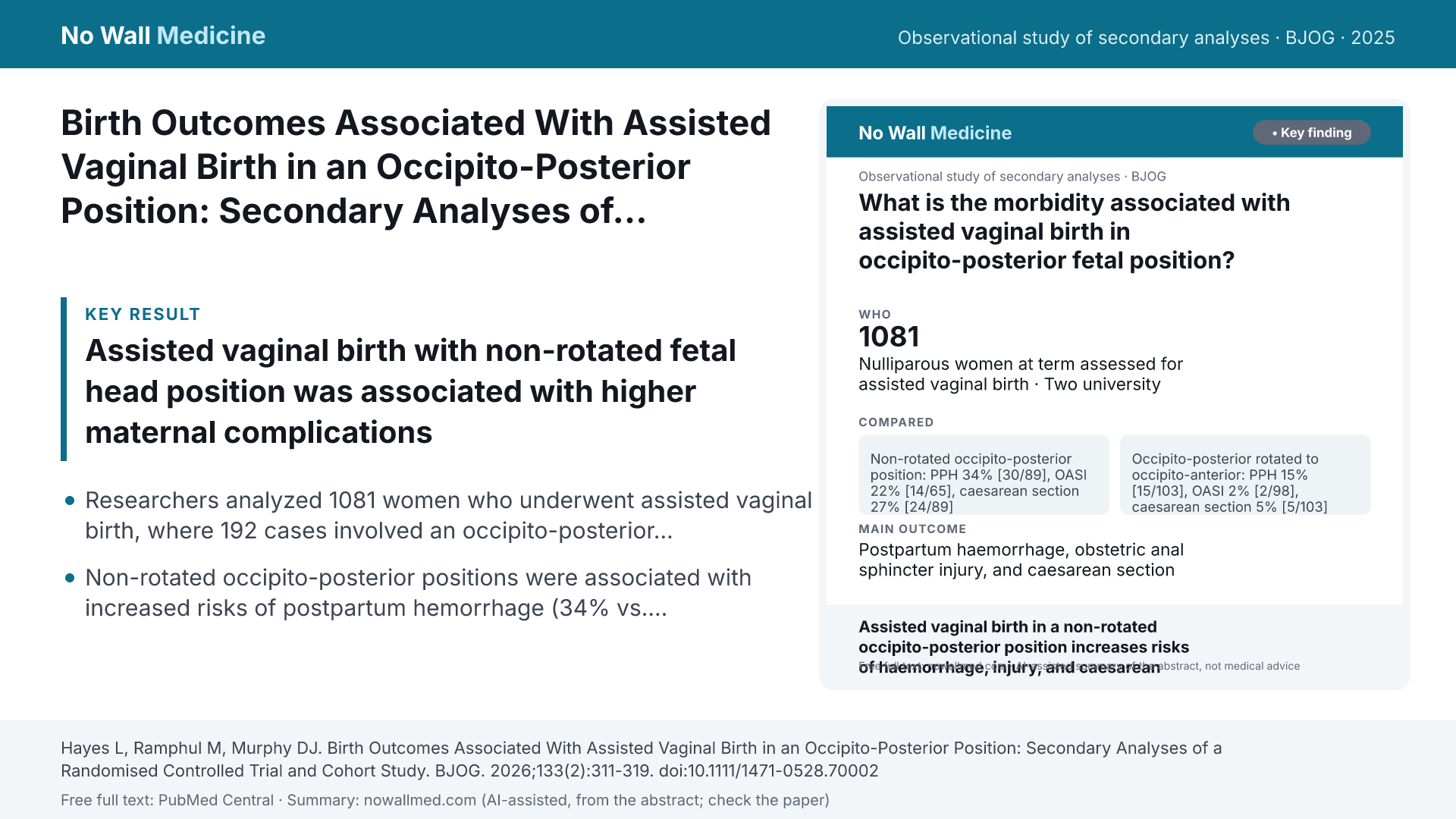
Key result: Assisted vaginal birth with non-rotated fetal head position was associated with higher maternal complications
Observational study of secondary analysesKey finding
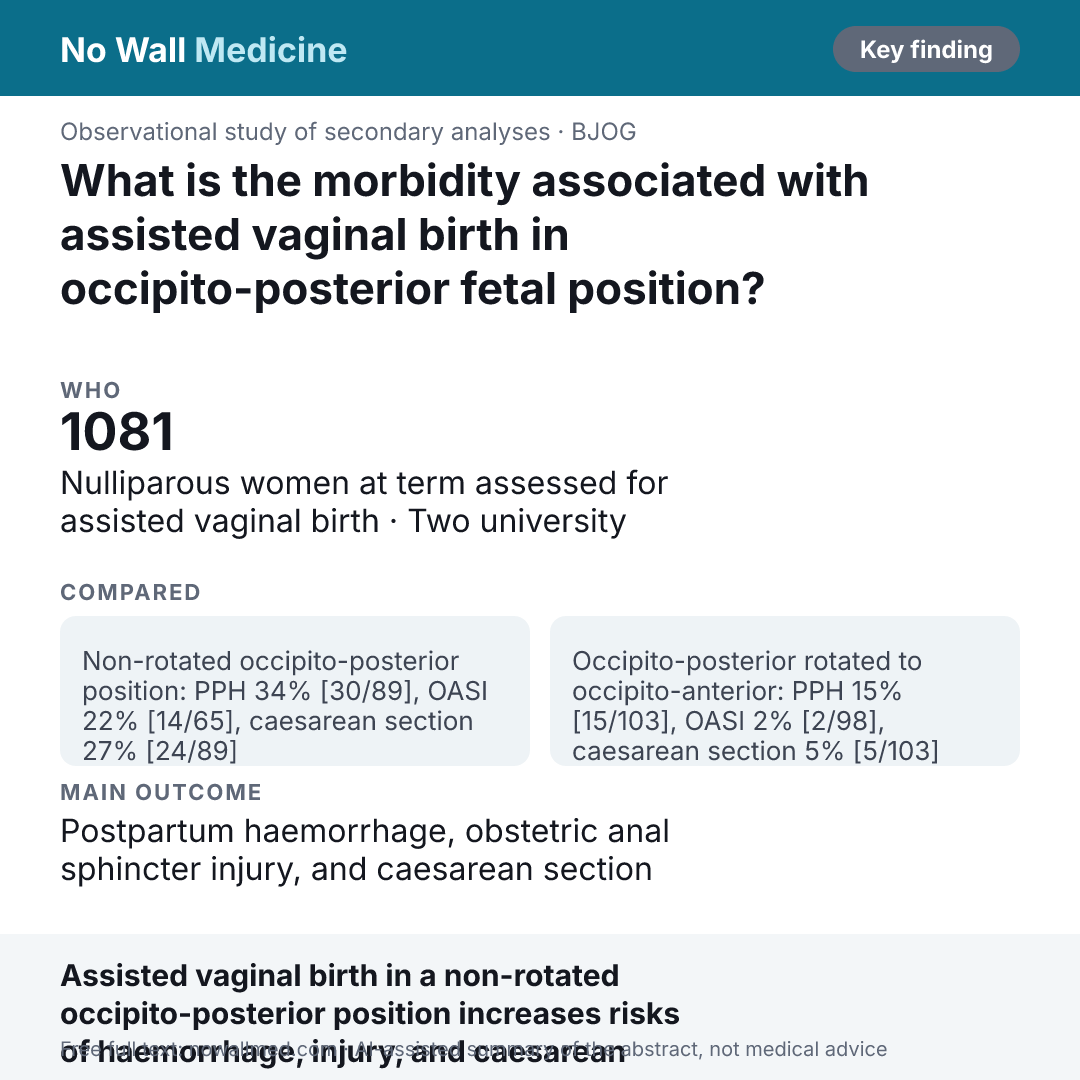
What is the morbidity associated with assisted vaginal birth in occipito-posterior fetal position?
Who
1081
Nulliparous women at term assessed for assisted vaginal birth · Two university affiliated maternity hospitals in Ireland
Compared
Non-rotated occipito-posterior position: PPH 34% [30/89], OASI 22% [14/65], caesarean section 27% [24/89]
Occipito-posterior rotated to occipito-anterior: PPH 15% [15/103], OASI 2% [2/98], caesarean section 5% [5/103]
Main outcome
Postpartum haemorrhage, obstetric anal sphincter injury, and caesarean section
Result: adj OR 3.57 (95% CI 1.68 to 7.58) for PPH; adj OR 12.62 (95% CI 2.65 to 60.12) for OASI; adj OR 8.99 (95% CI 3.14 to 25.74) for caesarean section
Bottom line: Assisted vaginal birth in a non-rotated occipito-posterior position increases risks of haemorrhage, injury, and caesarean section.
BJOG · 2025-09-14 · Save PNG
Key points
- Researchers analyzed 1081 women who underwent assisted vaginal birth, where 192 cases involved an occipito-posterior fetal head position.
- Non-rotated occipito-posterior positions were associated with increased risks of postpartum hemorrhage (34% vs. 15%), obstetric anal sphincter injury (22% vs. 2%), and caesarean section (27% vs. 5%).
- No significant differences were found in neonatal outcomes between the groups studied.
Discussion prompts
- Would these patients look like yours? Who was left out?
- Is the main outcome one that matters to patients?
- Is the difference large enough to change what you do?
Cite: Hayes L, Ramphul M, Murphy DJ. Birth Outcomes Associated With Assisted Vaginal Birth in an Occipito-Posterior Position: Secondary Analyses of a Randomised Controlled Trial and Cohort Study. BJOG. 2026;133(2):311-319. doi:10.1111/1471-0528.70002
Free full text: PubMed Central · Summary and visual abstract: nowallmed.com/a/birth-outcomes-associated-with-assisted-vaginal-birth-in-an-occipito-4fejll/ (AI-assisted from the abstract; check the paper before relying on it).