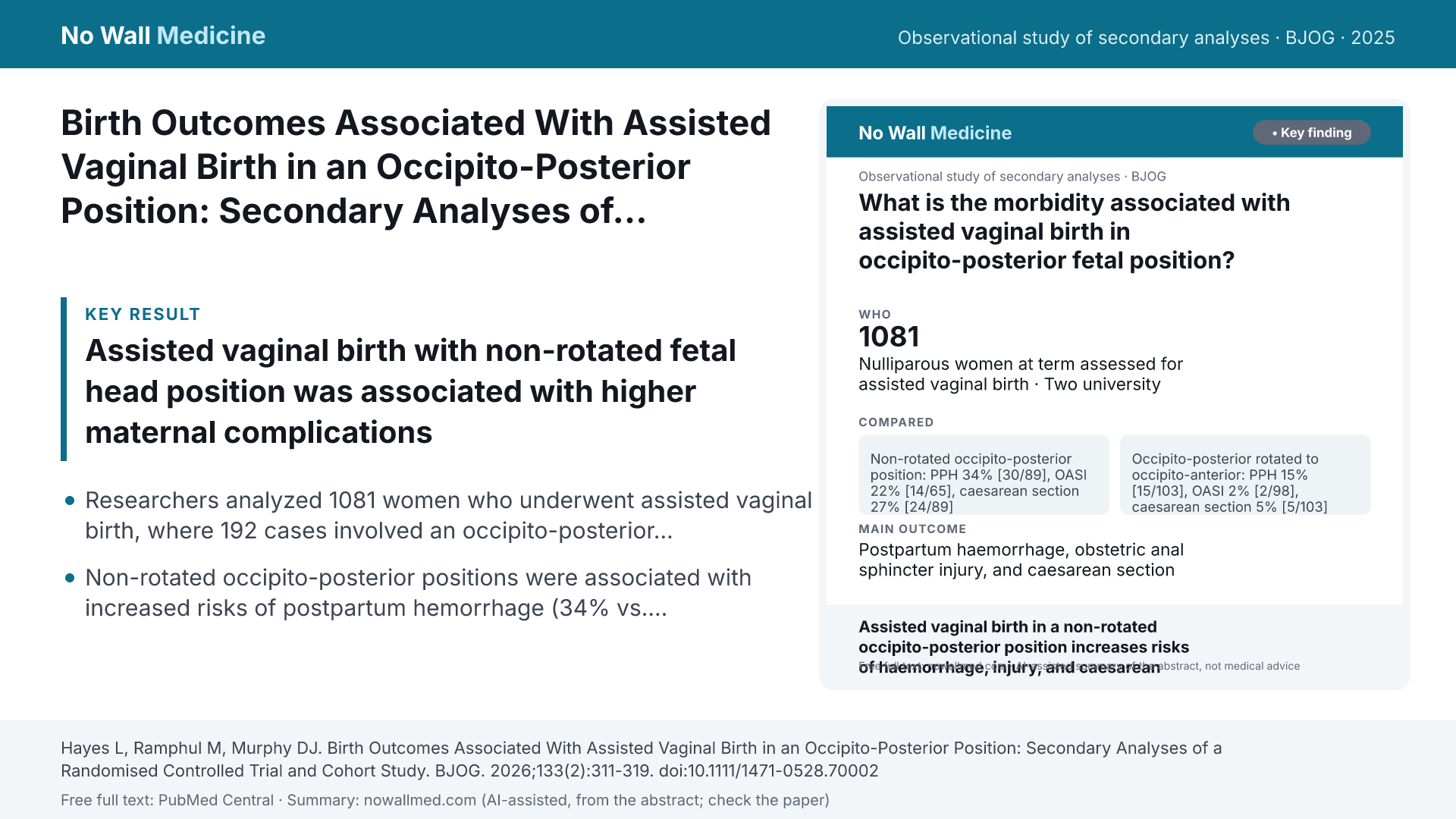
Assisted vaginal birth with non-rotated fetal head position was associated with higher maternal complications
Birth Outcomes Associated With Assisted Vaginal Birth in an Occipito-Posterior Position: Secondary Analyses of a Randomised Controlled Trial and Cohort Study
Obstetrics & GynecologyAdult and pediatric
Observational study of secondary analysesHarm found
What is the morbidity associated with assisted vaginal birth in occipito-posterior fetal position?
Who
1081
Nulliparous women at term assessed for assisted vaginal birth · Two university affiliated maternity hospitals in Ireland
Compared
Non-rotated occipito-posterior position: PPH 34% [30/89], OASI 22% [14/65], caesarean section 27% [24/89]
Occipito-posterior rotated to occipito-anterior: PPH 15% [15/103], OASI 2% [2/98], caesarean section 5% [5/103]
Main outcome
Postpartum haemorrhage, obstetric anal sphincter injury, and caesarean section
Result: adj OR 3.57 (95% CI 1.68 to 7.58) for PPH; adj OR 12.62 (95% CI 2.65 to 60.12) for OASI; adj OR 8.99 (95% CI 3.14 to 25.74) for caesarean section
Bottom line: Assisted vaginal birth in a non-rotated occipito-posterior position increases risks of haemorrhage, injury, and caesarean section.
BJOG · 2025-09-14Download image
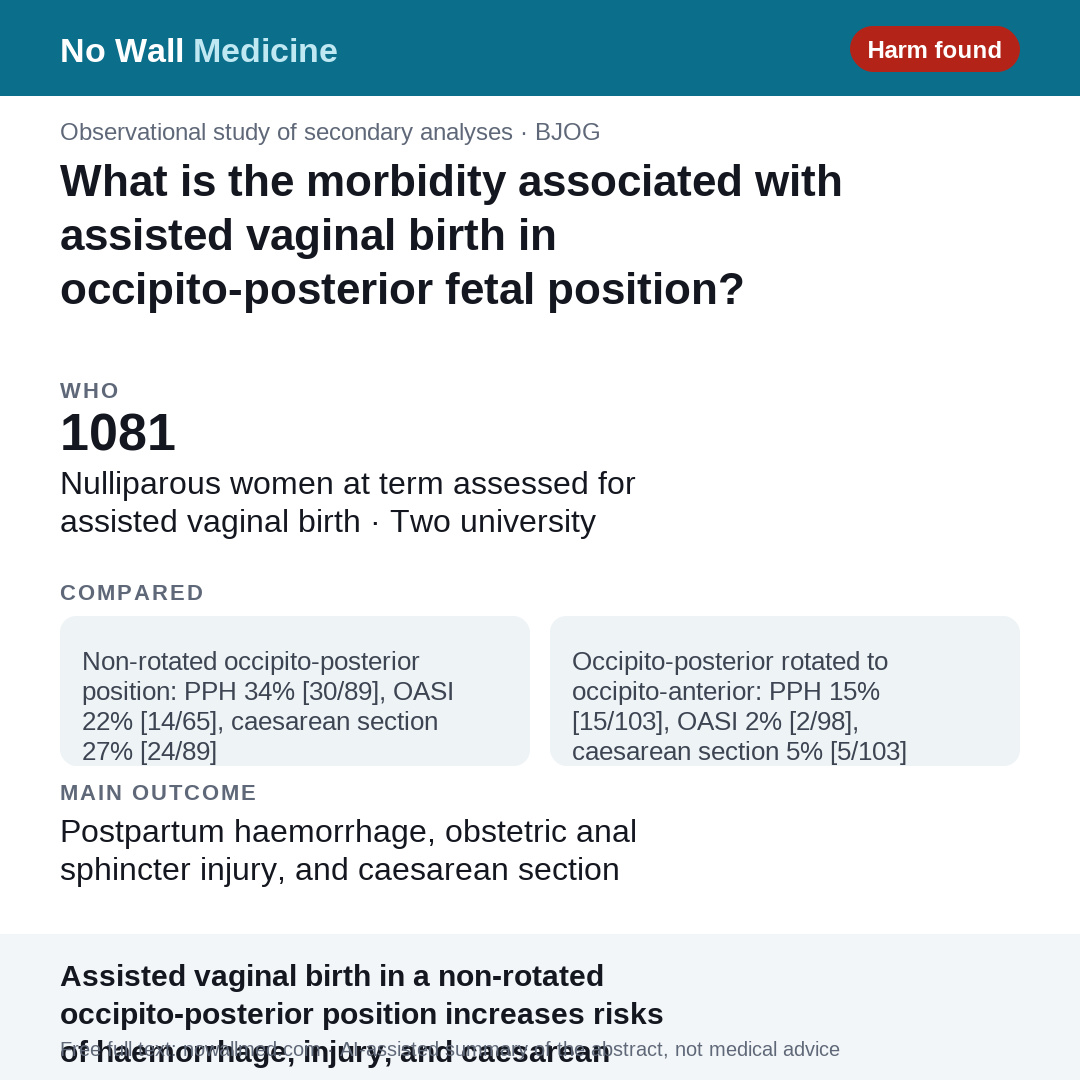
Clinical question: What is the morbidity associated with assisted vaginal birth in occipito-posterior fetal position?
Why it matters: It is unknown how the position of the fetal head during assisted vaginal birth affects maternal and neonatal morbidity.
Key points
- Researchers analyzed 1081 women who underwent assisted vaginal birth, where 192 cases involved an occipito-posterior fetal head position.
- Non-rotated occipito-posterior positions were associated with increased risks of postpartum hemorrhage (34% vs. 15%), obstetric anal sphincter injury (22% vs. 2%), and caesarean section (27% vs. 5%).
- No significant differences were found in neonatal outcomes between the groups studied.
Headline and key points written with AI from the paper’s abstract, with every number checked against it. Read the paper before relying on them.
Was this summary helpful?
Subject terms
Cite this article
Hayes L, Ramphul M, Murphy DJ. Birth Outcomes Associated With Assisted Vaginal Birth in an Occipito-Posterior Position: Secondary Analyses of a Randomised Controlled Trial and Cohort Study. BJOG. 2025. doi:10.1111/1471-0528.70002
Spotted a mistake? Suggest a correction