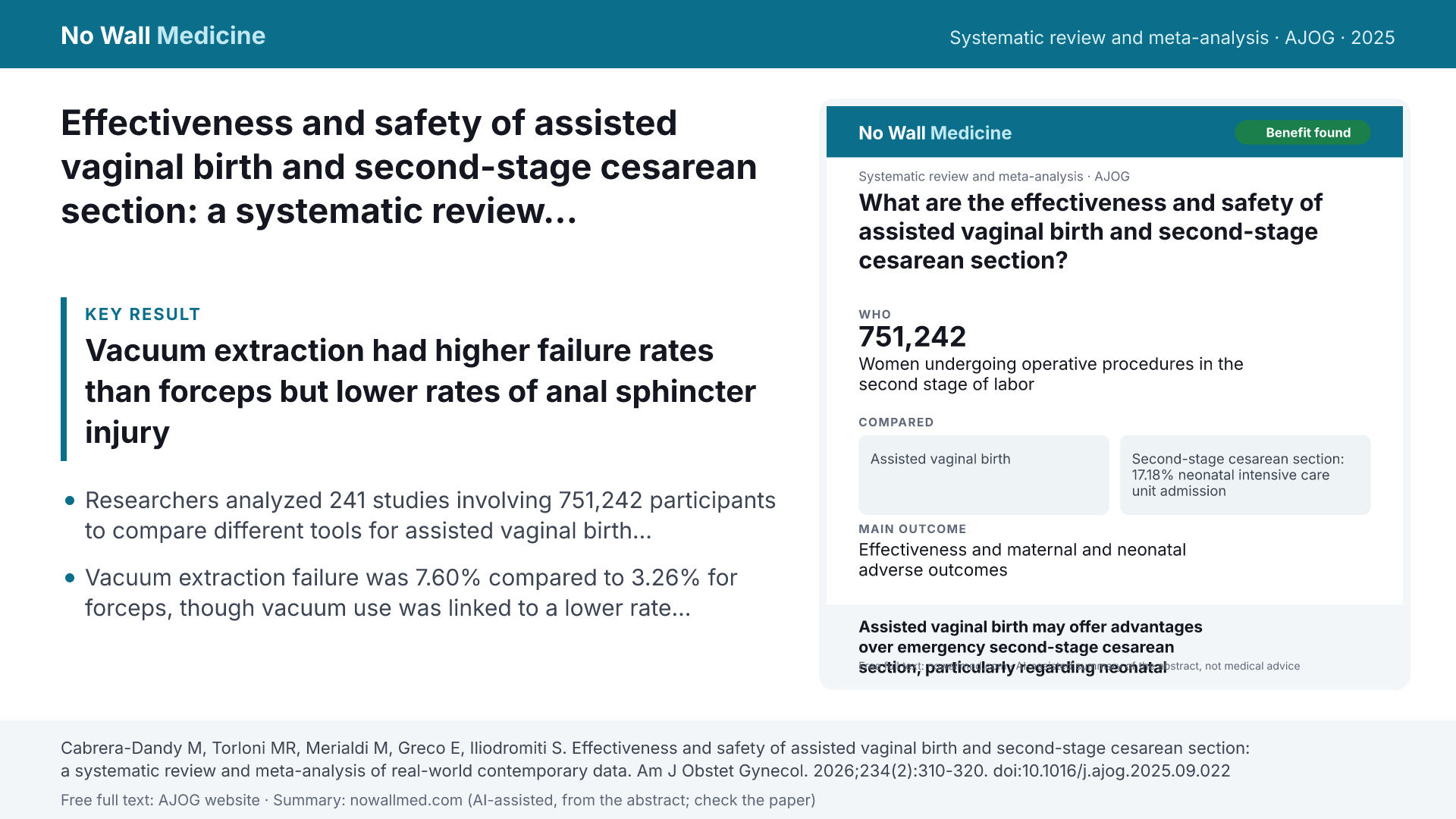
Vacuum extraction had higher failure rates than forceps but lower rates of anal sphincter injury
Effectiveness and safety of assisted vaginal birth and second-stage cesarean section: a systematic review and meta-analysis of real-world contemporary data
Systematic review and meta-analysisBenefit found
What are the effectiveness and safety of assisted vaginal birth and second-stage cesarean section?
Who
751,242
Women undergoing operative procedures in the second stage of labor
Compared
Assisted vaginal birth
Second-stage cesarean section: 17.18% neonatal intensive care unit admission
Main outcome
Effectiveness and maternal and neonatal adverse outcomes
Bottom line: Assisted vaginal birth may offer advantages over emergency second-stage cesarean section, particularly regarding neonatal outcomes.
AJOG · 2025-09-12Download image
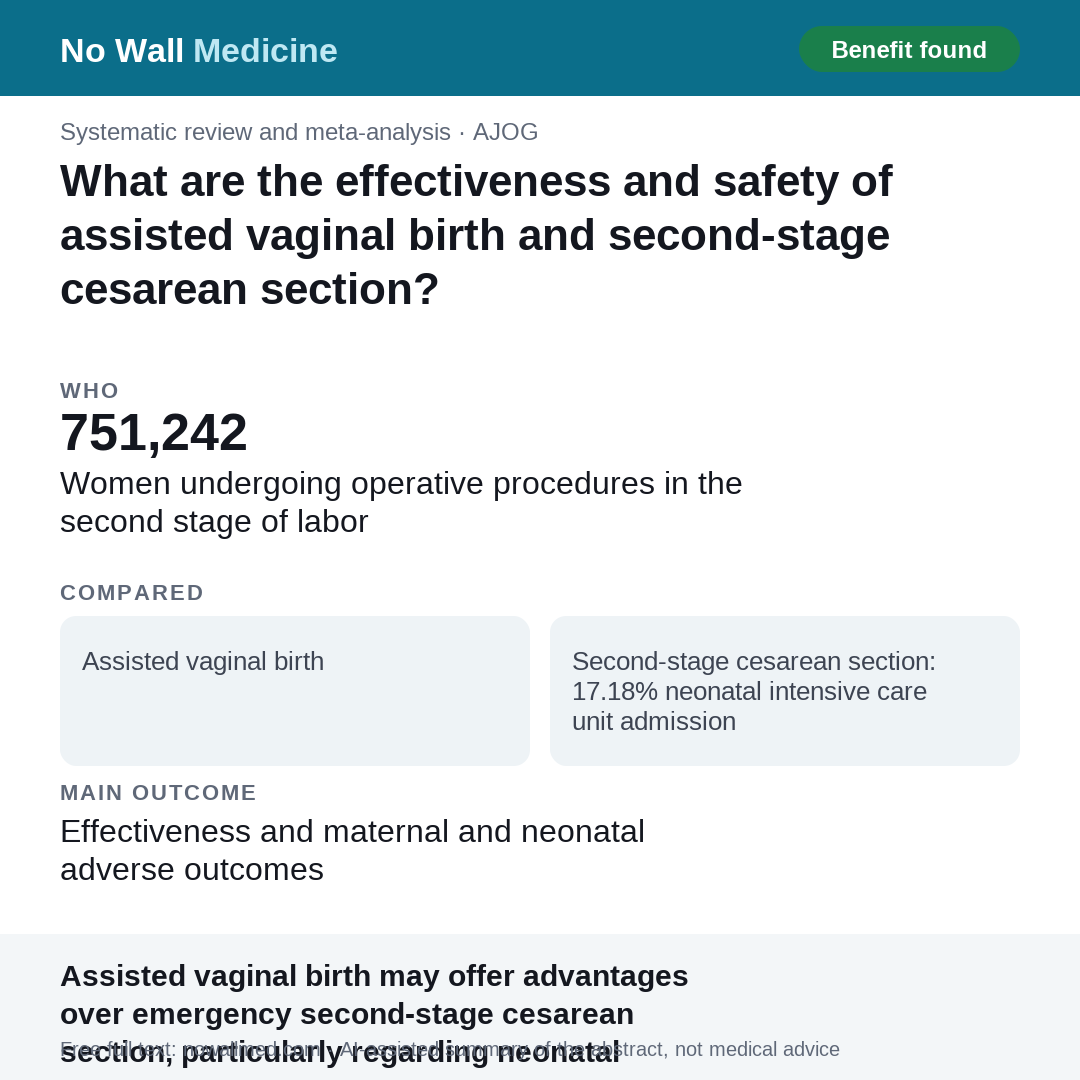
Clinical question: What are the effectiveness and safety of assisted vaginal birth and second-stage cesarean section?
Why it matters: Evidence is needed to understand the effectiveness of different instruments for assisted vaginal birth and the risks of second-stage cesarean section.
Key points
- Researchers analyzed 241 studies involving 751,242 participants to compare different tools for assisted vaginal birth and second-stage cesarean section.
- Vacuum extraction failure was 7.60% compared to 3.26% for forceps, though vacuum use was linked to a lower rate of obstetric anal sphincter injury.
- Second-stage cesarean section was associated with higher rates of neonatal intensive care unit admission (17.18%) and neonatal death (1.95%) compared to assisted vaginal birth.
Headline and key points written with AI from the paper’s abstract, with every number checked against it. Read the paper before relying on them.
Was this summary helpful?
Subject terms
Cite this article
Cabrera-Dandy M, Torloni MR, Merialdi M, Greco E, Iliodromiti S. Effectiveness and safety of assisted vaginal birth and second-stage cesarean section: a systematic review and meta-analysis of real-world contemporary data. Am J Obstet Gynecol. 2026;234(2):310-320. doi:10.1016/j.ajog.2025.09.022
Spotted a mistake? Suggest a correction