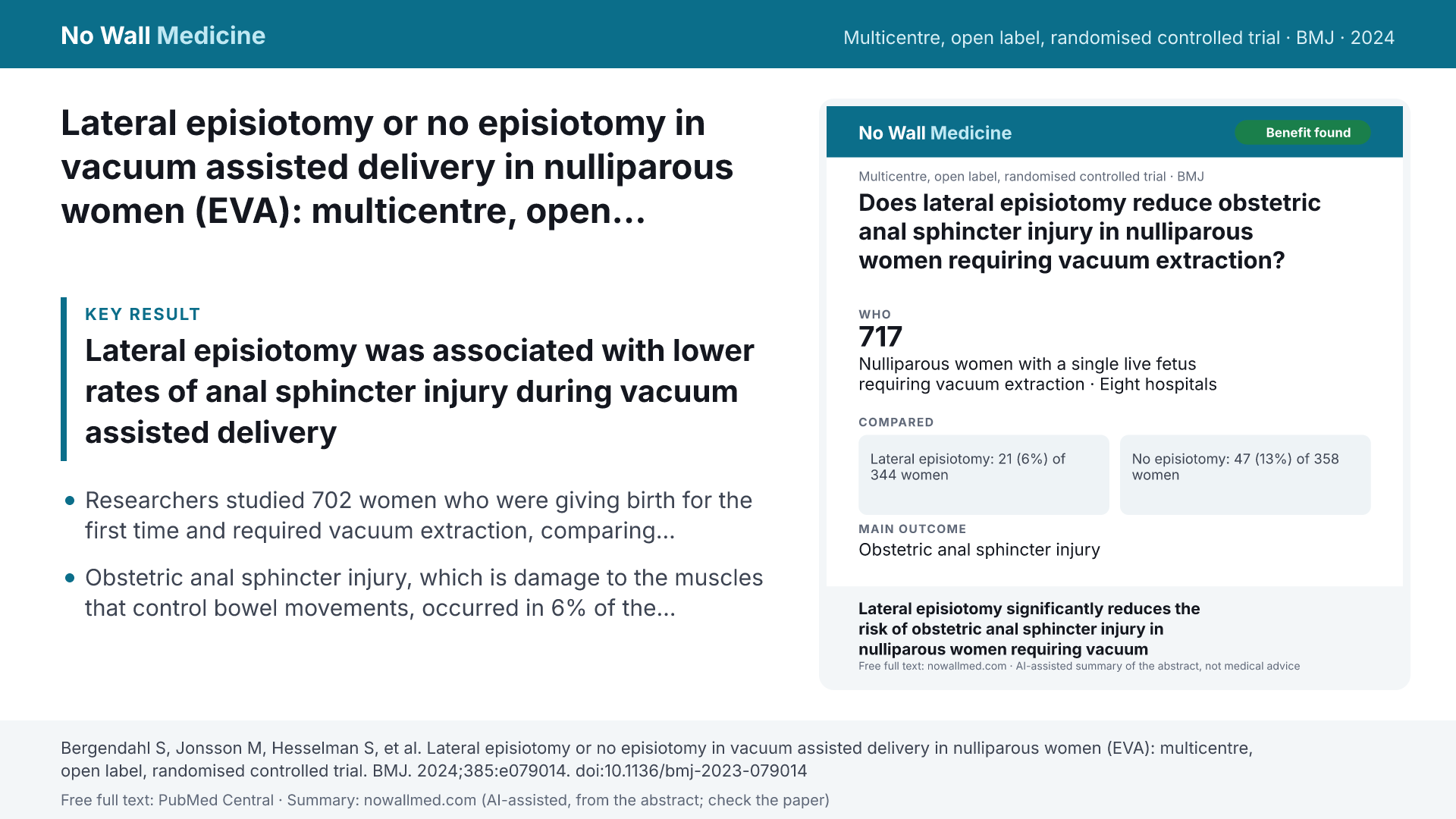
Lateral episiotomy was associated with lower rates of anal sphincter injury during vacuum assisted delivery
Lateral episiotomy or no episiotomy in vacuum assisted delivery in nulliparous women (EVA): multicentre, open label, randomised controlled trial
Multicentre, open label, randomised controlled trialBenefit found
Does lateral episiotomy reduce obstetric anal sphincter injury in nulliparous women requiring vacuum extraction?
Who
717
Nulliparous women with a single live fetus requiring vacuum extraction · Eight hospitals in Sweden
Compared
Lateral episiotomy: 21 (6%) of 344 women
No episiotomy: 47 (13%) of 358 women
Main outcome
Obstetric anal sphincter injury
Result: risk difference -7.0% (96% CI -11.7% to -2.5%)
Bottom line: Lateral episiotomy significantly reduces the risk of obstetric anal sphincter injury in nulliparous women requiring vacuum extraction.
BMJ · 2024-06-17 · Save PNG
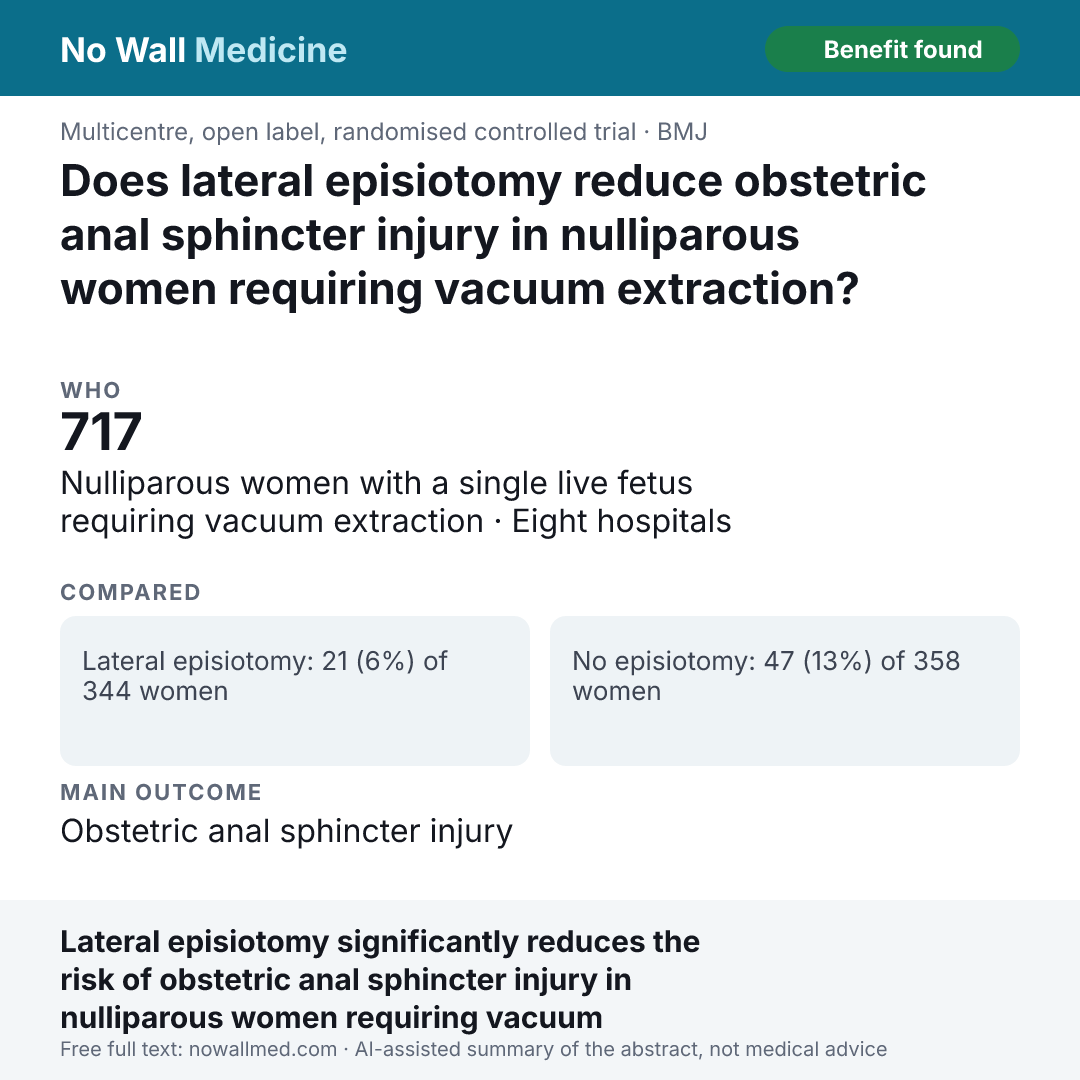
Clinical question: Does lateral episiotomy reduce obstetric anal sphincter injury in nulliparous women requiring vacuum extraction?
Key points
- Researchers studied 702 women who were giving birth for the first time and required vacuum extraction, comparing lateral episiotomy to no episiotomy.
- Obstetric anal sphincter injury, which is damage to the muscles that control bowel movements, occurred in 6% of the episiotomy group compared to 13% in the no episiotomy group.
- The episiotomy group had more instances of wound infections and wound separation, though there were no significant differences in postpartum pain or blood loss.
Headline and key points written with AI from the paper’s abstract, with every number checked against it. Read the paper before relying on them.
Was this summary helpful?
Abstract
Objective
To assess the effect of lateral episiotomy, compared with no episiotomy, on obstetric anal sphincter injury in nulliparous women requiring vacuum extraction. Design
A multicentre, open label, randomised controlled trial. Setting
Eight hospitals in Sweden, 2017-23. Participants
717 nulliparous women with a single live fetus of 34 gestational weeks or more, requiring vacuum extraction were randomly assigned (1:1) to lateral episiotomy or no episiotomy using sealed opaque envelopes. Randomisation was stratified by study site. Intervention
A standardised lateral episiotomy was performed during the vacuum extraction, at crowning of the fetal head, starting 1-3 cm from the posterior fourchette, at a 60° (45-80°) angle from the midline, and 4 cm (3-5 cm) long. The comparison was no episiotomy unless considered indispensable. Main outcome measures
The primary outcome of the episiotomy in vacuum assisted delivery (EVA) trial was obstetric anal sphincter injury, clinically diagnosed by combined visual inspection and digital rectal and vaginal examination. The primary analysis used a modified intention-to-treat population that included all consenting women with attempted or successful vacuum extraction. As a result of an interim analysis at significance level P<0.01, the primary endpoint was tested at 4% significance level with accompanying 96% confidence interval (CI). Results
From 1 July 2017 to 15 February 2023, 717 women were randomly assigned: 354 (49%) to lateral episiotomy and 363 (51%) to no episiotomy. Before vacuum extraction attempt, one woman withdrew consent and 14 had a spontaneous birth, leaving 702 for the primary analysis. In the intervention group, 21 (6%) of 344 women sustained obstetric anal sphincter injury, compared with 47 (13%) of 358 women in the comparison group (P=0.002). The risk difference was -7.0% (96% CI -11.7% to -2.5%). The risk ratio adjusted for site was 0.47 (96% CI 0.23 to 0.97) and unadjusted risk ratio was 0.46 (0.28 to 0.78). No significant differences were noted between groups in postpartum pain, blood loss, neonatal outcomes, or total adverse events, but the intervention group had more wound infections and dehiscence. Conclusions
Lateral episiotomy can be recommended for nulliparous women requiring vacuum extraction to significantly reduce the risk of obstetric anal sphincter injury. Trial registration
ClinicalTrials.gov NCT02643108.
Abstract reproduced under the article’s CC BY NC licence.
Subject terms
Headline, design, result, key points, caveat and citation as plain text.
Cite this article
Bergendahl S, Jonsson M, Hesselman S, et al. Lateral episiotomy or no episiotomy in vacuum assisted delivery in nulliparous women (EVA): multicentre, open label, randomised controlled trial. BMJ. 2024;385:e079014. doi:10.1136/bmj-2023-079014
Spotted a mistake? Suggest a correction