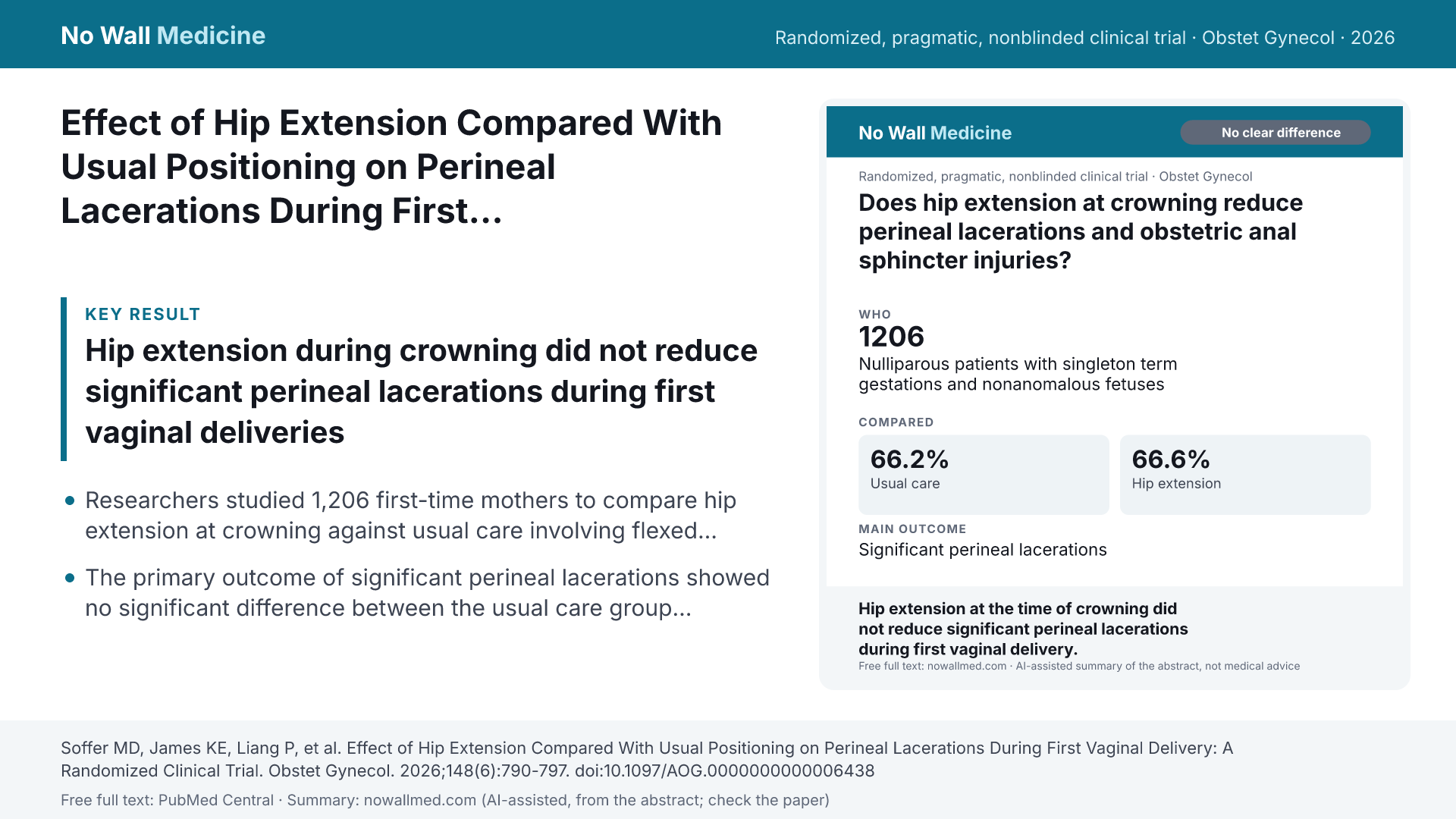
Hip extension during crowning did not reduce significant perineal lacerations during first vaginal deliveries
Effect of Hip Extension Compared With Usual Positioning on Perineal Lacerations During First Vaginal Delivery: A Randomized Clinical Trial
Randomized, pragmatic, nonblinded clinical trialNo clear difference
Does hip extension at crowning reduce perineal lacerations and obstetric anal sphincter injuries?
Who
1206
Nulliparous patients with singleton term gestations and nonanomalous fetuses
Compared
66.2%Usual care
66.6%Hip extension
Main outcome
Significant perineal lacerations
Bottom line: Hip extension at the time of crowning did not reduce significant perineal lacerations during first vaginal delivery.
Obstet Gynecol · 2026-09-22Download image
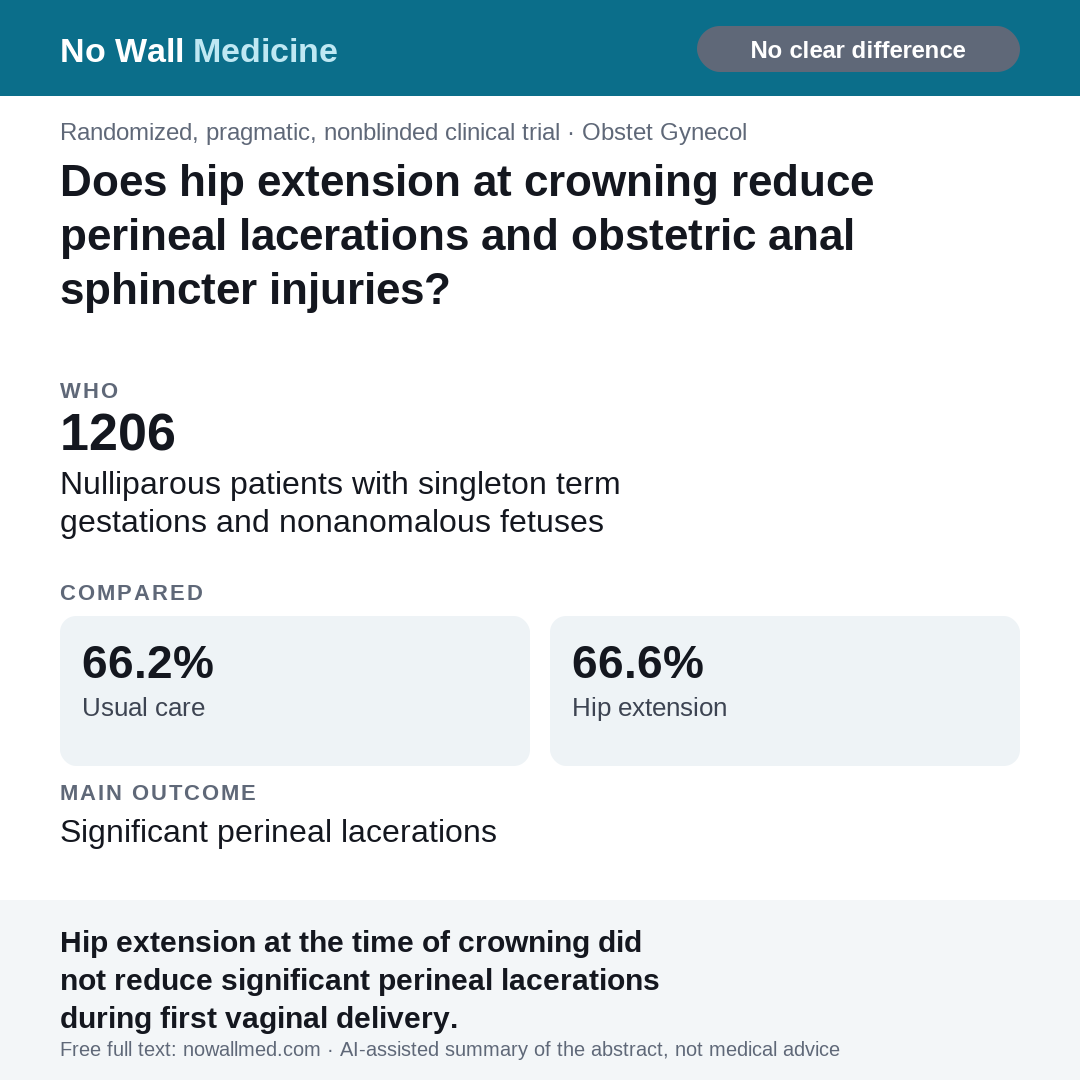
Clinical question: Does hip extension at crowning reduce perineal lacerations and obstetric anal sphincter injuries?
Why it matters: It is unclear if changing the angle of the hips during the crowning stage of labor can prevent tears in the perineum.
Key points
- Researchers studied 1,206 first-time mothers to compare hip extension at crowning against usual care involving flexed hip positions.
- The primary outcome of significant perineal lacerations showed no significant difference between the usual care group (66.2%) and the intervention group (66.6%).
- In unadjusted analyses for those who followed the hip extension protocol, rates of obstetric anal sphincter injuries were 5.2% compared to 9.9% in the flexion group.
Headline and key points written with AI from the paper’s abstract, with every number checked against it. Read the paper before relying on them.
Was this summary helpful?
Subject terms
Cite this article
Soffer MD, James KE, Liang P, et al. Effect of Hip Extension Compared With Usual Positioning on Perineal Lacerations During First Vaginal Delivery: A Randomized Clinical Trial. Obstet Gynecol. 2026. doi:10.1097/AOG.0000000000006438
Spotted a mistake? Suggest a correction