Effect of Hip Extension Compared With Usual Positioning on Perineal Lacerations During First Vaginal Delivery: A Randomized Clinical Trial
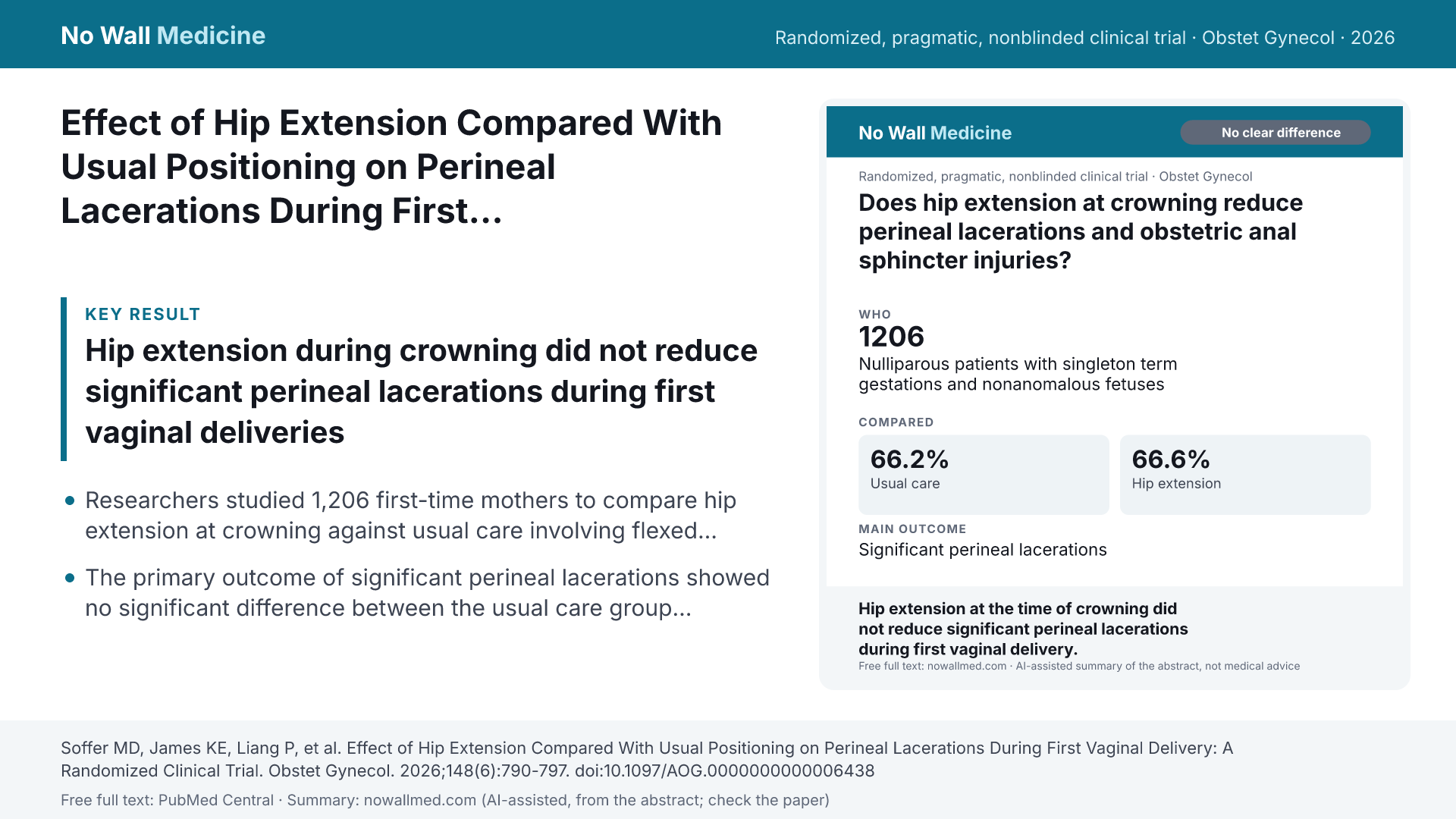
Key result: Hip extension during crowning did not reduce significant perineal lacerations during first vaginal deliveries
Randomized, pragmatic, nonblinded clinical trialNo clear difference
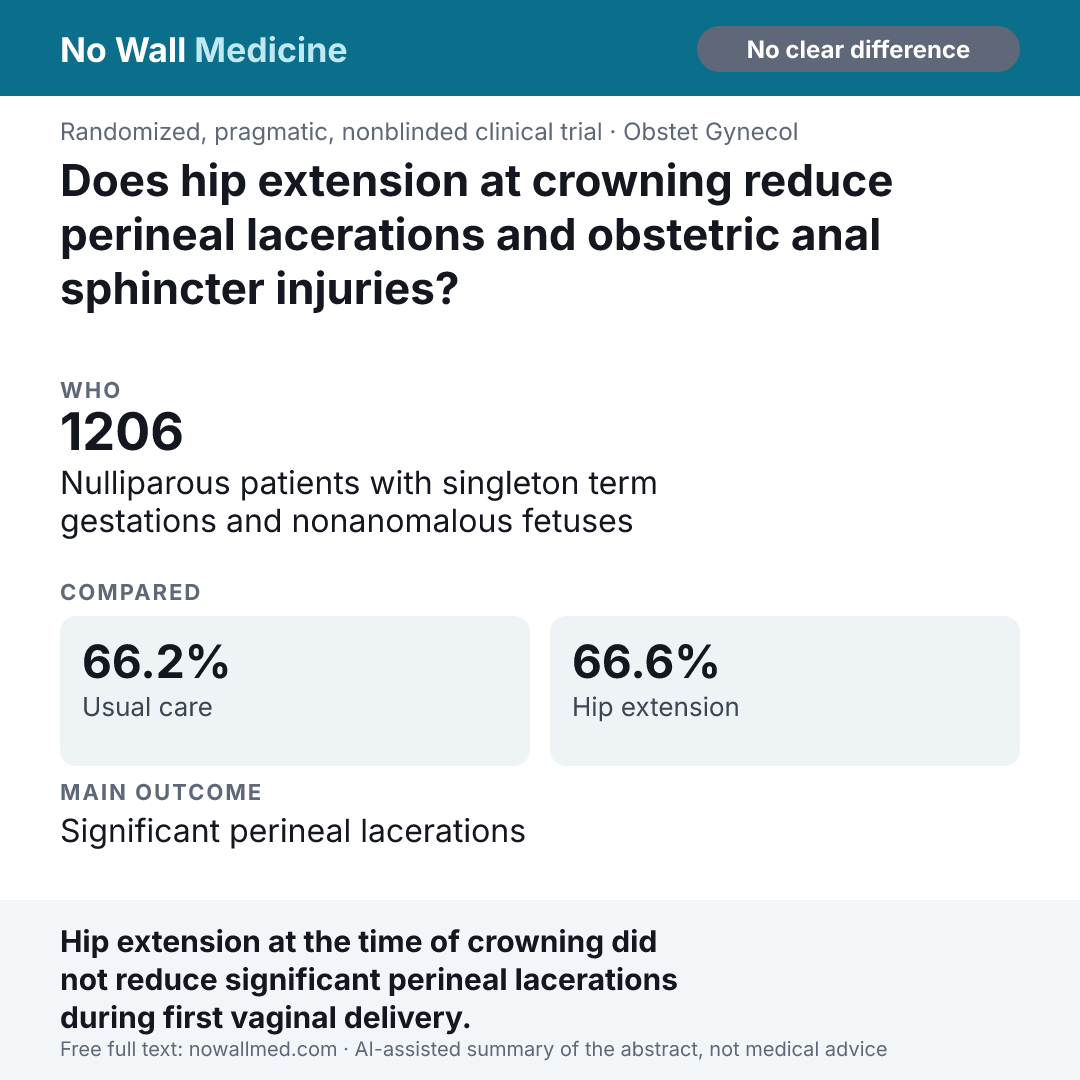
Does hip extension at crowning reduce perineal lacerations and obstetric anal sphincter injuries?
Who
1206
Nulliparous patients with singleton term gestations and nonanomalous fetuses
Compared
66.2%Usual care
66.6%Hip extension
Main outcome
Significant perineal lacerations
Bottom line: Hip extension at the time of crowning did not reduce significant perineal lacerations during first vaginal delivery.
Obstet Gynecol · 2026-09-22 · Save PNG
Key points
- Researchers studied 1,206 first-time mothers to compare hip extension at crowning against usual care involving flexed hip positions.
- The primary outcome of significant perineal lacerations showed no significant difference between the usual care group (66.2%) and the intervention group (66.6%).
- In unadjusted analyses for those who followed the hip extension protocol, rates of obstetric anal sphincter injuries were 5.2% compared to 9.9% in the flexion group.
Discussion prompts
- Would these patients look like yours? Who was left out?
- Is the main outcome one that matters to patients?
- Is the difference large enough to change what you do?
Cite: Soffer MD, James KE, Liang P, et al. Effect of Hip Extension Compared With Usual Positioning on Perineal Lacerations During First Vaginal Delivery: A Randomized Clinical Trial. Obstet Gynecol. 2026;148(6):790-797. doi:10.1097/AOG.0000000000006438
Free full text: PubMed Central · Summary and visual abstract: nowallmed.com/a/effect-of-hip-extension-compared-with-usual-positioning-on-perineal-10t9jxg/ (AI-assisted from the abstract; check the paper before relying on it).