Longer second stage of labor and pushing duration were associated with maternal and neonatal risks
Evaluating the impact of the second-stage and pushing duration on maternal and neonatal outcomes: a systematic review and meta-analysis
Systematic review and meta-analysisHarm found
Does second stage and pushing duration affect maternal and neonatal outcomes?
Who
Nulliparous and multiparous individuals in labor
Compared
Second stage or pushing duration ≥60 minutes
Second stage or pushing duration <60 minutes
Main outcome
Cesarean delivery, maternal and neonatal morbidity
Bottom line: Prolonged second stage and pushing duration increase risks of maternal and neonatal morbidity, especially in nulliparous individuals.
Limitation: Pooled estimates rely on a small, clinically heterogeneous subset of studies.
AJOG · 2025-07-10Download image
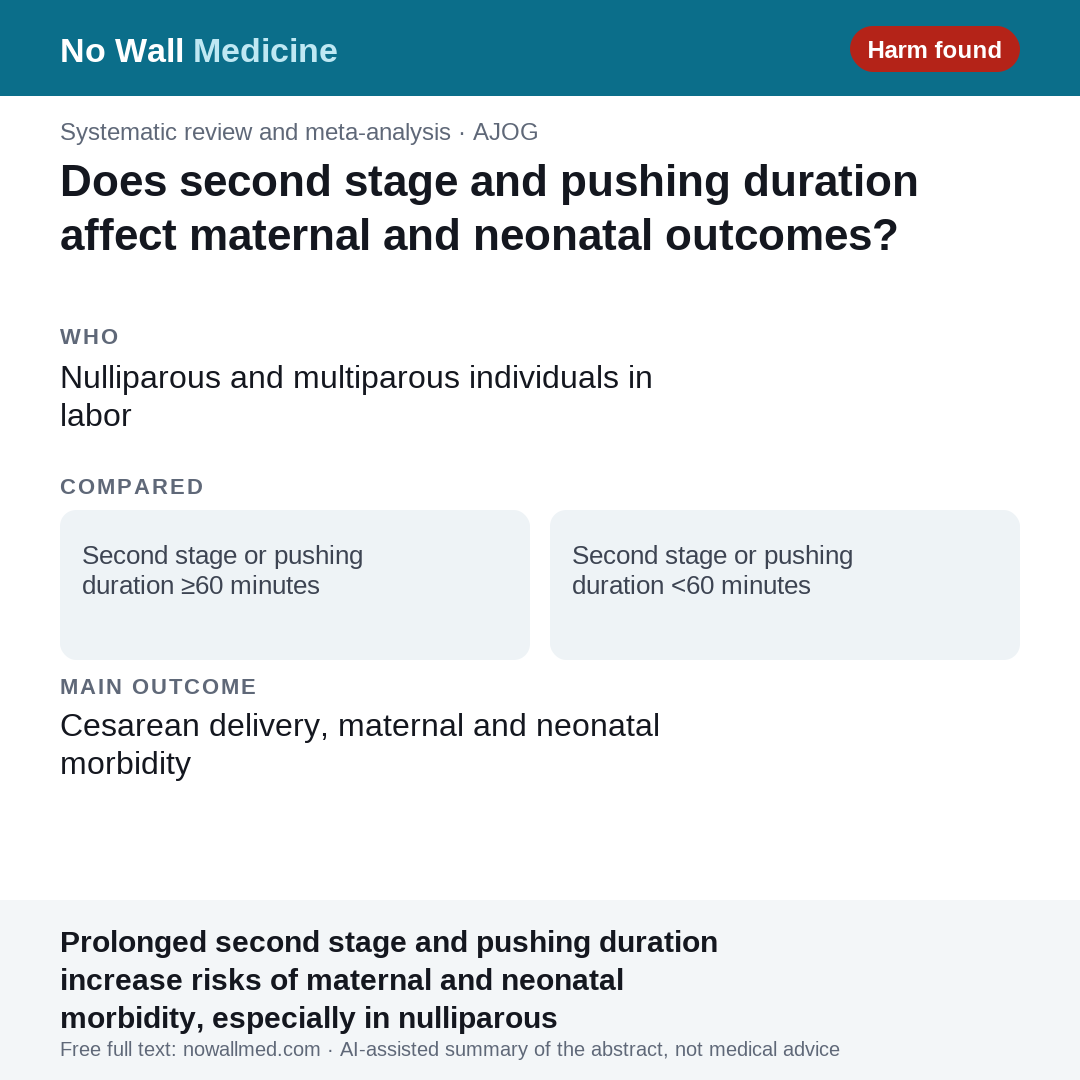
Clinical question: Does second stage and pushing duration affect maternal and neonatal outcomes?
Why it matters: The exact timing at which maternal and neonatal morbidity begins to rise during the second stage of labor is not clearly defined.
Key points
- Researchers analyzed 26 studies involving nulliparous and multiparous individuals to examine how the duration of the second stage of labor and active pushing affects outcomes.
- In nulliparous individuals, a second stage exceeding 1 hour was associated with increased risks of cesarean delivery, blood transfusion, perineal laceration, and chorioamnionitis.
- Pushing beyond 60 minutes in nulliparous individuals was significantly associated with a low 5-minute Apgar score and neonatal intensive care unit admission.
Limitation the authors note: The pooled estimates rely on a small, clinically heterogeneous subset of studies.
Headline and key points written with AI from the paper’s abstract, with every number checked against it. Read the paper before relying on them.
Was this summary helpful?
Subject terms
Cite this article
Aboukhater D, Hayasaka M, Furukawa N, Jones S, Grantz KL, Kawakita T. Evaluating the impact of the second-stage and pushing duration on maternal and neonatal outcomes: a systematic review and meta-analysis. AJOG. 2025. doi:10.1016/j.ajog.2025.07.014
Spotted a mistake? Suggest a correction
Top studies every Monday
The week’s key trials and guidelines in your specialties, plus any topics you follow. By email, free.
Get the weekly digest