Stopping oxytocin stimulation during active labour did not change caesarean section rates in women
Continued versus discontinued oxytocin stimulation in the active phase of labour (CONDISOX): double blind randomised controlled trial
International multicentre, double blind, randomised controlled trialNo clear difference
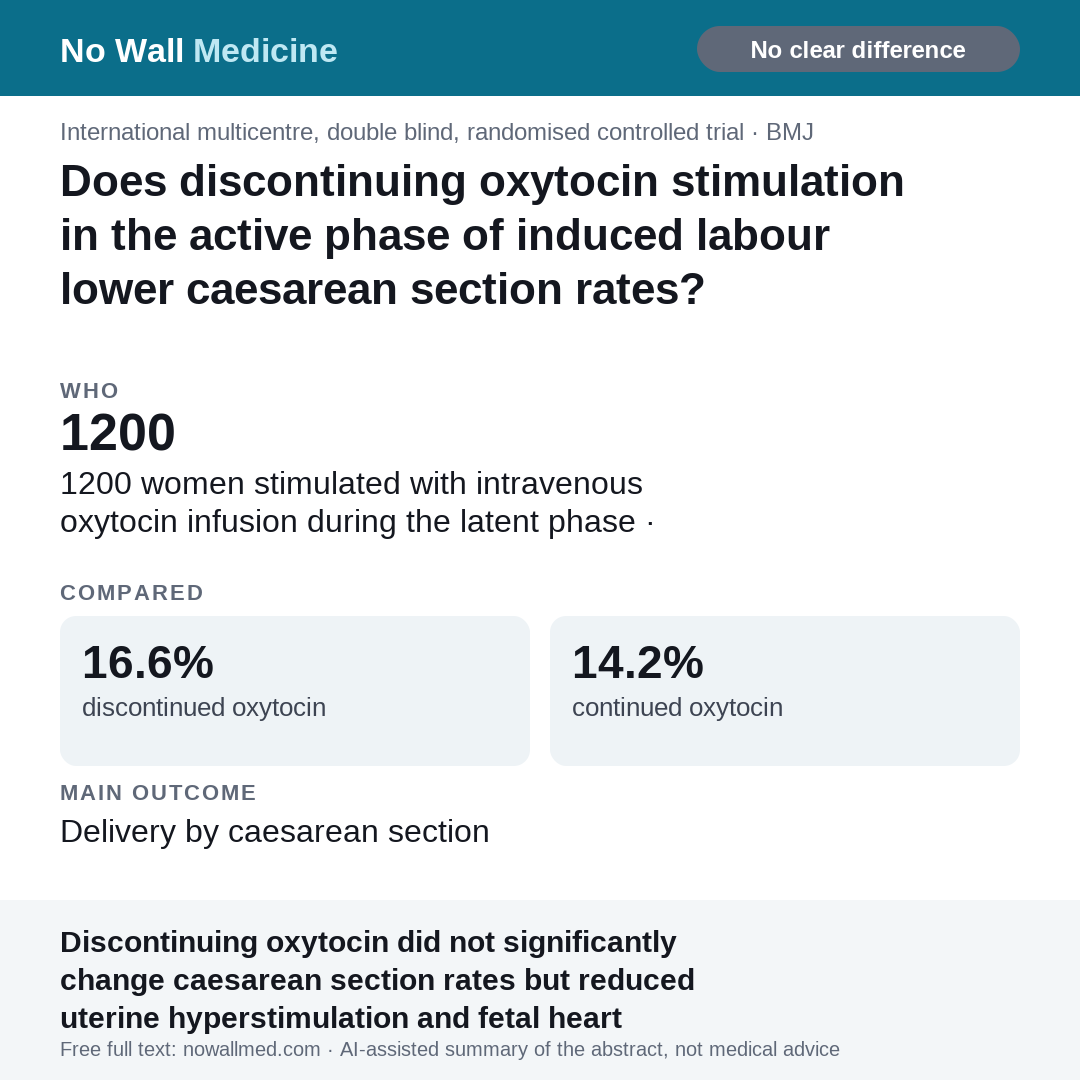
Does discontinuing oxytocin stimulation in the active phase of induced labour lower caesarean section rates?
Who
1200
1200 women stimulated with intravenous oxytocin infusion during the latent phase · Ten hospitals in Denmark and the Netherlands
Compared
16.6%discontinued oxytocin (n=101)
14.2%continued oxytocin (n=84)
Main outcome
Delivery by caesarean section
Result: relative risk 1.17, 95% confidence interval 0.90 to 1.53
Bottom line: Discontinuing oxytocin did not significantly change caesarean section rates but reduced uterine hyperstimulation and fetal heart rate abnormalities.
BMJ · 2021-04-14Download image
Clinical question: Does discontinuing oxytocin stimulation in the active phase of induced labour lower caesarean section rates?
Why it matters: It is unknown whether stopping oxytocin stimulation during the active phase of induced labour reduces the rate of caesarean sections.
Key points
- Researchers studied 1200 women receiving intravenous oxytocin, a hormone used to induce contractions, to see if stopping the infusion during active labour changed outcomes.
- The caesarean section rate was 16.6% in the discontinuation group and 14.2% in the continuation group, which was not a statistically significant difference.
- Discontinuing oxytocin was associated with a longer duration of labour, a lower risk of uterine hyperstimulation (3.7% vs 12.9%), and fewer fetal heart rate abnormalities (27.9% vs 40.8%).
Headline and key points written with AI from the paper’s abstract, with every number checked against it. Read the paper before relying on them.
Was this summary helpful?
Abstract
Objective
To determine whether discontinuing oxytocin stimulation in the active phase of induced labour is associated with lower caesarean section rates. Design
International multicentre, double blind, randomised controlled trial. Setting
Nine hospitals in Denmark and one in the Netherlands between 8 April 2016 and 30 June 2020. Participants
1200 women stimulated with intravenous oxytocin infusion during the latent phase of induced labour. Intervention
Women were randomly assigned to have their oxytocin stimulation discontinued or continued in the active phase of labour. Main outcome measure
Delivery by caesarean section. Results
A total of 607 women were assigned to discontinuation and 593 to continuation of the oxytocin infusion. The rates of caesarean section were 16.6% (n=101) in the discontinued group and 14.2% (n=84) in the continued group (relative risk 1.17, 95% confidence interval 0.90 to 1.53). In 94 parous women with no previous caesarean section, the caesarean section rate was 7.5% (11/147) in the discontinued group and 0.6% (1/155)in the continued group (relative risk 11.6, 1.15 to 88.7). Discontinuation was associated with longer duration of labour (median from randomisation to delivery 282 v 201 min; P<0.001), a reduced risk of hyperstimulation (20/546 (3.7%) v 70/541 (12.9%); P<0.001), and a reduced risk of fetal heart rate abnormalities (153/548 (27.9%) v 219/537 (40.8%); P<0.001) but rates of other adverse maternal and neonatal outcomes were similar between groups. Conclusions
In a setting where monitoring of the fetal condition and the uterine contractions can be guaranteed, routine discontinuation of oxytocin stimulation may lead to a small increase in caesarean section rate but a significantly reduced risk of uterine hyperstimulation and abnormal fetal heart rate patterns. Trial registration
ClinicalTrials.gov NCT02553226.
Abstract reproduced under the article’s CC BY NC licence.
Subject terms
Cite this article
Boie S, Glavind J, Uldbjerg N, Steer PJ, Bor P, CONDISOX trial group. Continued versus discontinued oxytocin stimulation in the active phase of labour (CONDISOX): double blind randomised controlled trial. BMJ. 2021. doi:10.1136/bmj.n716
Spotted a mistake? Suggest a correction
Top studies every Monday
The week’s key trials and guidelines in your specialties, plus any topics you follow. By email, free.
Get the weekly digest