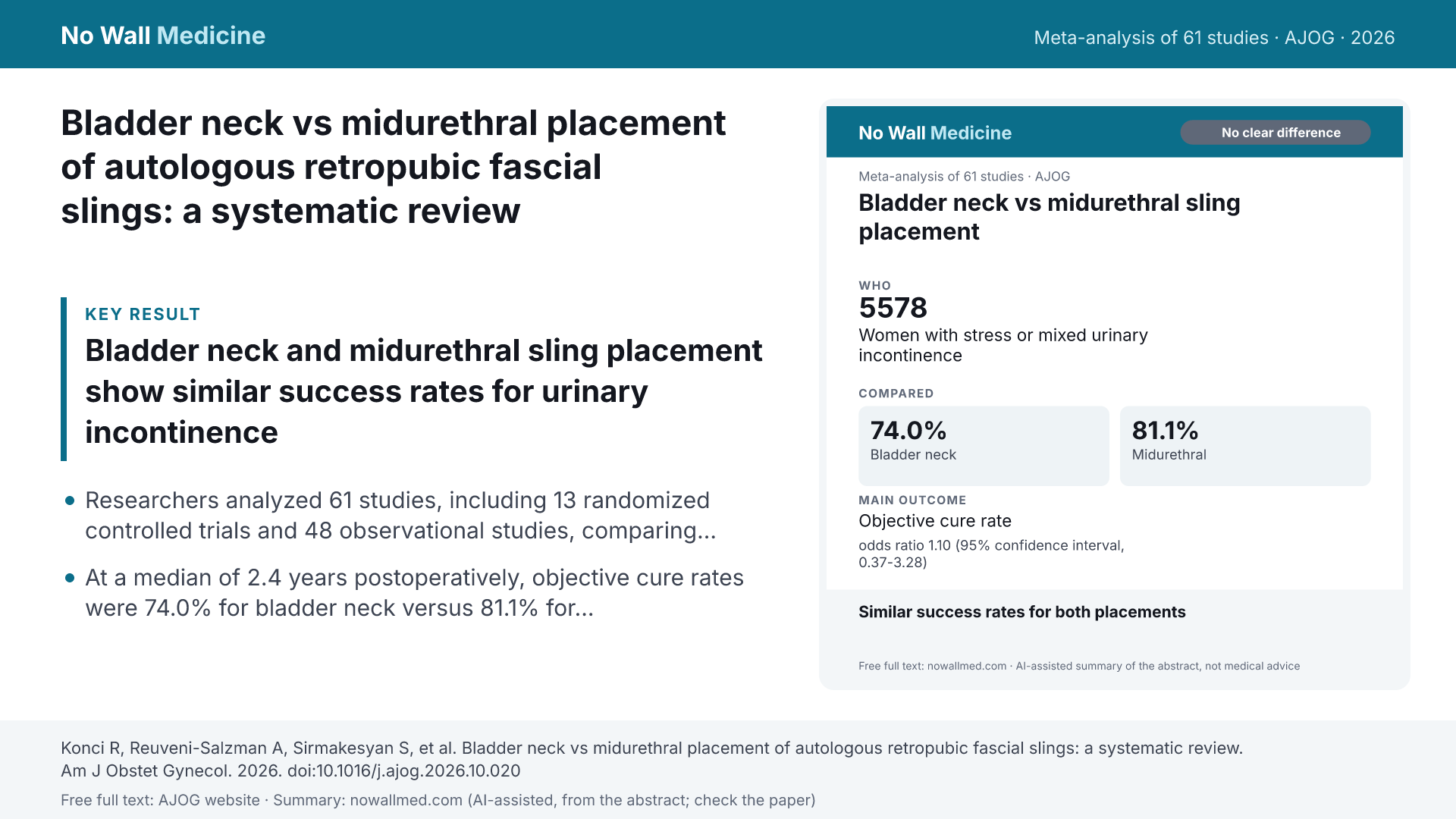
Bladder neck and midurethral sling placement show similar success rates for urinary incontinence
Bladder neck vs midurethral placement of autologous retropubic fascial slings: a systematic review
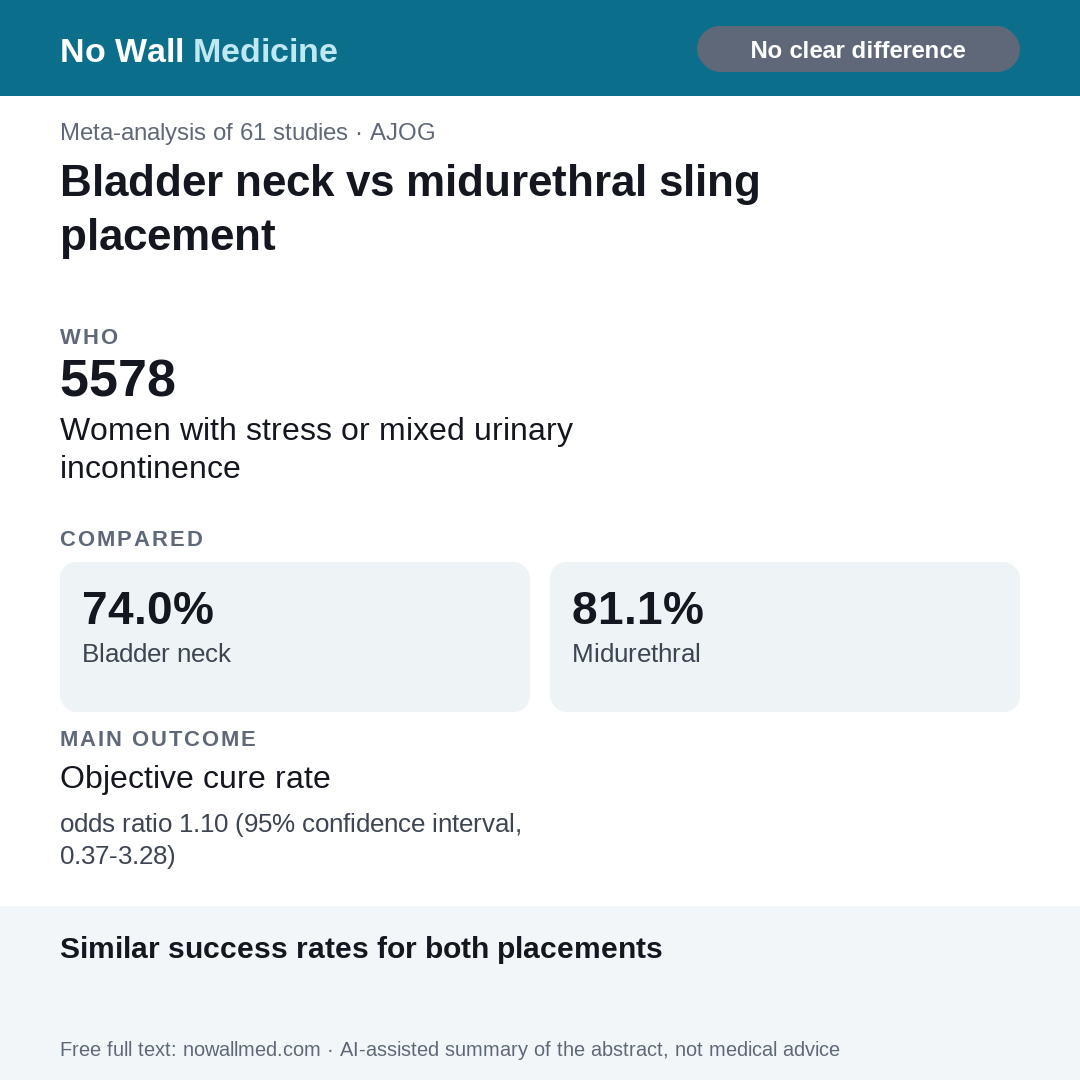
Meta-analysis of 61 studiesNo clear difference
Bladder neck vs midurethral sling placement
Who
5578
Women with stress or mixed urinary incontinence
Compared
74.0%Bladder neck
81.1%Midurethral
Main outcome
Objective cure rate
Result: odds ratio 1.10 (95% confidence interval, 0.37-3.28)
Bottom line: Similar success rates for both placements
Limitation: Moderate-to-high risk of bias
AJOG · 2026-10-22Download image
Why it matters: It is unclear whether placing a retropubic autologous fascial sling at the bladder neck or the midurethra provides better surgical outcomes for women with urinary incontinence.
Key points
- Researchers analyzed 61 studies, including 13 randomized controlled trials and 48 observational studies, comparing two different placement locations for autologous retropubic fascial slings.
- At a median of 2.4 years postoperatively, objective cure rates were 74.0% for bladder neck versus 81.1% for midurethral placement, which was not statistically significant.
- Midurethral placement was associated with a lower risk of de novo urgency, which is the new onset of the sudden urge to urinate, at 8.3% versus 15.0%.
Limitation the authors note: The included studies showed a moderate-to-high risk of bias.
Headline and key points written with AI from the paper’s abstract, with every number checked against it. Read the paper before relying on them.
Was this summary helpful?
Cite this article
Konci R, Reuveni-Salzman A, Sirmakesyan S, et al. Bladder neck vs midurethral placement of autologous retropubic fascial slings: a systematic review. AJOG. 2026. doi:10.1016/j.ajog.2026.10.020
Spotted a mistake? Suggest a correction