Blended parenting program improves child development and parent behaviors in Jamaican primary health care
Blended Delivery of a Primary Care Parenting Program for Child Development: A Randomized Clinical Trial
Single-blind randomized clinical trialBenefit found
Does a blended parenting program benefit child development and parenting behaviors?
Who
627
Families with children aged 3 to 28 months · Primary health care centers in Jamaica
Compared
Intervention
Waiting list control
Main outcome
Child development and parenting behaviors
Result: overall developmental quotient ES 0.17 SD (95% CI 0.01-0.33 SD)
Bottom line: A blended parenting program delivered through primary health care benefits child development and parenting behaviors.
JAMA Netw Open · 2026-02-02Download image
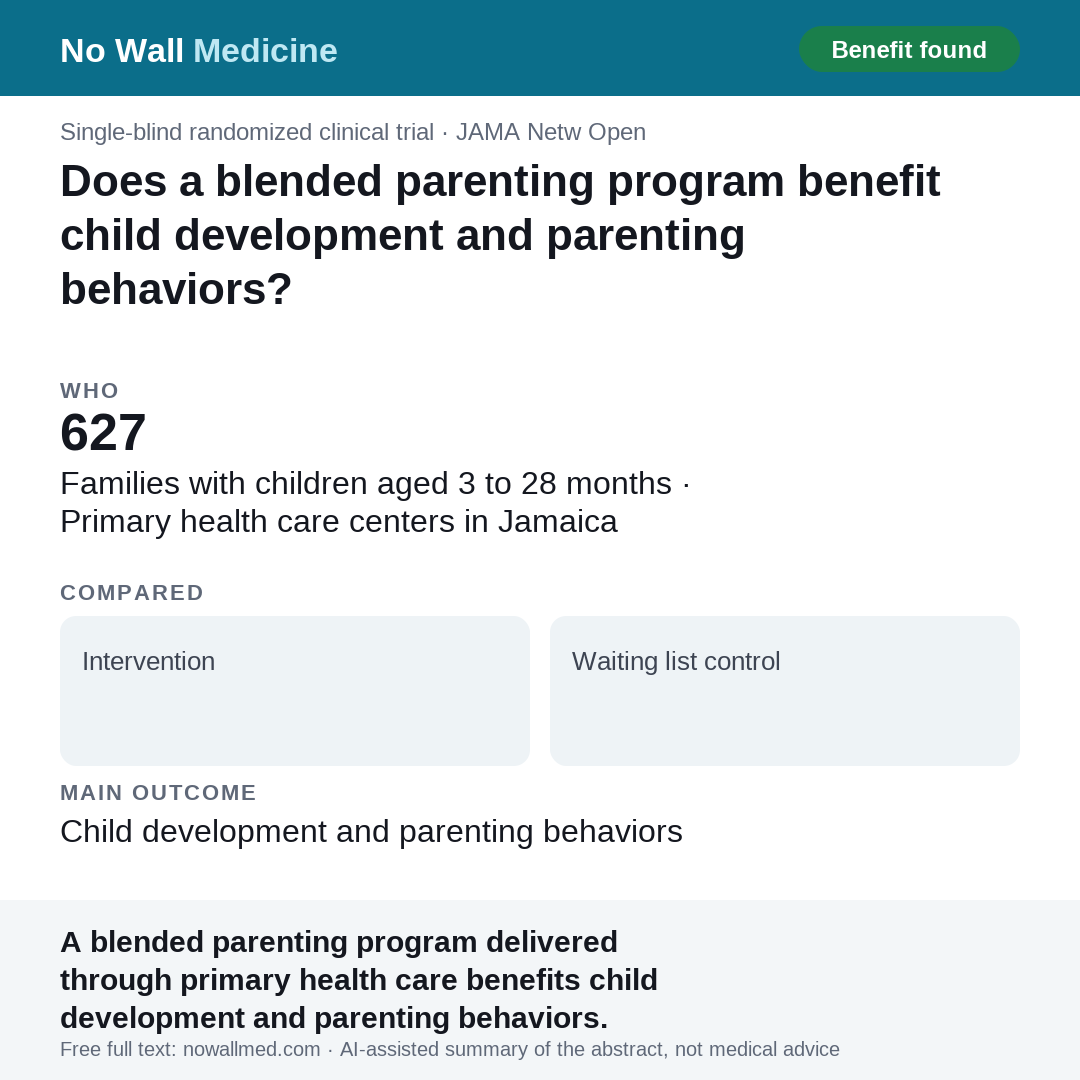
Clinical question: Does a blended parenting program benefit child development and parenting behaviors?
Why it matters: Evidence is needed on how to integrate and scale parenting programs that build support for early learning within government services.
Key points
- Researchers studied 627 children aged 3 to 28 months in Jamaica, comparing a blended program of home visits and phone calls to a waiting list control.
- The intervention group showed improvements in overall developmental quotient (effect size 0.17 SD), fine motor ability (effect size 0.19 SD), and parent behaviors (effect size 0.25 SD).
- The study included 311 children in the intervention group and 316 in the control group, with 491 children assessed at follow-up.
Headline and key points written with AI from the paper’s abstract, with every number checked against it. Read the paper before relying on them.
Topics
Cite this article
Chang SM, Smith JA, Wright AS, Rowe-Porter J, Shaw-Kelly K, Lopez-Boo F. Blended Delivery of a Primary Care Parenting Program for Child Development: A Randomized Clinical Trial. JAMA Netw Open. 2026. doi:10.1001/jamanetworkopen.2025.56024
Spotted a mistake? Suggest a correction