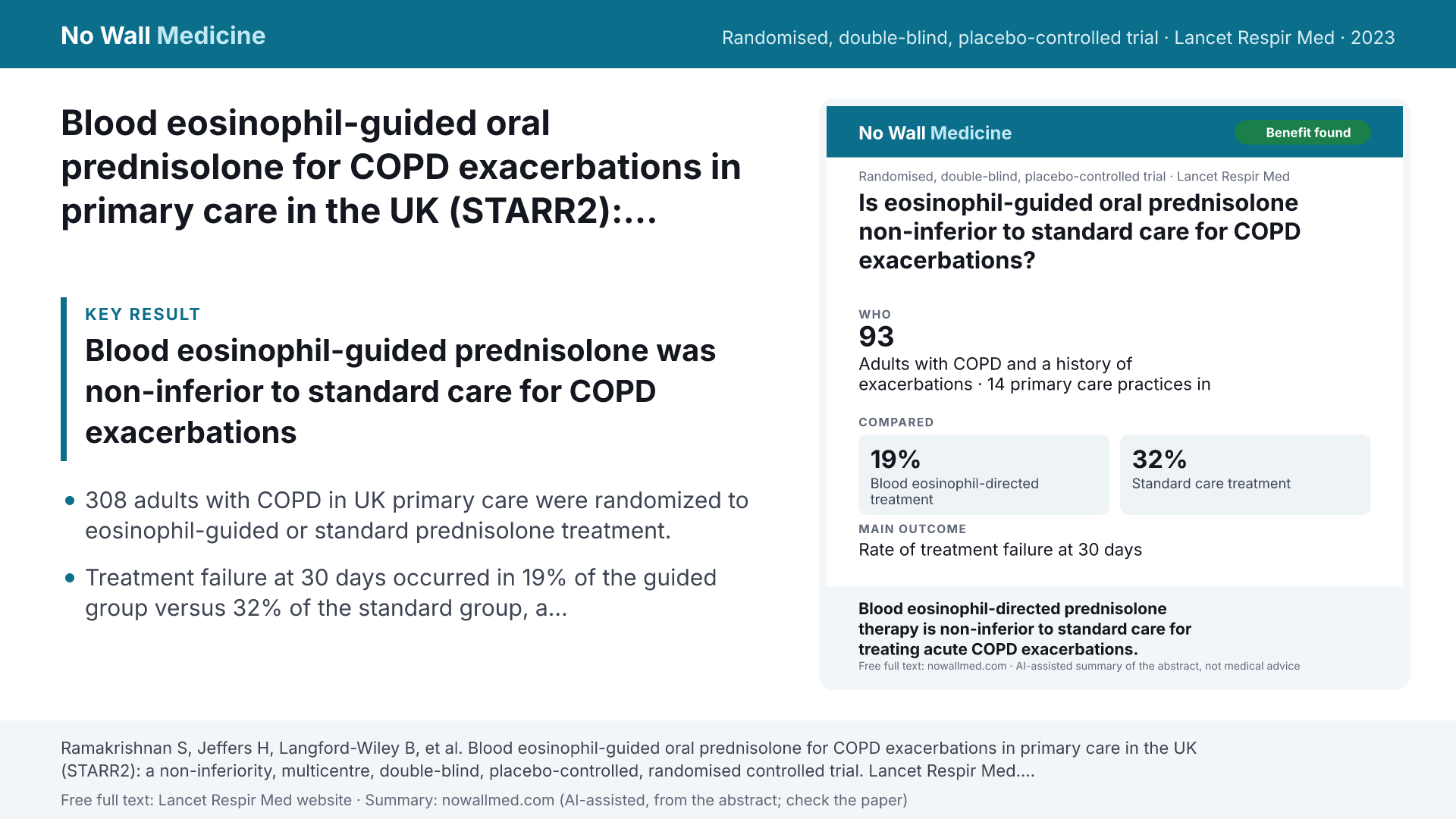
Blood eosinophil-guided prednisolone was non-inferior to standard care for COPD exacerbations
Blood eosinophil-guided oral prednisolone for COPD exacerbations in primary care in the UK (STARR2): a non-inferiority, multicentre, double-blind, placebo-controlled, randomised controlled trial
Randomised, double-blind, placebo-controlled trialBenefit found
Is eosinophil-guided oral prednisolone non-inferior to standard care for COPD exacerbations?
Who
93
Adults with COPD and a history of exacerbations · 14 primary care practices in the UK
Compared
19%Blood eosinophil-directed treatment
32%Standard care treatment
Main outcome
Rate of treatment failure at 30 days
Result: RR 0.60 (95% CI 0.33-1.04)
Bottom line: Blood eosinophil-directed prednisolone therapy is non-inferior to standard care for treating acute COPD exacerbations.
Limitation: The study converted from a superiority trial to a non-inferiority trial due to a randomisation code error.
Funded by: National Institute for Health and Care Research
Lancet Respir Med · 2023-11-02Download image
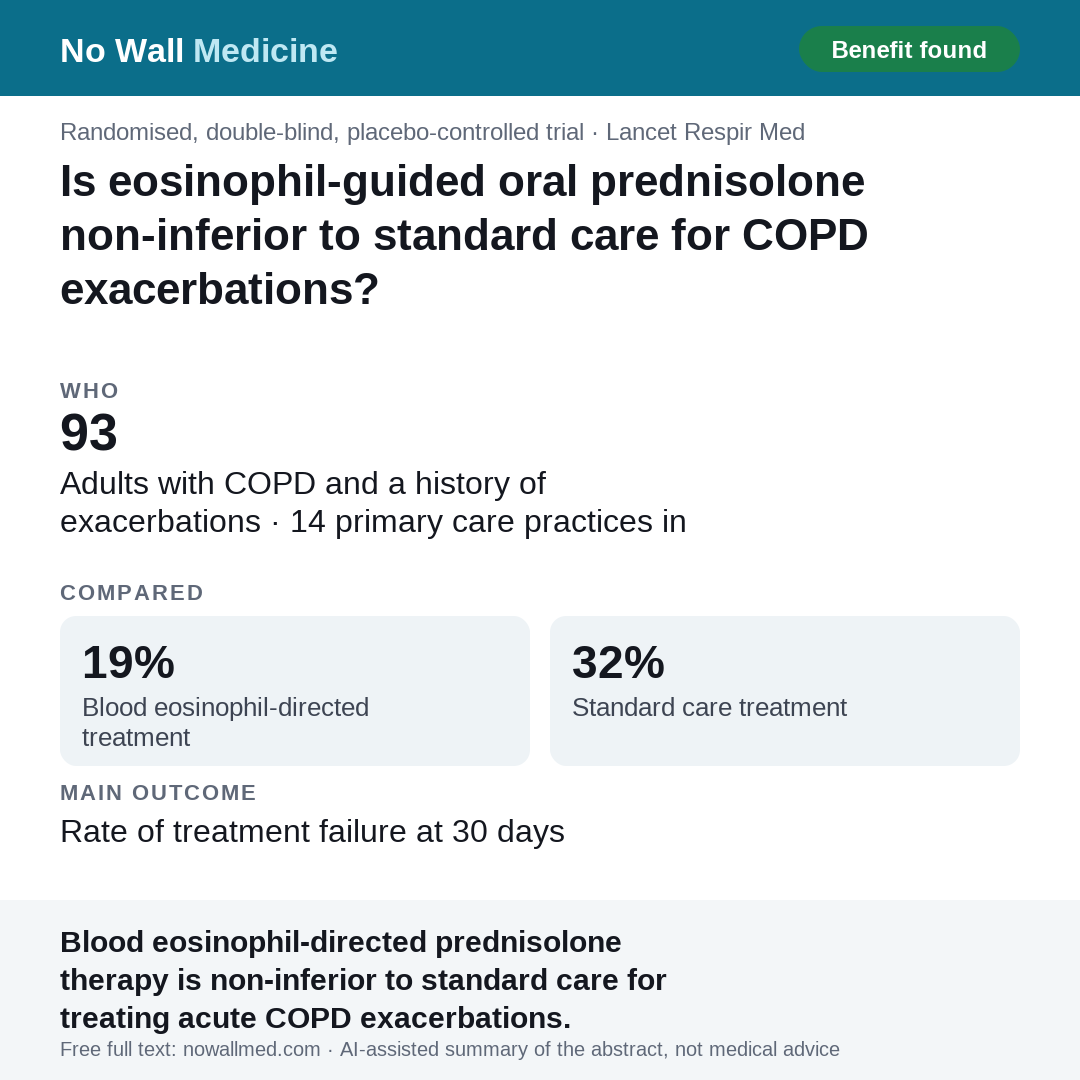
Clinical question: Is eosinophil-guided oral prednisolone non-inferior to standard care for COPD exacerbations?
Why it matters: Systemic glucocorticoids are recommended for COPD exacerbations but carry increased harm, so a safer dosing strategy was needed.
Key points
- 308 adults with COPD in UK primary care were randomized to eosinophil-guided or standard prednisolone treatment.
- Treatment failure at 30 days occurred in 19% of the guided group versus 32% of the standard group, a non-significant difference.
- The study confirmed the guided approach was non-inferior to standard care, with similar adverse event rates between groups.
Headline and key points written with AI from the paper’s abstract, with every number checked against it. Read the paper before relying on them.
Was this summary helpful?
Abstract
Background
Systemic glucocorticoids are recommended for use in chronic obstructive pulmonary disease (COPD) exacerbations; however, there is increased harm associated with their use. We hypothesised that the use of eosinophil biomarker-directed oral prednisolone therapy at the time of an exacerbation of COPD was effective at reducing prednisolone use without affecting adverse outcomes. Methods
The studying acute exacerbations and response (STARR2) study was a multicentre, randomised, double-blind, placebo-controlled trial conducted in 14 primary care practices in the UK. We included adults (aged ≥40 years), who were current or former smokers (with at least a 10 pack year smoking history) with a diagnosis of COPD, defined as a post-bronchodilator FEV1/forced vital capacity ratio of less than 0·7 previously recorded by the primary care physician, and a history of at least one exacerbation in the previous 12 months requiring systemic corticosteroids with or without antibiotics. All study staff and participants were masked to study group allocation and to treatment allocation. Participants were randomly assigned (1:1) to blood eosinophil-directed treatment (BET; to receive oral prednisolone 30 mg once daily if eosinophil count was high [≥2%] or placebo if eosinophil count was low [<2%]) or to standard care treatment (ST; to receive prednisolone 30 mg once daily irrespective of the point-of-care eosinophil result). Treatment was prescribed for 14 days and all patients also received antibiotics. The primary outcome was the rate of treatment failure, defined as any need for re-treatment with antibiotics or steroids, hospitalisation for any cause, or death, assessed at 30 days after exacerbation in the modified intention-to-treat population. Participants were eligible for re-randomisation at further exacerbations (with a maximum of four exacerbations per participant). A safety analysis was conducted on all randomly assigned participants. Although designed as a superiority trial, after identification of an error in the randomisation code before data lock the study converted to show non-inferiority. An upper margin of 1·105 for the 95% CI was defined as the non-inferiority margin. This study was registered with EudraCT, 2017-001586-24, and is complete. Findings
Between Nov 6, 2017, and April 30, 2020, 308 participants were recruited from 14 general practices. 144 exacerbations (73 in the BET group and 71 in the ST group) from 93 participants (mean age 70 years [range 46-84] and mean percent predicted FEV1 60·9% [SD 19·4]; 52 [56%] male and 41 [44%] female; ethnicity data was not collected]) were included in the modified intention-to-treat analysis. There were 14 (19%) treatment failures at 30 days post-exacerbation in the BET group and 23 (32%) in the ST group; we found a large non-significant estimated effect between BET and ST (RR 0·60 [95% CI 0·33-1·04]; p=0·070) in reducing treatment failures after a COPD exacerbation. The non-inferiority analysis supported that BET was non-inferior to ST. Frequency of adverse events were similar between the study groups; glycosuria (2/102 [2%] in BET group and 1/101 [1%] in the ST group) and hospital admission for COPD exacerbation (2/102 [2%] in BET group and 1/101 [1%] in the ST group) were the two most common adverse events in both groups. No deaths occurred in the study. Interpretation
Blood eosinophil-directed prednisolone therapy at the time of an acute exacerbation of COPD is non-inferior to standard care and can be used to safely reduce systemic glucocorticoid use in clinical practice. Funding
National Institute for Health and Care Research.
Abstract reproduced under the article’s CC BY licence.
Subject terms
Cite this article
Ramakrishnan S, Jeffers H, Langford-Wiley B, et al. Blood eosinophil-guided oral prednisolone for COPD exacerbations in primary care in the UK (STARR2): a non-inferiority, multicentre, double-blind, placebo-controlled, randomised controlled trial. Lancet Respir Med. 2023. doi:10.1016/S2213-2600(23)00298-9
Spotted a mistake? Suggest a correction